Icelandic Sjónabók

I have wanted this book for nearly a year now, ever since the first time I saw it at a bookshop in Reykjavik and had planned to buy it next time we go to Iceland since there is so much more to explore on Iceland, see my post on 101-reykjavik and on knitting-iceland. But fortunately I was tipped off – yes, Ravelry again – that it was available online at shopicelandic – going there can be rather expensive, you have been warned. So what is this book, you ask. Traditional pattterns for textiles from Icelandic Manuscripts from the 17th through 19th Centuries collected and presented on grids and redrawn digitally. The patterns were used in embroidery, weaving and various forms of needlework.
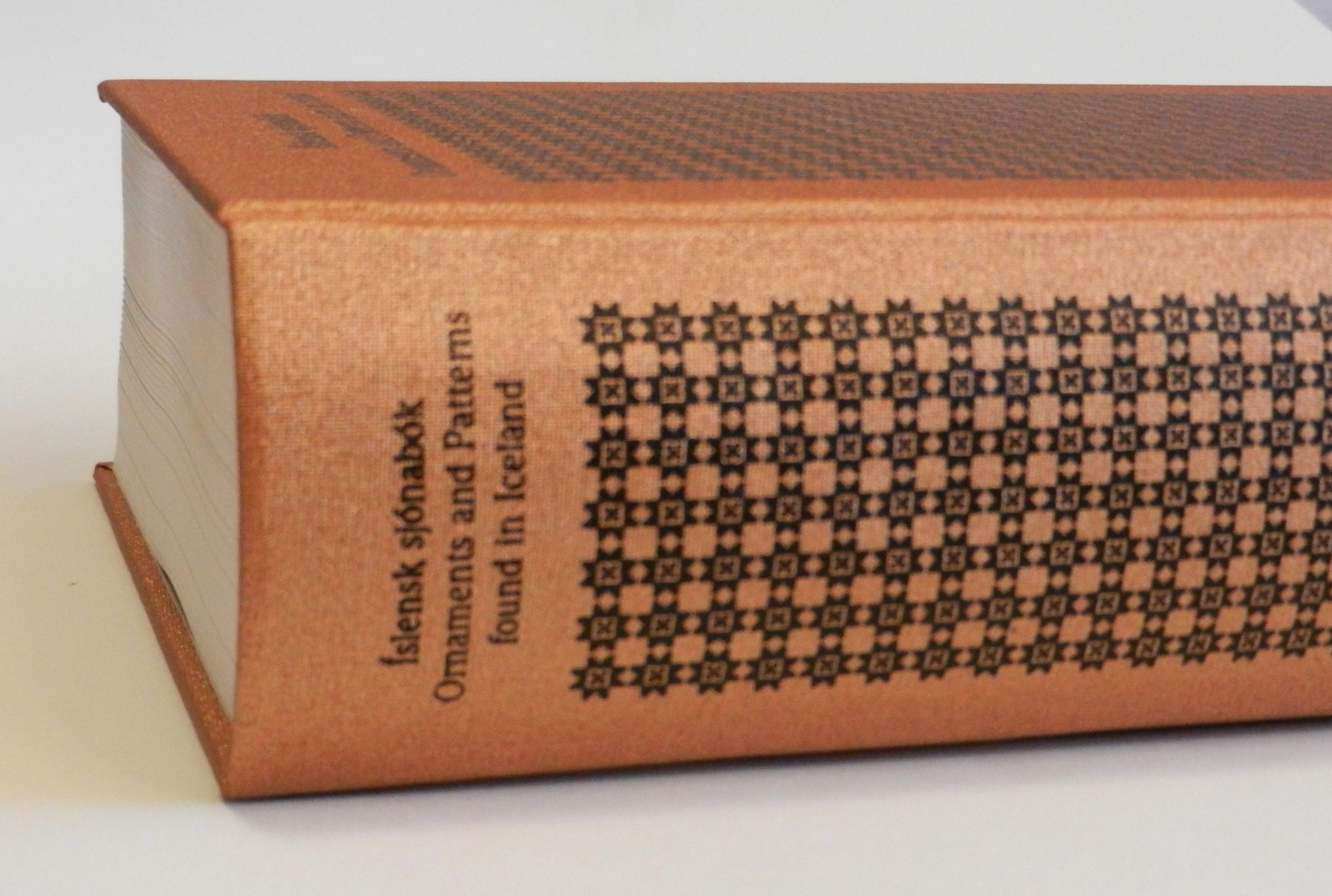
The idea to publish a reference book of the old sjónabók manuscripts came at the 2007 conference on Nordic handcrafts in Iceland organised by the Icelandic Handcraft Association. “The Department of Design and Architecture at the Iceland Academy of the Arts expressed an interest in collaborating with the conference organisers by offering a course for graphic design students in which all of the sjónabók patterns would be drawn in electronic format. The aim of the course was to introduce aspiring designers to the ten pattern books, as well as to make this wealth of patterns and designs more accessible than before.” The result is a magnificent fabric bound hard cover book consisting of more than 780 pages and including a CD with all the patterns. Be aware that the CD is made for Windows and not Mac friendly – but thankfully my husband still has windows on his mac.
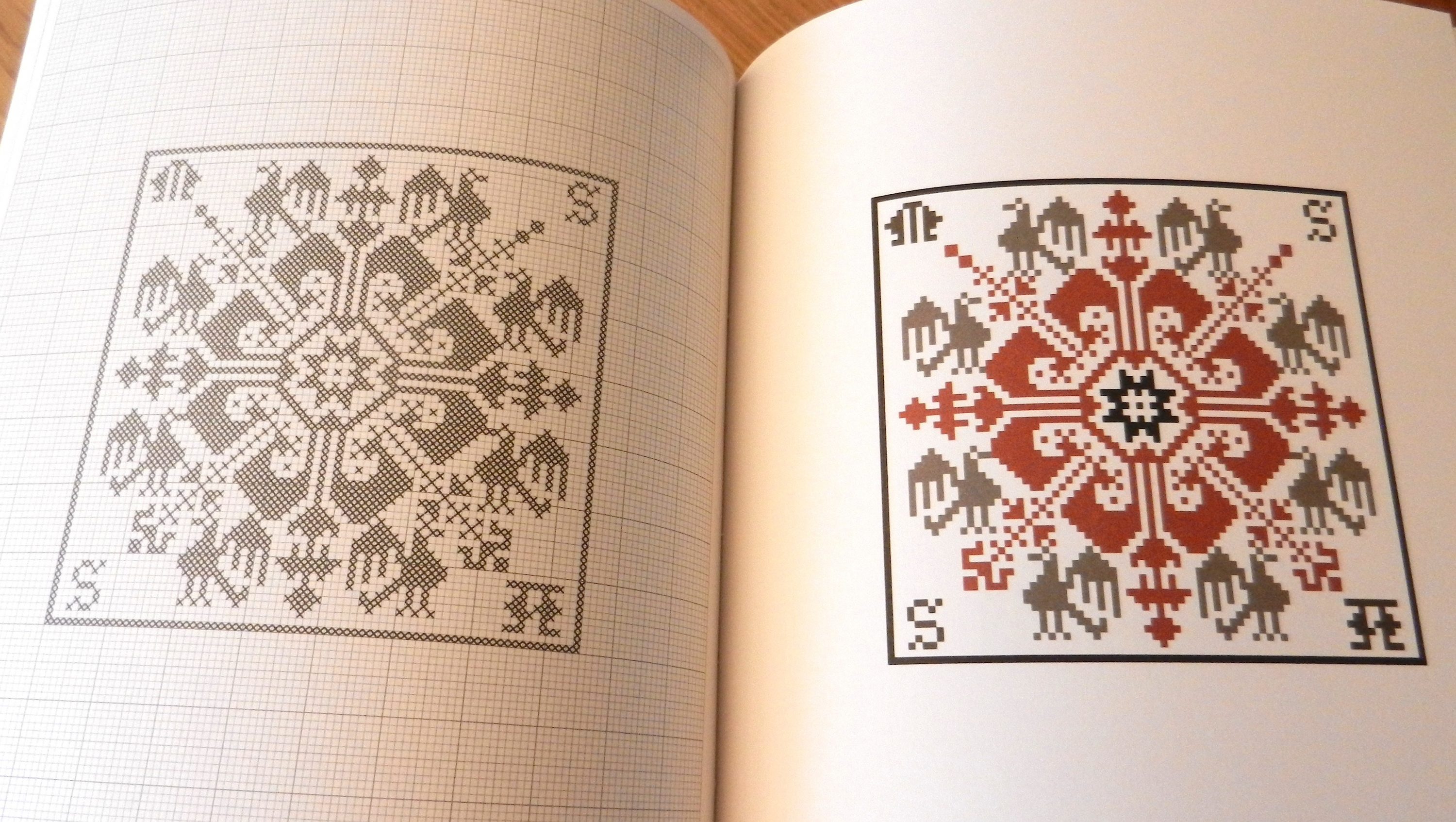
Nine of the manuscripts are registered and preserved at the National Museum of Iceland, while one is in the collection of the National Museum of Denmark. Each one has a brief description by Lilja Árnadôttir of the National Museum of Iceland. You will find the patterns in the book analysed under three headings: rosettes, friezes, and planar patterns in an essay by Lasse Savola of FIT, State University of New York, called “A Preliminary Mathematical Analysis of Patterns in Icelandic Sjônabók”.

Equally interesting but even more thought provoking is the essay by Gudmundur Oddur Magnússon of Iceland Academy of the Arts, introducing the patterns: “In our time, patterns or decorations have acquired a negative image precisely because they have lost their original symbolic values. Throughout history and across cultures, there are many examples of patterns having been designed not because of their decorative aesthetic value in and out itself, but rather to complete another given work and to emphasize its meaning. Patterns and symmetry originally stem from insight, purpose, and necessity, not from an aesthetic impulse or a superficial need for decorations. To imagine a pattern as a decoration that one can attach to an object out of personal taste and desire without it changing the object’s function is a more recent concept – a concept born after losing our understanding of the symbolic meaning of the pattern and having begun to see it as an empty form.”
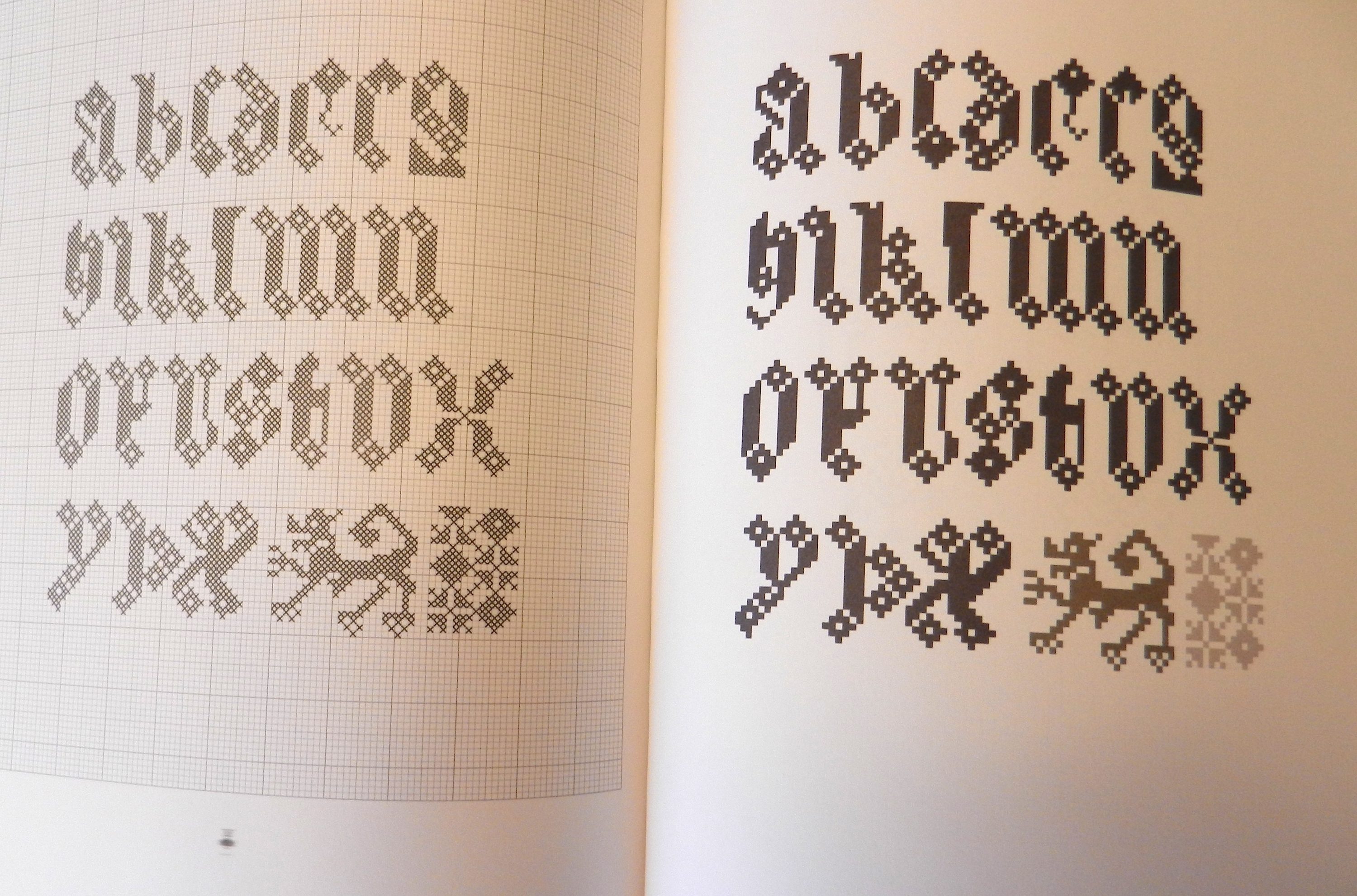
The book “has been created for those who want to breathe new life into this rich world of designs and patterns that until now have been fairly inaccessible. It is to be used freely by creative people who wish to understand symbolic values and the divinity of symmetry.” Such an admirably undertaking it has been to make this book and I am extremely grateful that it is available – also online – even though it is worth a trip to Iceland all on its own!

Share

Putefest/Cushion Party

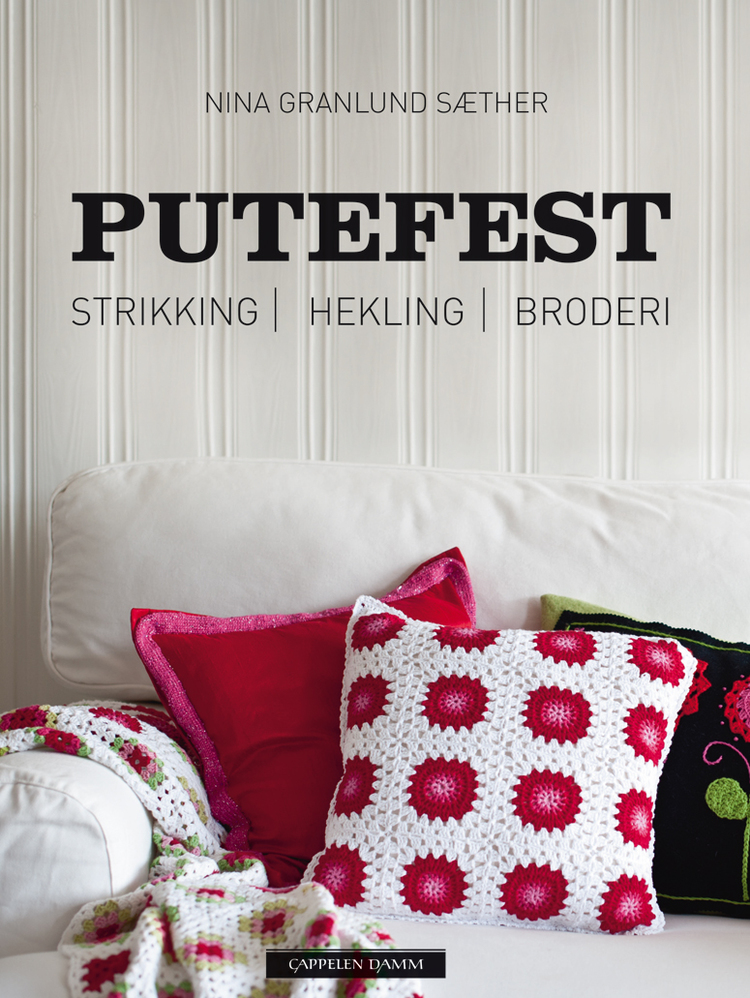
I was so happy to be invited to my first “Putefest”, except that it was not a party where we were throwing cushions at each other but the launch of Nina Granlund Sæther’s new book – no 6, yes, I am in awe of the years of work that calculates to be when it comes to handicraft books – at Cappelen Damm last Monday! Just her latest book took approximately 40 hours per cushion and there are 70 cushions and 2 blankets in the book, all of them knitted, crocheted or embroidered by her while she was working full time as an editor in chief for the magazine “Hus & Bolig”/House & Dwelling. But then Nina is a former teacher and journalist who knows everything about deadlines and has learnt the lesson of working even standing waiting for the bus. Her mum, present at the launch, was claiming that the only place she did not work on a cushion was at funerals…

The book is stunningly photographed by Guri Pfeifer – yes, she has also photographed some of my swatches, see more photos on her website: guripfeifer. Nina’s cushions are in different styles to suit everyone and includes a few with texts you do read twice in astonishment since it does not sink in the first time. An American publisher is among the interested foreign ones but did want to exclude a small selection. Do look at Hobbyklubben’s webpage and you will soon find one of the suspects, klick on: “se bilder” on hobbyklubben.

Mostly, I admire the newspaper cushions where she has transcribed only a small part of the text that you can read but the rest is clearly embroidered or crocheted to look like printed text. Do take a look at Nina’s blog – use Google translate if you do not read Norwegian, it is worth the effort – to see more photographs and read some of her other post! Here at syl.tynn. I, for one, am happy she has started blogging again after completing her latest book.

Share

Villa Stenersen

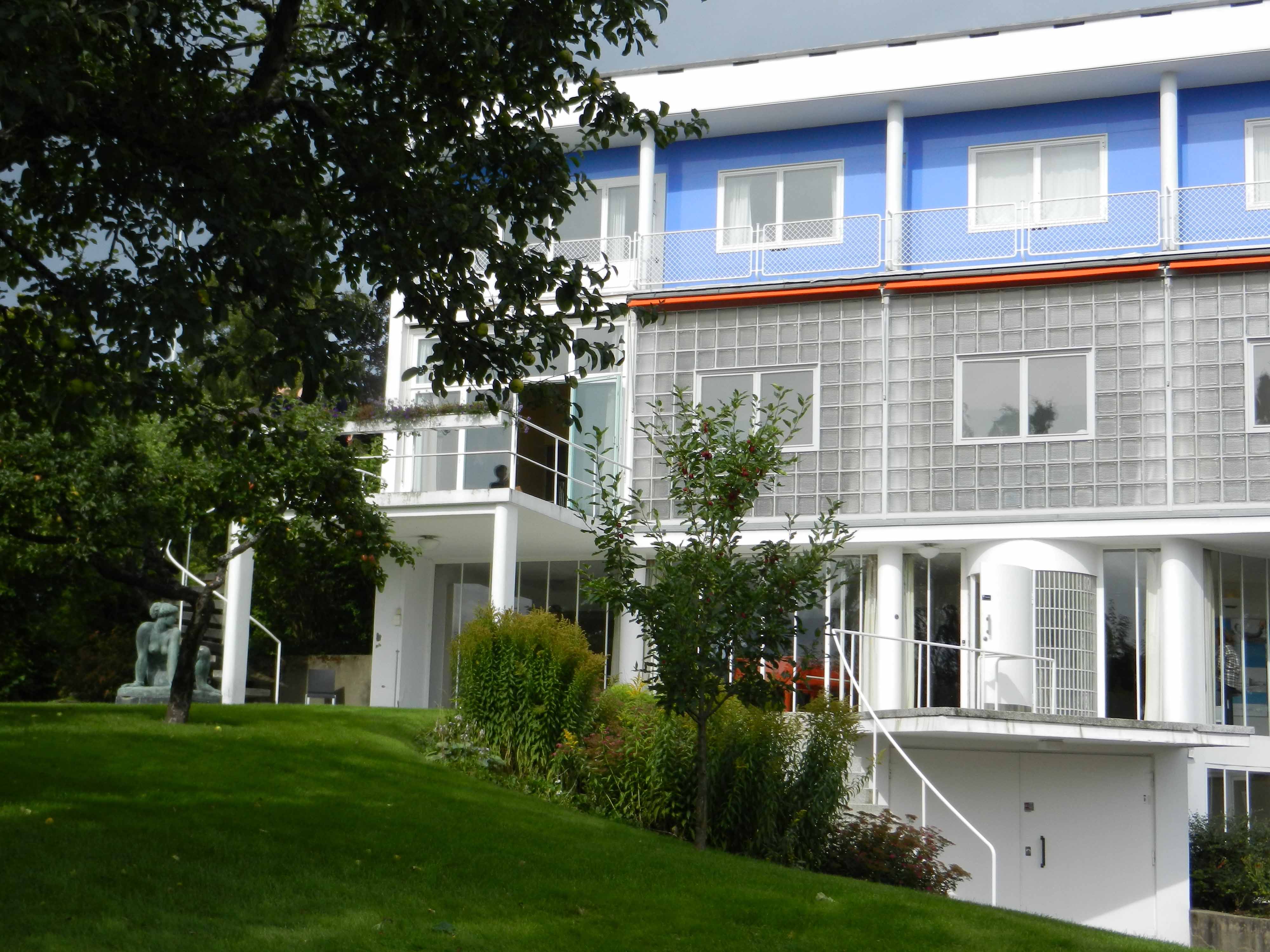
An acknowledged villa, unlike the one we live in though also, designed by architect Arne Korsmo, built in 1937-1939, for the financier, art collector and author Rolf Stenersen and his family. It was to be his house but also a frame for his extensive art collection including numerous works by Picasso, Mondrian and Munch – now at the Stenersen Museum for more details see stenersen.museum – he assisted Munch in his youth. The villa is considered one of the main works of Norwegian functionalism and was, indeed, this year ranked among the 100 most important functionalist buildings in the world.

The house was given to the state in 1974 to be used as an honorary building but only one prime minister has lived there and it has been left unused for long periods of time even close to be sold at one point but the Stenersen family interfered reminding the state it was a gift. Unfortunately it has not been refurbished to the extent it needs. I could say that also applies to our house. My husband would love to restore it to its former glory given the opportunity and equally essential; the financial means to do so…

Since 2000, the villa has been run by Norsk Form who offers guided tours on Sundays throughout the spring and summer – Sunday 2. September was the last of the season – and uses it as a gathering place for meetings and seminars of an architectural – or design related nature, see for visiting details: norskform. We found a long list of similarities between the villa and our house: (if this is news to you: do see my posts: we-are-moving and reunited-with-my-belongings)

  • Identical columns on the ground.
  • Identical colour scheme chosen throughout the building.
  • Equally beautiful door handles – photos already requested by other architect friends.
  • Identical stone slab in front of the fireplace.
  • Identical “space ship” lamp in the living room – though not actually acknowledged as Korsmo’s design.
  • Huge sliding windows in front of the living room – Korsmo was way ahead of his time!

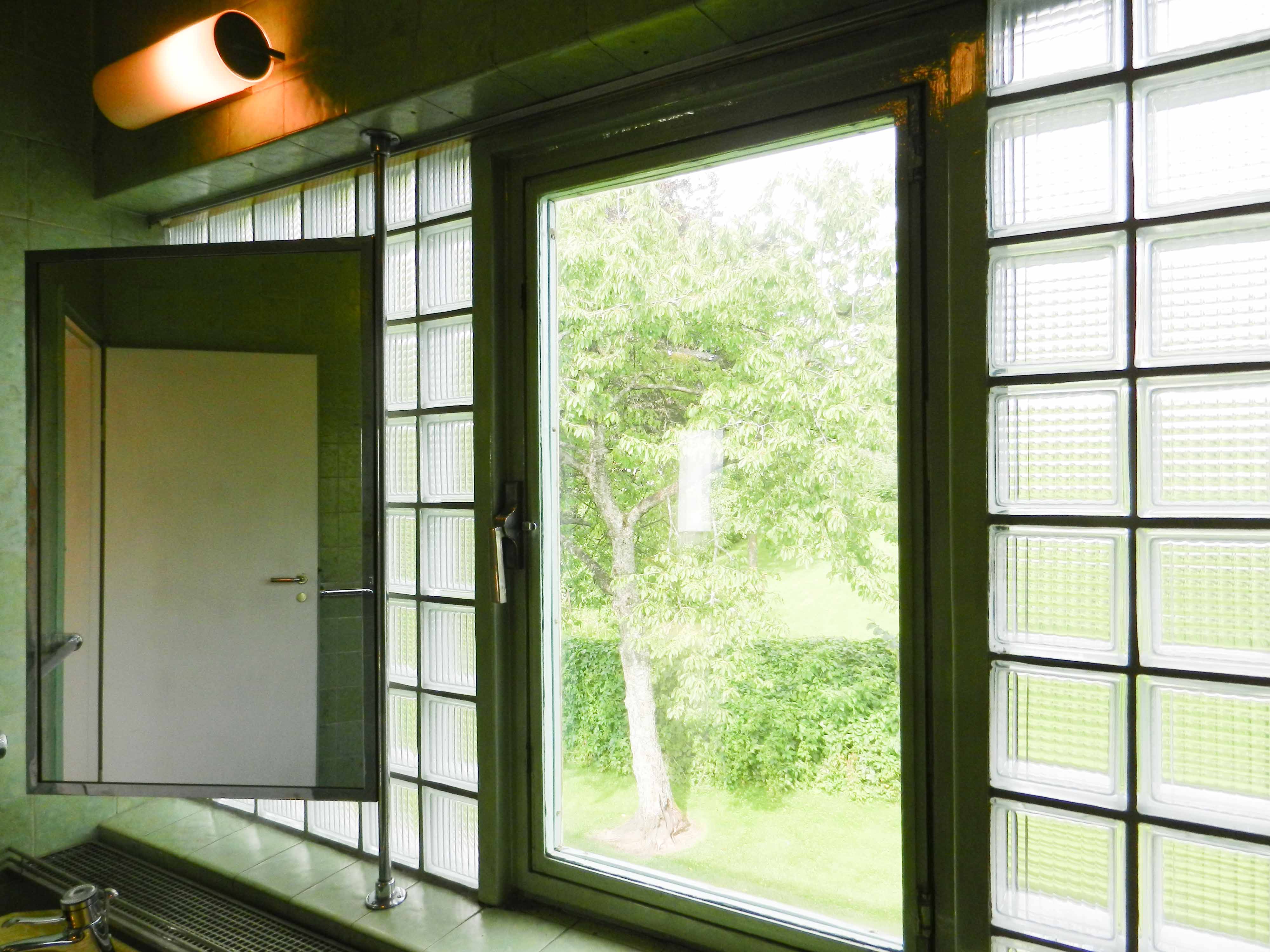
The bathroom at Villa Stenersen, using glass bricks to capture as much light as possible just as the whole facade, with a very clever mirror that can be swung into position. I must admit that ours is not as functional nor one of Korsmo’s designs, unfortunately.

The crowd visiting on Sunday was substantial and we could quite easily spot the architects present – just look for those wearing all black and with trendy glasses. The villa is now, finally, listed by the Norwegian Directorate for Cultural Heritage. “The semi-circle cuts through the otherwise cubic structure and creates dynamics and tension in the composition of the villa. Circles are used as a theme throughout the house, both as a play with geometrical shapes, and as a means of giving the villa a more dynamic expression.” taken from Norsk Form’s introduction and not an unfamiliar theme even today, see my post on parallel-practises-in-fashion-and-architecture. And do study the entrance and the columns.

I was delighted to discover that Villa Stenersen has a Garden Room, a reception room for many of Rolf Stenersen’s dinner party guests, with a circular dance floor and a bar especially designed by Korsmo, photographed by Norwegian Broadcaster nrk. Rolf Stenersen youngest son had his 80th birthday at the villa and can remember a number of parties in his youth at a very popular bar… As you might have guessed we do not have a Garden Room but our Living room does have a view of our garden and the fjord, so I am not complaining! Nor do we have any plans to offer guided tours…

Share

Mina Milanda a Flower Heaven

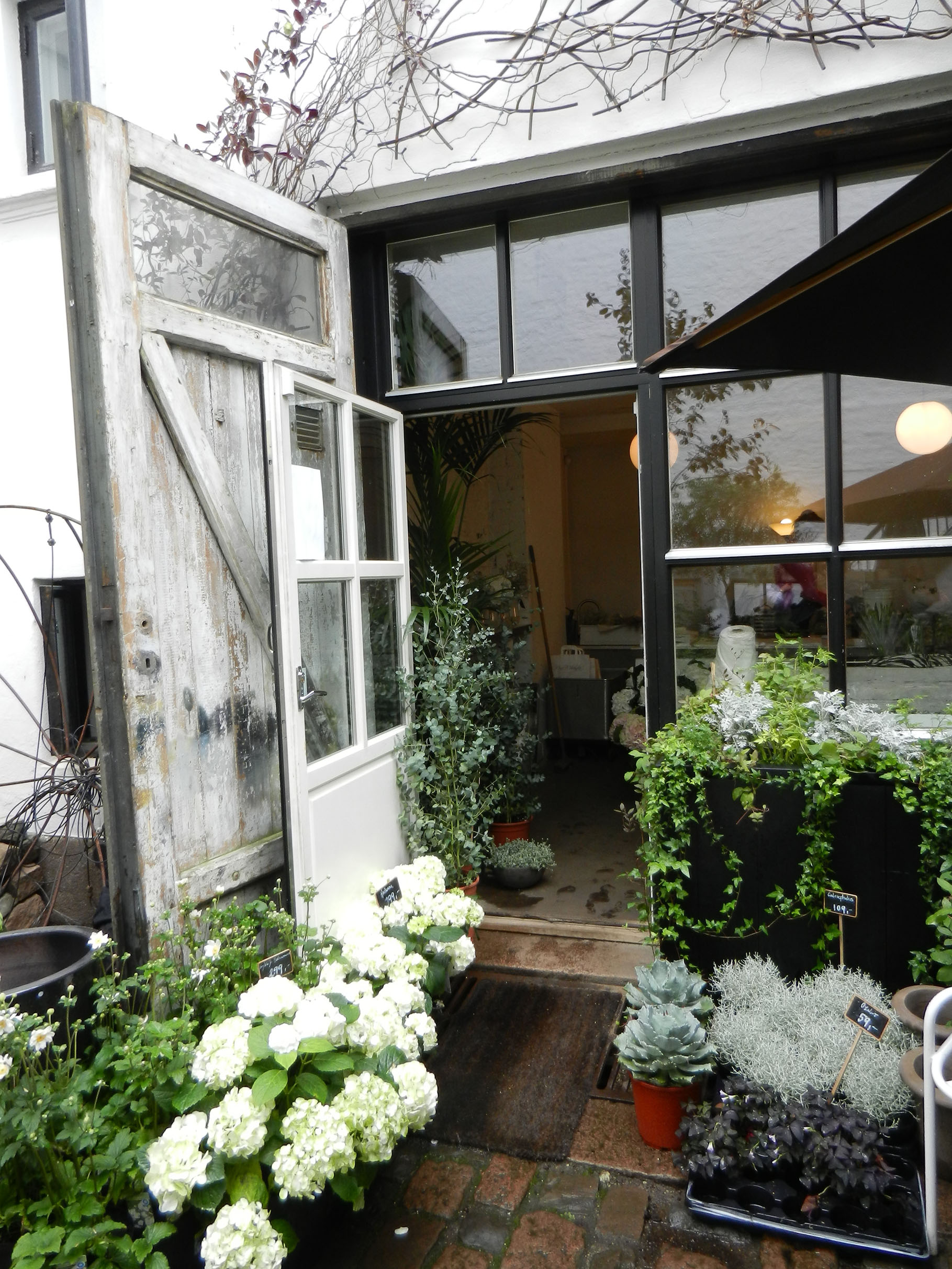
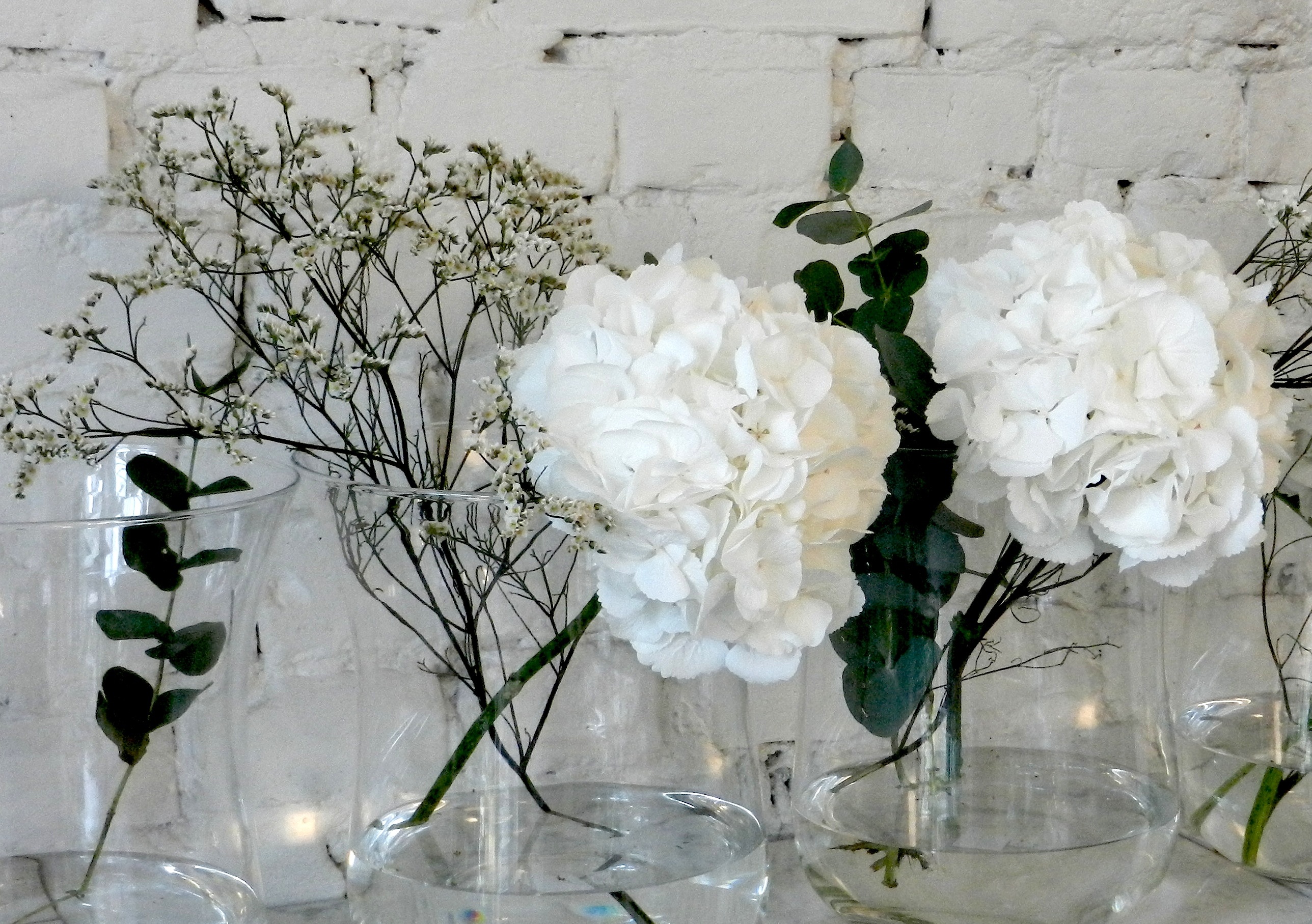
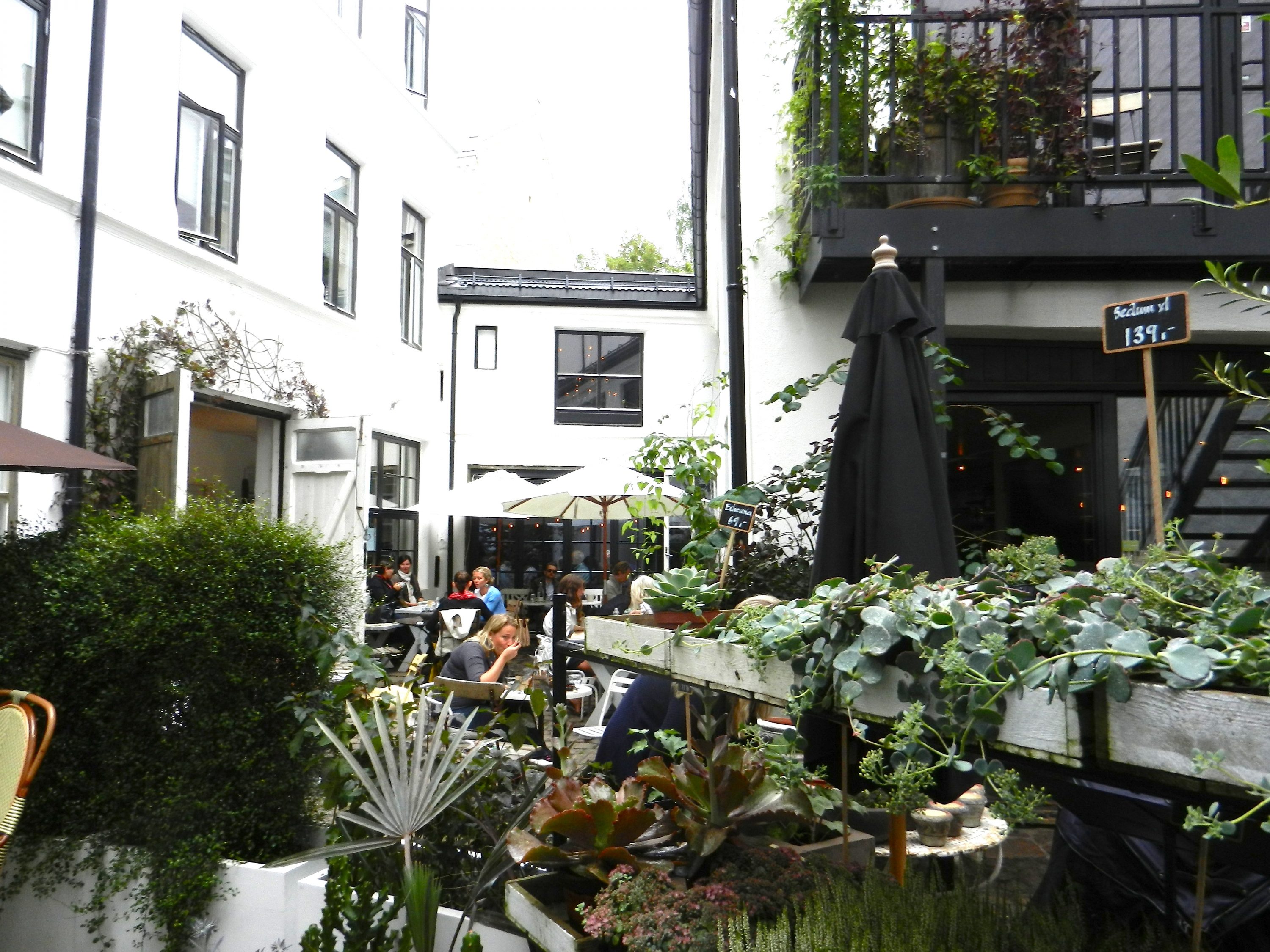
I have finally visited the flower shop Mina Milanda at Frogner in Oslo. Recommended by friends, it is a delightful place to visit. You do need to know its location to find it since it inside the back yard of a block of flats, next door to a popular coffee shop called “Kolonihagen”/The Allotment Garden. So there is yet another reason to visit! The flowers that welcome you in do take your breath away, see above. You will also meet extremely dedicated professionals who love what they do.

Here is a photo of the entrance to the shop that offers interior related items such as candles, vases etc.  Below is their exquisite  fireplace decoration.

Below you can also see coffee shop, full when we were there, with the extremely well fitting name of “Kolonihagen”/The Allotment Garden. All their food is ecological, do check it out on kolonihagenfrogner. It does look a garden you would want to take part in creating and draw inspiration from. Mina Milanda change their selection of flowers not only with season but also of colour and the current topic is white summer flowers. If you are not able to visit I do recommend you merely admire their beautiful photos on facebook.com/pages/MinaMilanda The love for flowers has just increased with age and I adore studying their colours, shape and texture.

Share

Bergere de France

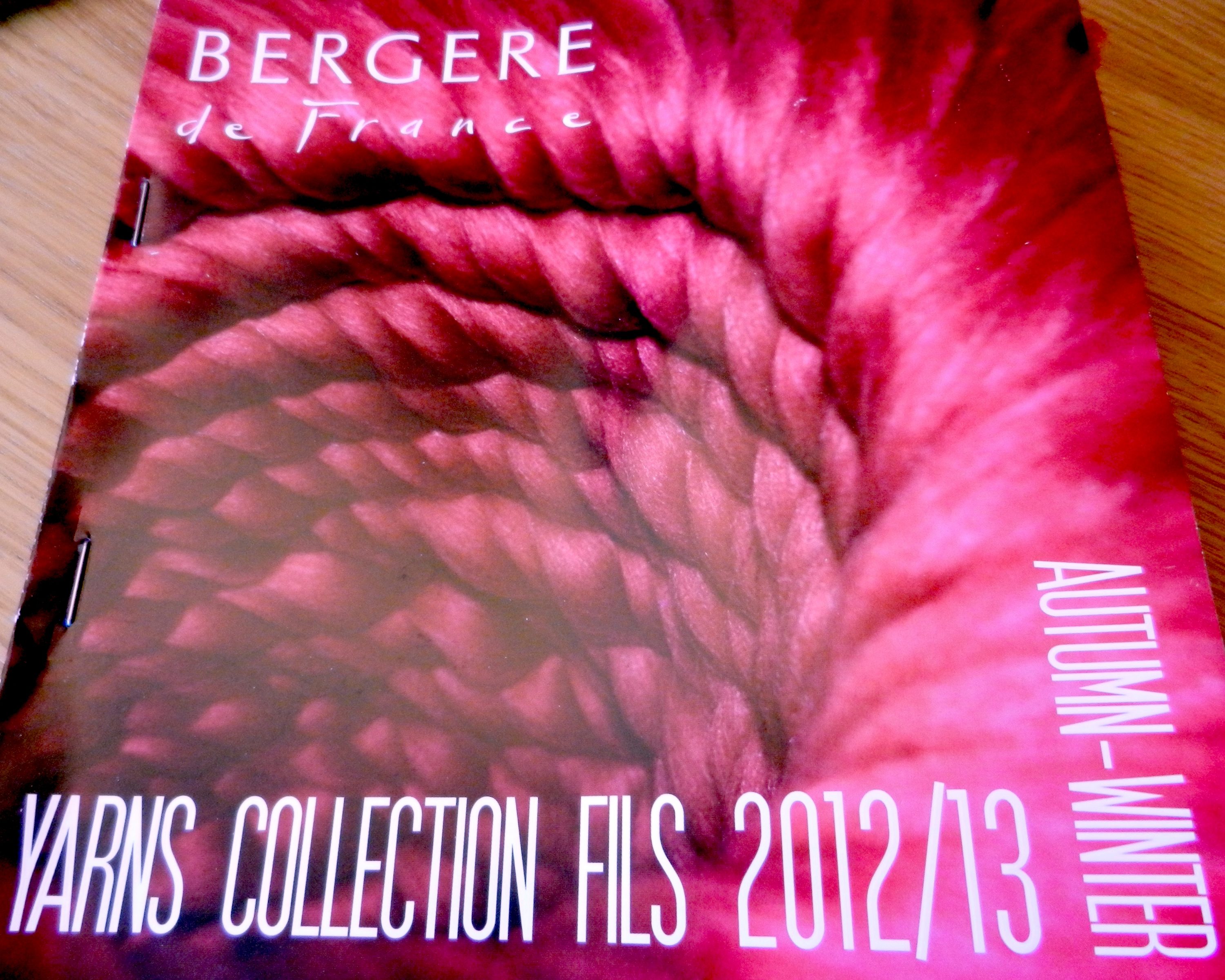
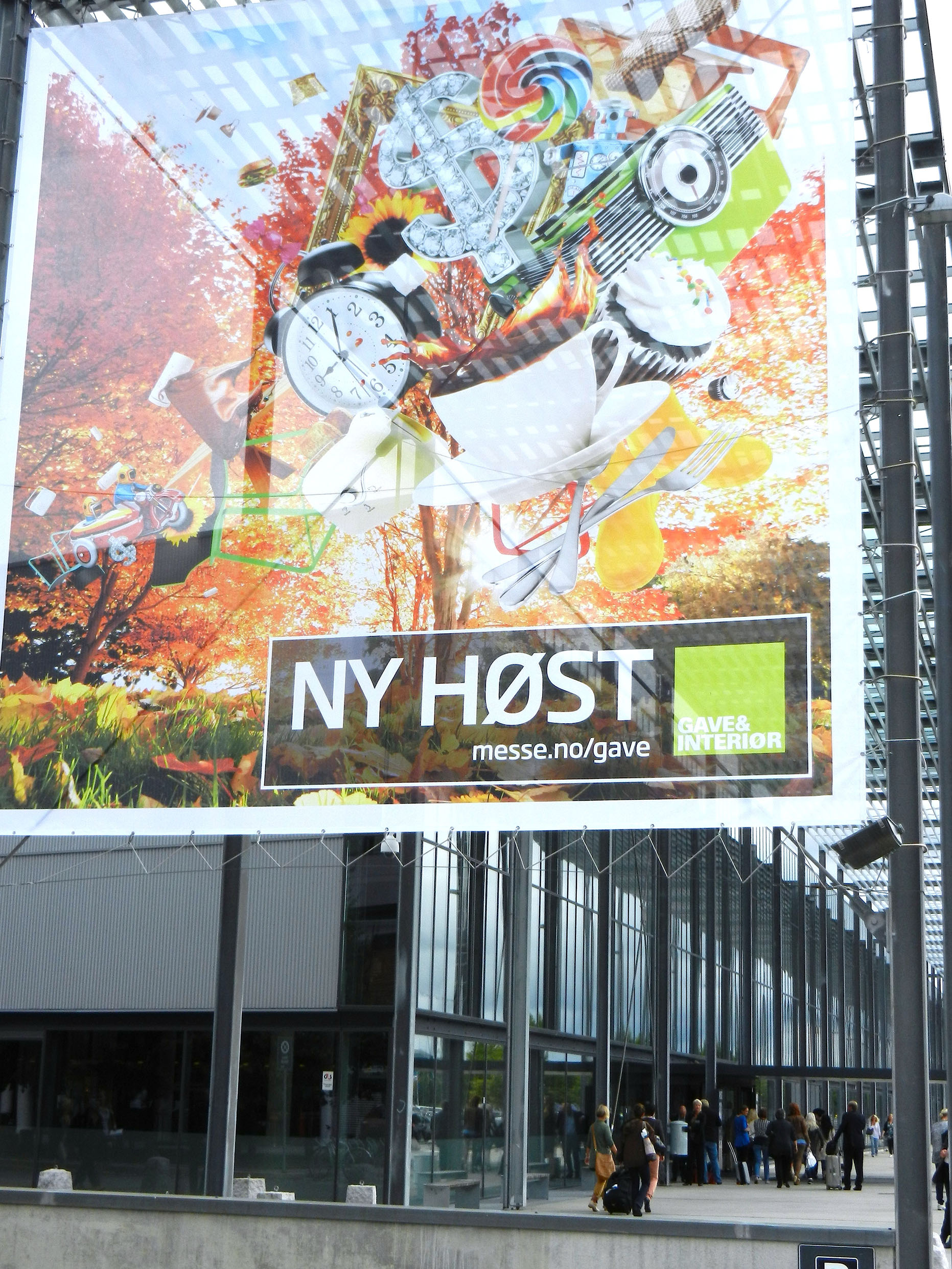
I have received yet another shade card with tiny yarn cuttings to study and admire! This time it is from the French yarn company Bergere, soon available in Norway. I have been translating a number of their patterns into Norwegian, from English, and am still busy working on more so I knew Bergere would have a stand at last week’s “Gave og Interiør Messe”/”Gift and Interior Trade Fair” at Lillestrøm, just outside of Oslo. For me, their stand was one of the highlights of the fair, titled “New Autumn”, just as the Trend Zone with its extensive book shop was! I was able to see the knitted up garments of the patterns I had translated. The fair is also the place to meet fellow designers, yarn producers, publishers and to make new acquaintances.

Bergere’s pattern designs are trendy and fashionably photographed, see bergeredefrance. A selection of their yarns and patterns will shortly be available at the yarn shop Nøstet Mitt in Oslo, among other shops, see bergeredefrance.no. In the mean time I need to translate more patterns, I am pleased to say that I have absorbed a few new techniques I would like to develop further into my own patterns.

Share

Parallel Practises in Fashion and Architecture

Skin & Bones, was the name of a captivating exhibition I went to at Somerset House in London in 2008, marking the launch of the Embankment Galleries with their barrel vaulted space, which was extremely inspiring but equally thought provoking. It was a travelling exhibition from MOCA (Museum of Contemporary Art, Los Angeles) but even if you missed it – do not despair – there is a magnificent catalogue, see amazon.co.uk, and here is the: skinbones_exhibition_guide and the moca.galleryguide. The differences between the disciplines, traditionally remaining quite distinct, are obvious but the parallels are less visible until recent years. Curator Brooke Hodge express it better than I can: “Regardsless of scale, however, the point of origin for both practices is the body. Both protect and shelter, while providing a means to express identity – whether personal, political, religious, or cultural.”

Photograph: Kim Müller

“While the fashion designer and architect create objects that differ in size and materials, their creative processes can be strikingly similar. Both begin with a flat two-demensional medium, transforming it to create complex three-dimensional forms. The same prevailing aesthetic tendencies, ideological and theoretical foundations, and technological innovations have influenced each, resulting in garments and buildings that share stylistic or structural qualities or derive from common creative impulses. And, over time, designers in both fields have drawn from each other for inspiration as well as certain technical strategies. Vocabulary derived from architecture has been applied to garments “architectonic”, “constructed”, “sculptural” etc. And architects have also borrowed and adapted sartorial strategies and vocabulary from the fashion world, draping, wrapping, weaving, folding, printing and pleating surfaces and materials. The significant and manifold parallels manifested in the skin and bones of both garments and buildings are the subject of this exhibition and catalogue.” explains curator Brooke Hodge in the introduction to the extensive catalogue.

The interweaving of fashion and architecture continues at an ever increasing speed. At the exhibition 50 World leading designers and architect were presented, including their experiments with unusual materials, such as Vivienne Westwood, Alexander McQueen, Comme des Garcons, Yohji Yamamoto, Future Systems, Frank Gehry and Zaha Hadid. The catalogue is a visual treat, presenting architects and designers side by side.

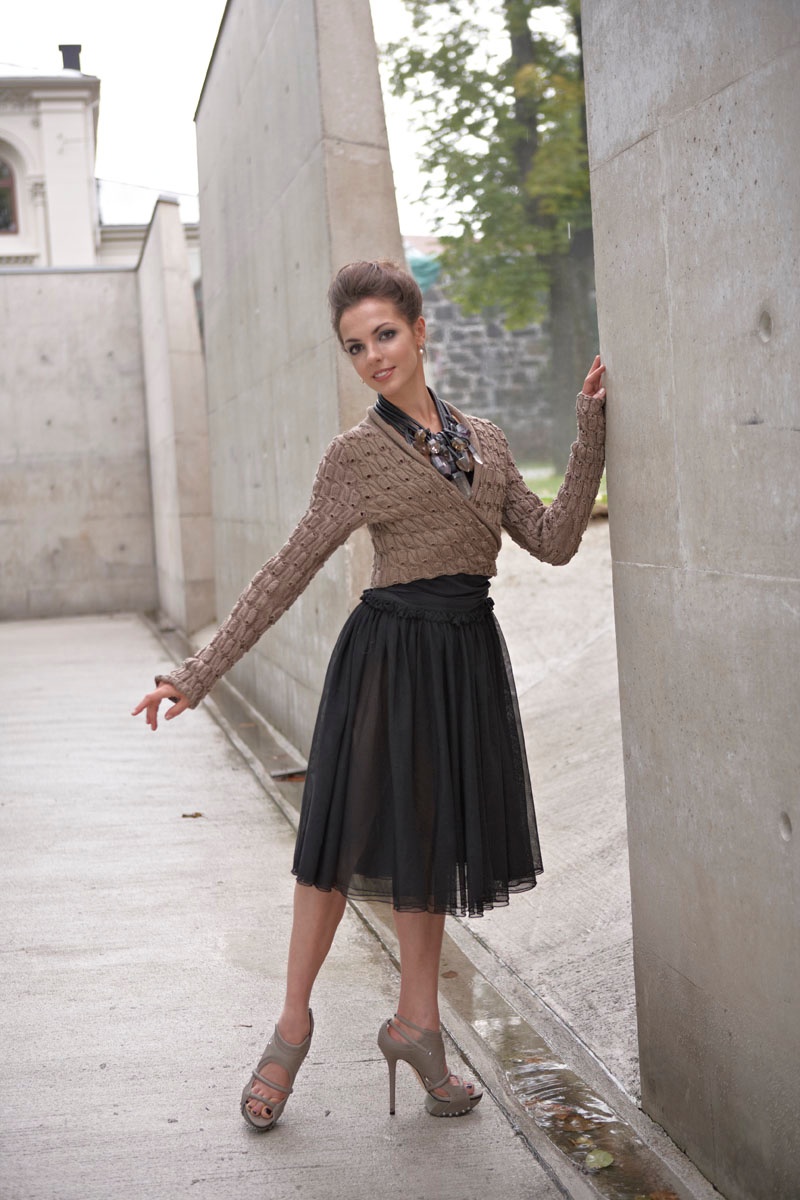
A pure geometrical shape inspires both architects and designers alike at a conceptual stage of a design. Creating a sculptural design that play with dimensions is one of my aims together with an equally attractive reversible wrong side. I chose the “Cloister Walk”, at the Architectural Museum in Oslo, concrete walls placed next to each other leaving triangular glass openings as a back drop for selected patterns with similar openings in my knitting book. Above is a photo of dancer Francesca Golfetto from the National Ballet wearing Jacket in Cross. So unless you already study buildings around you, I suggest you do and ask yourself what inspired it? What geometrical shape formed this? How would it look in fabric? Or, indeed, knitted?

Share

Arne & Carlos Exhibition at Doga

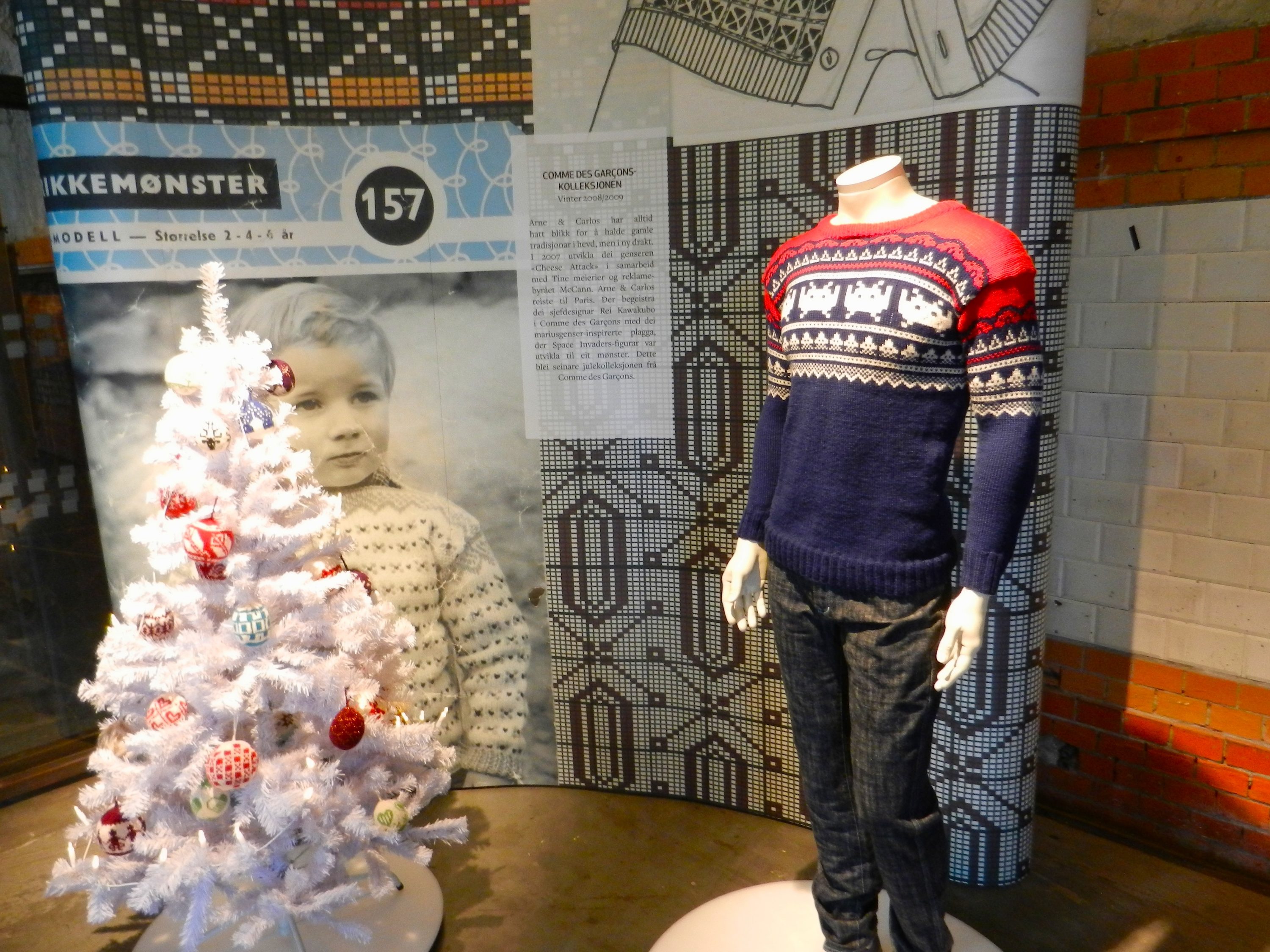
Just like the British artist couple Gilbert & George, Arne & Carlos has become a conceptual art piece in themselves. They are multi talented and have an impressive ability to adapt into different directions from fashion to book production to knitting patterns. Every workshop or talk they give, is like a critical review of their experiences and life expressed in a very playful way just like their designs: A traditional Norwegian sweater knitting pattern is transformed by space invaders. See the photo below and enjoy their classroom presentation called: “Crawlers, country and Space Invaders” where they are both wearing one. The video is in Norwegian but you will enjoy the visuality of  their scrap books and designs here at: doga

Arne & Carlos’s aim with the exhibition was to give an insight into the design process, how they work together, their use of inspirational sources as well as encouraging you to design. You will find fancy paper dolls to dress as you like and a selection of traditional knitting pattern borders for you to play around with then you can photograph the result and send it to the National museum. The exhibition is on until 26. August, so you still have a chance to see it if you are in Oslo. Do look at this video – with English subtitles – and you will see their amazing house, a former train station located in the mountains, and a presentation of their Christmas Decorations to Knit: youtube.  That trend of knitting Christmas Decorations is still ongoing, by the way, just as the other one they started with knitting dolls …

Share

Whole Wood

Or rather “Hel Ved” in Norwegian is the title of an unlikely bestseller written by author Lars Mytting published by Kagge, last year, which is still close to the top of the list nearly a year later! Initially 4000 copies were printed but 129 000 copies later gives you a good idea of the fairytale it has been. All the practicalities on how to make firewood and its cultural history have captivated thousands of readers and it was the book my husband asked for when he started to cut down the trees behind our house because he needed to know how short to cut the firewood for our fireplace. I am pleased to tell you that all the talk about buying a chain saw stopped since a manual one did the job! Here is our firewood neatly stacked on the terrace under the roof, next to our living room, drying.

“There is no fuss with a stack of firewood. It does not loose its value on the stock market. It does not rust. It does not take out a divorce.” Firewood is a science and a passion according to Mytting.  It is burning love when you take out the wood you cut half a year earlier then left to dry, since it still smells nice and is dry and willing in the fireplace, he claims. Do take a look at his pictures and send him your firewood tips on: larsmytting. I have missed the smell and sight of a proper fireplace for years and one of those DVD films you can buy has been the closest I have come to one. So I do, very much, look forward to that burning love…

Share

Pom Pom Magazine

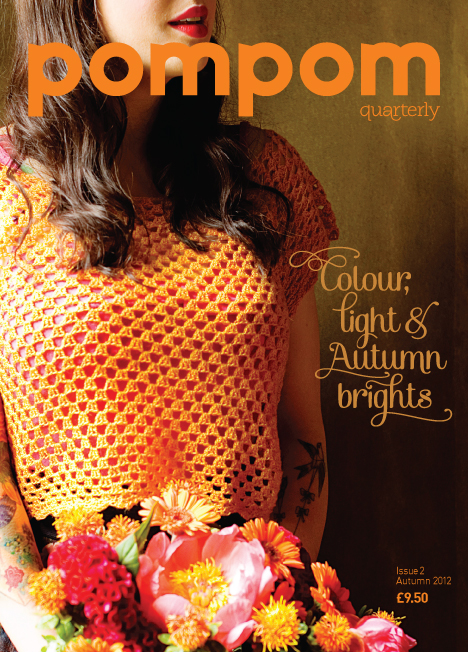
The second issue of Pom Pom quarterly is out and I have chosen to subscribe to this charming craftsy knitting- and crocheting magazine, established in London 2012, printed on recycled paper of good quality. This is the second issue edited by british designer Lydia Gluck and american designer Meghan Fernandes – yes, she is a friend and did test knit for my book, if you recognize the name. Issue 2 on colour, light & autumn brights contains 5 patterns – 4 knitting and 1 crochet – two articles to read on up-and-coming designer Anna Wilkinson and on life on master-dyer Ce Persiano as well as how to make Chilli Chocolate Mocha Cake which looks divine and an awesome Day of Dead embroidery tutorial by Lydia inspired by her stay in Mexico. The resident receipt-maven is Rebecca Litchfield – another friend and test knitter of mine – of no98.co.uk fame. You can sign up to their newsletter, subscribe and order through their website pompommag and take part in their KAL – knit along – in their group on ravelry.com/groups/pom-pom.

Share

Wollmeise – One of My Favourite Yarns

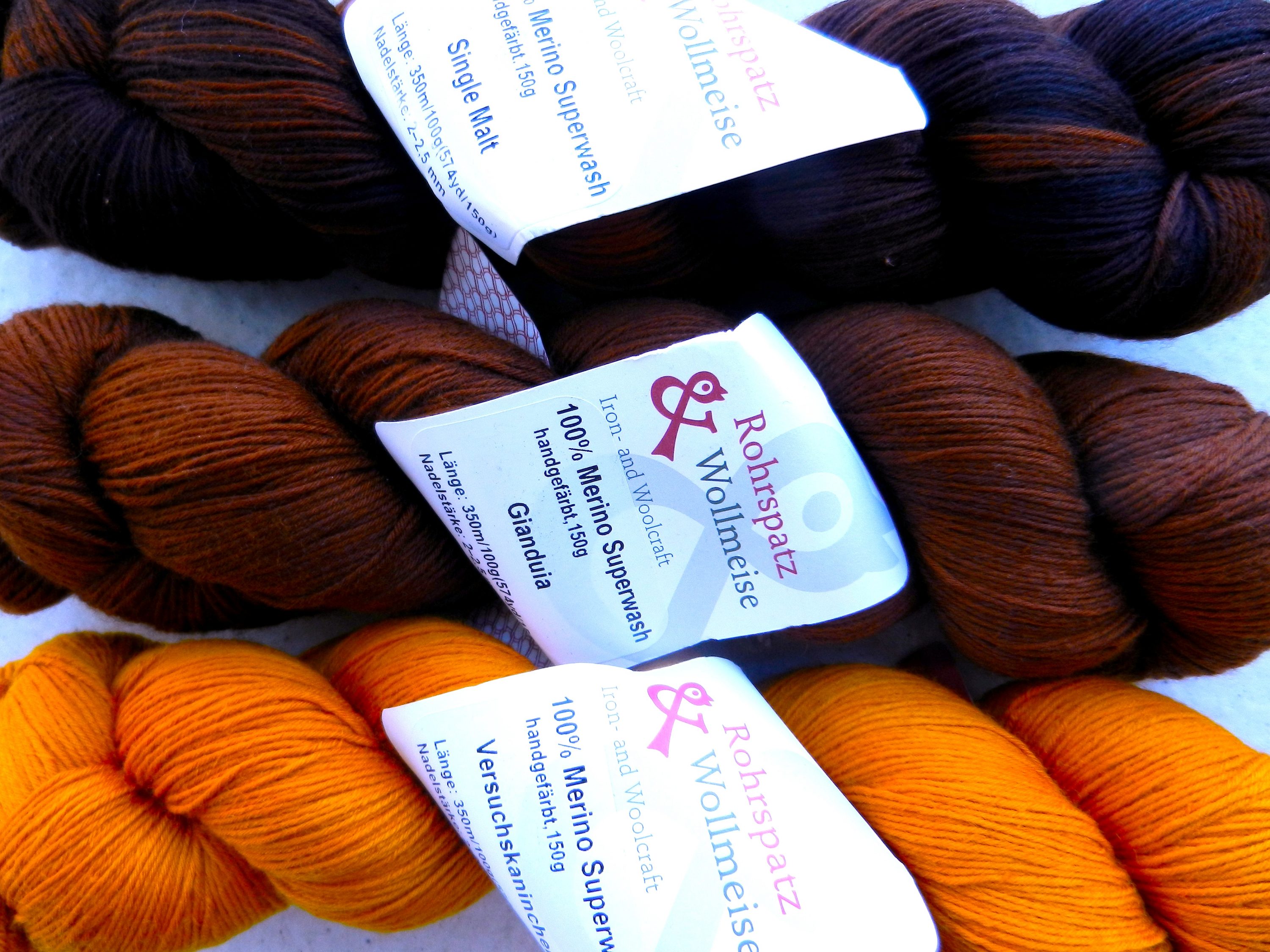
Yes, it is one of my favourite yarns too! The number of fans the German Wollmeise yarn has, seems to be increasing all the time. It is one of those discoveries you hear about through other knitters and whose reputation is going sky high. How did you get hold of yours? Is a common question among Wollmeise fans since the demand is so much larger than the supply from indie dyer Claudia Höll-Wellman of Wollmeise.

What makes it so special, you ask. It is the vibrantly intense colours that knock you sideways as well as the stunning stitch definition it gives. The number of colours is, just as the fanbase never ending, well above 150 solid, semi-solid and the multi-coloured combinations you could only dream about. Claudia never found the excact colour she wanted hence she started dying by hand herself: “…for a long time I experimented in getting for instance the velvet bluish lilac of violets and not only the ordinary lilac. Sometimes this just happens, like Rhubarb. I see the colour and remember the juicy leaves and shafts of rhubarb.”

Photograph: Kim Müller

I am one of nearly 5600 members of Wollmeiseholics Anonymous on Ravelry – a group for the seriously addicted. It comes in 2 thicknesses: sock and lace in generous hanks. Where can you buy it, you ask and here is the catch: you can only buy it directly from the shop in Germany – you need to follow their updates on whats available – or by visiting or telephoning Loop in London who receives a monthly supply – for updates see their group on Ravelry. Here are the links: rohrspatzundwollmeise and loopknitting.

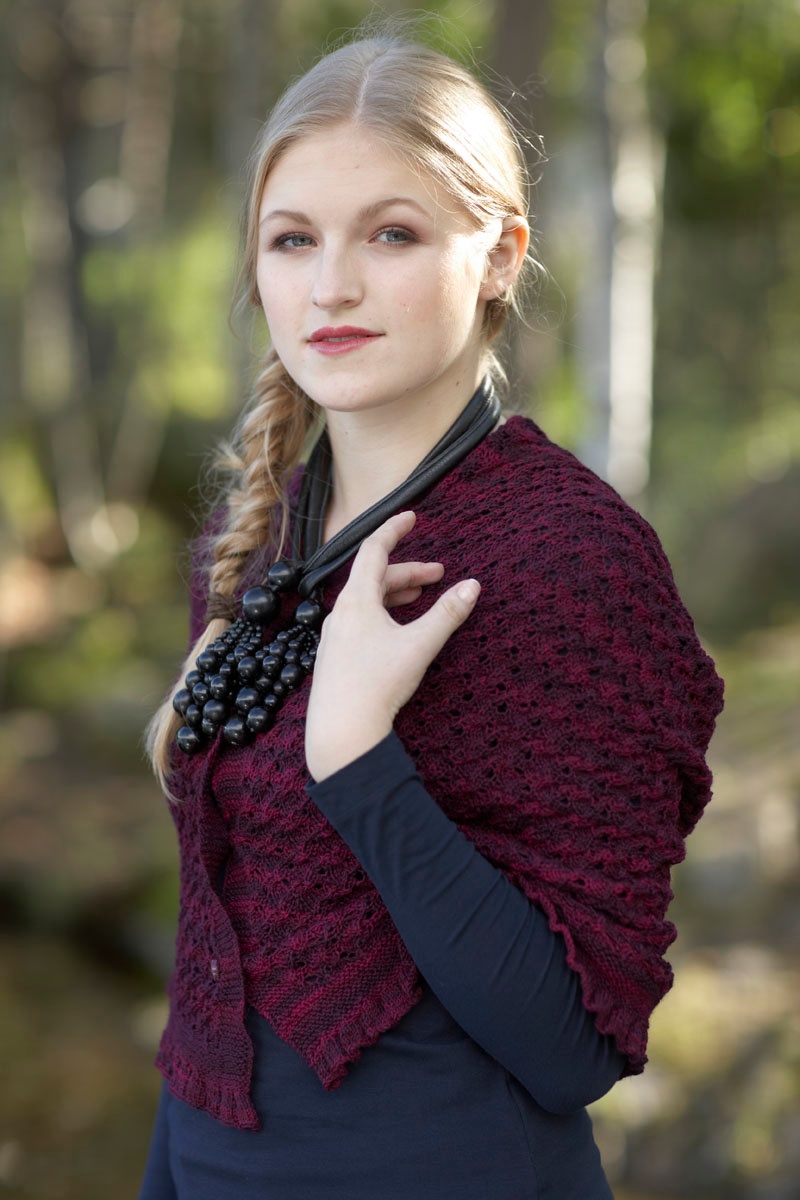
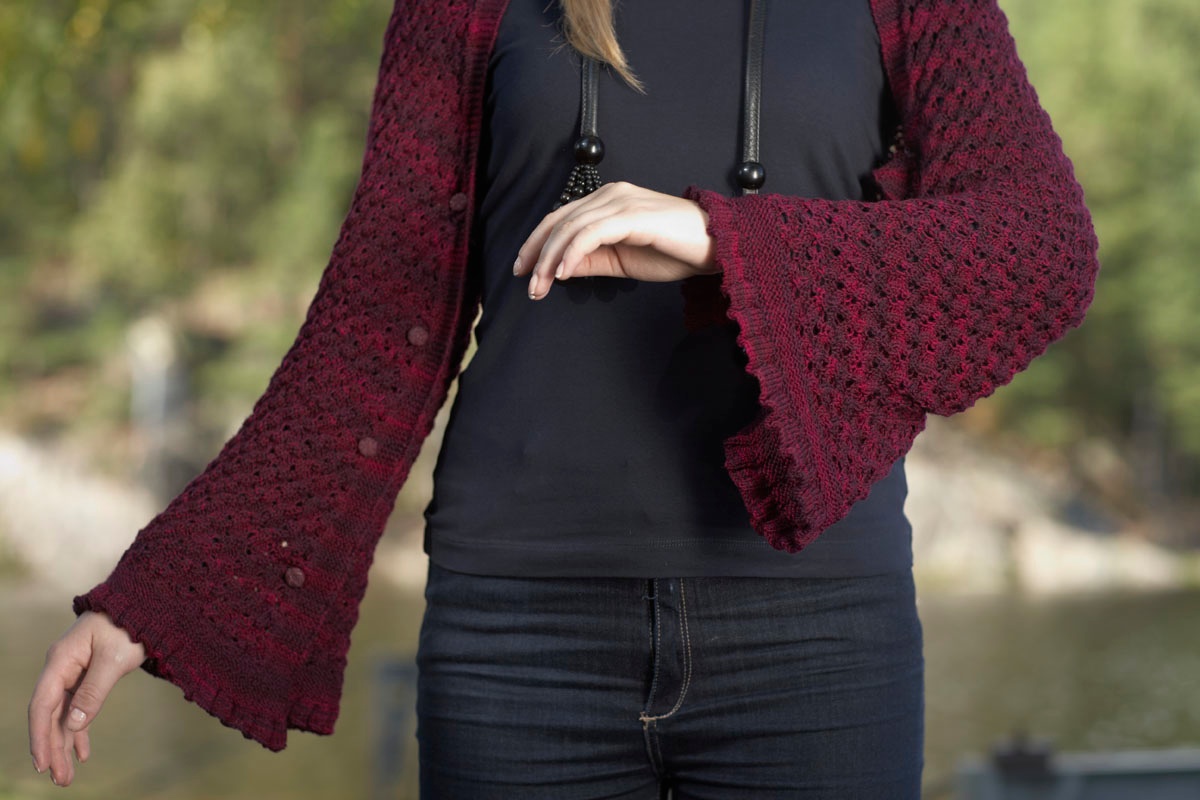
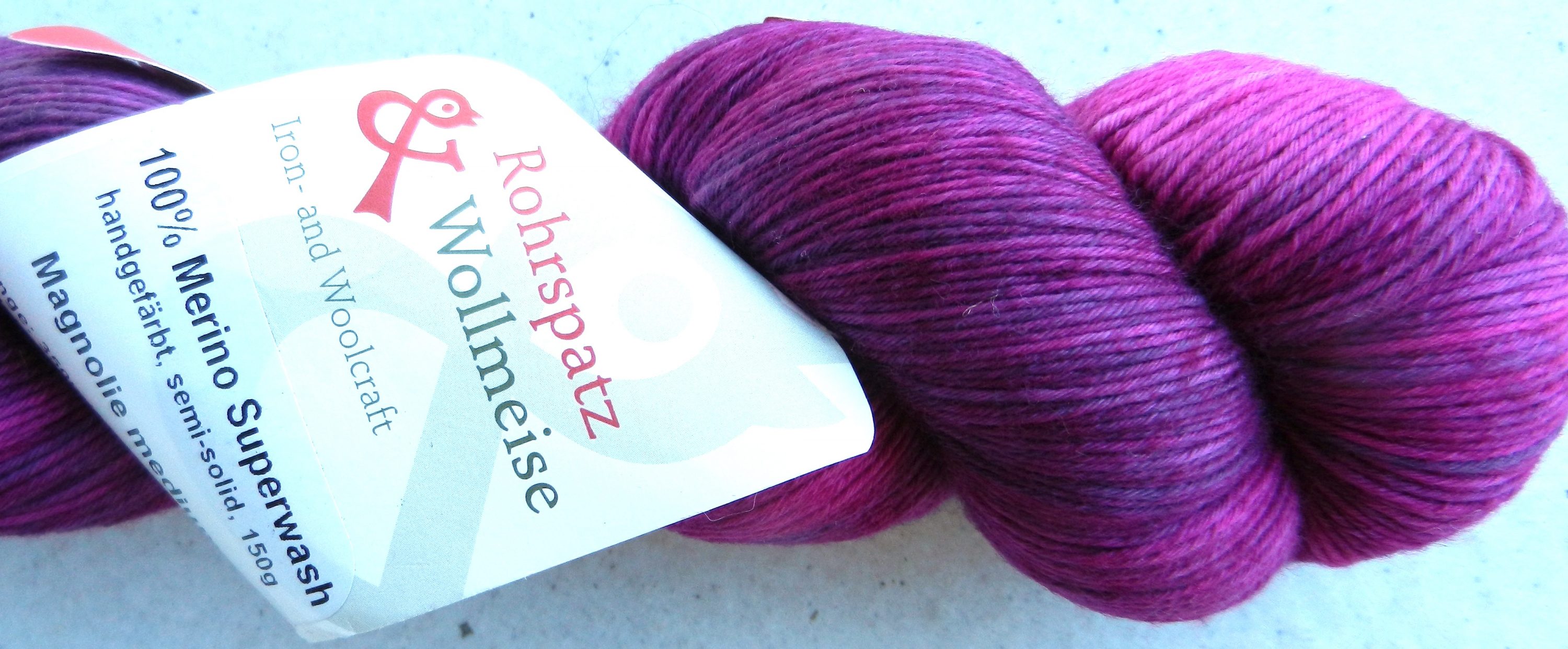
I felt the urge to use 1 hank of Lace in shade “Petit Poison” to make the “Milanese Lace Shawl” in my book – still only available in Norwegian – that can be buttoned into a shrug. Above are two photos of Anna Pfeifer wearing it, photographed by Kim Müller. I do not need to stash dive – I love that idea – to know that my Wollmeise stash could be larger and contains only enough yarn for 2 projects. Below is a photo of a hank of 100% in Magnolia. I have seen photos from the summer sale at the shop in Germany – yes, on Ravelry – and would love to go to admire each colour and bringing an empty suitcase…

Share