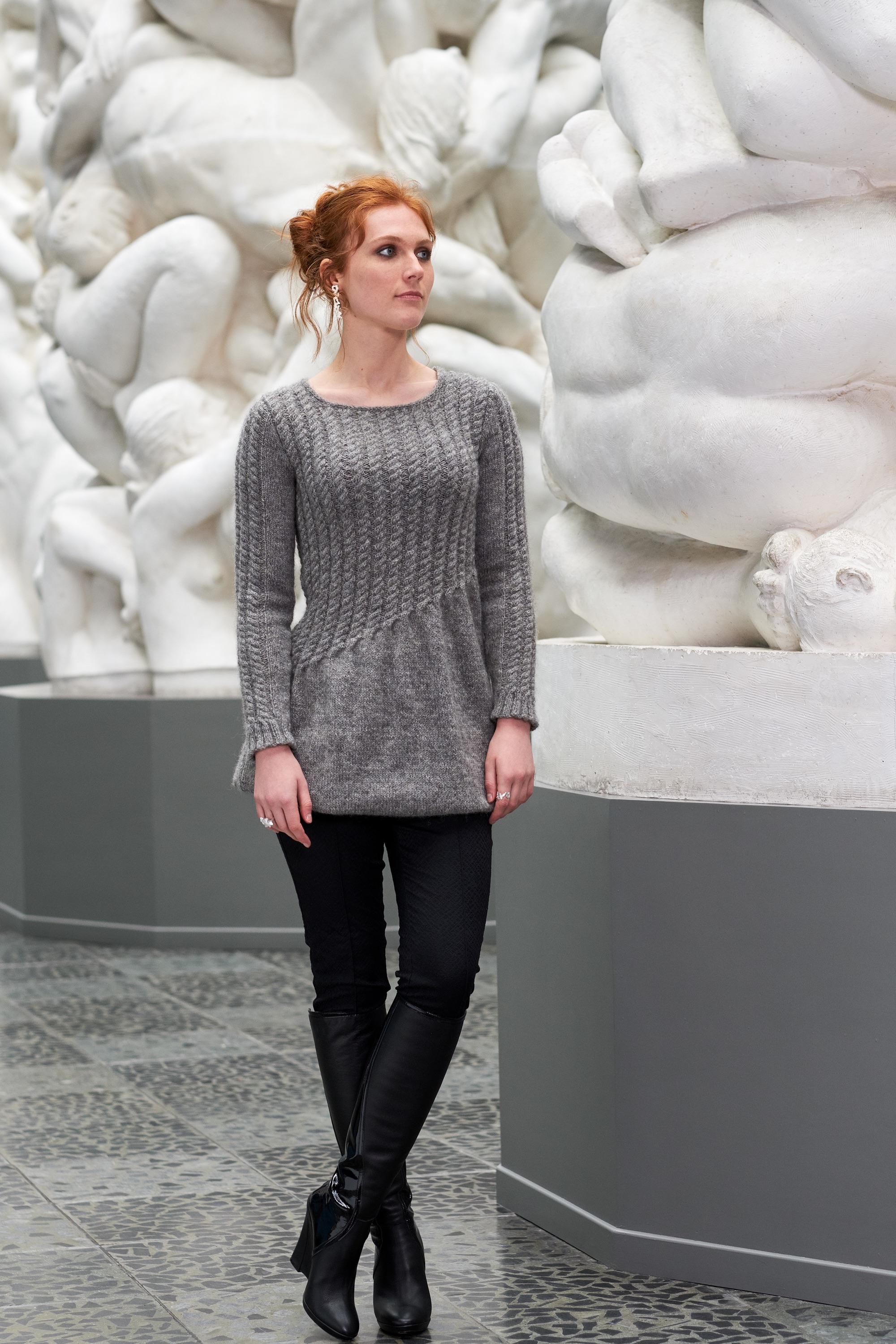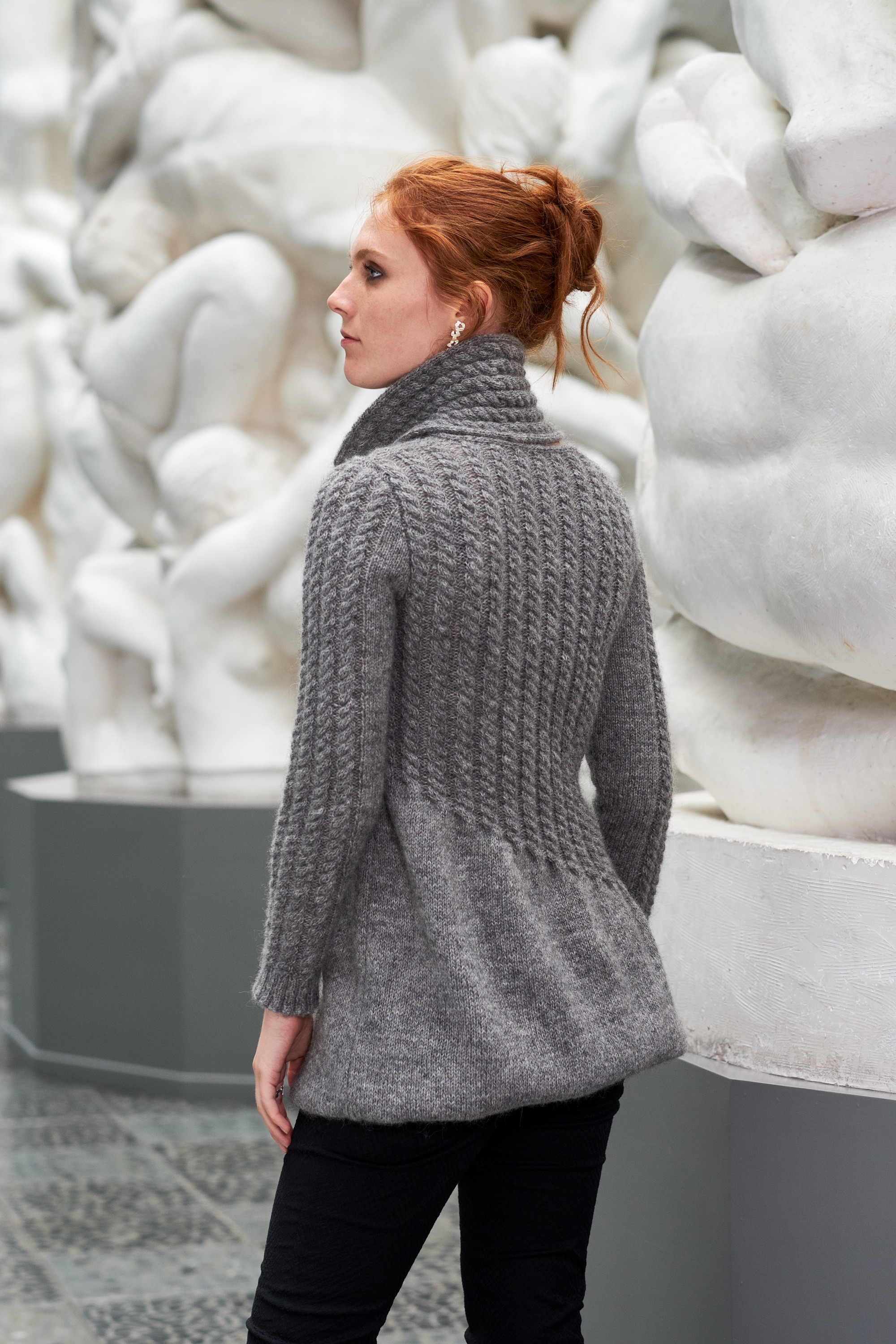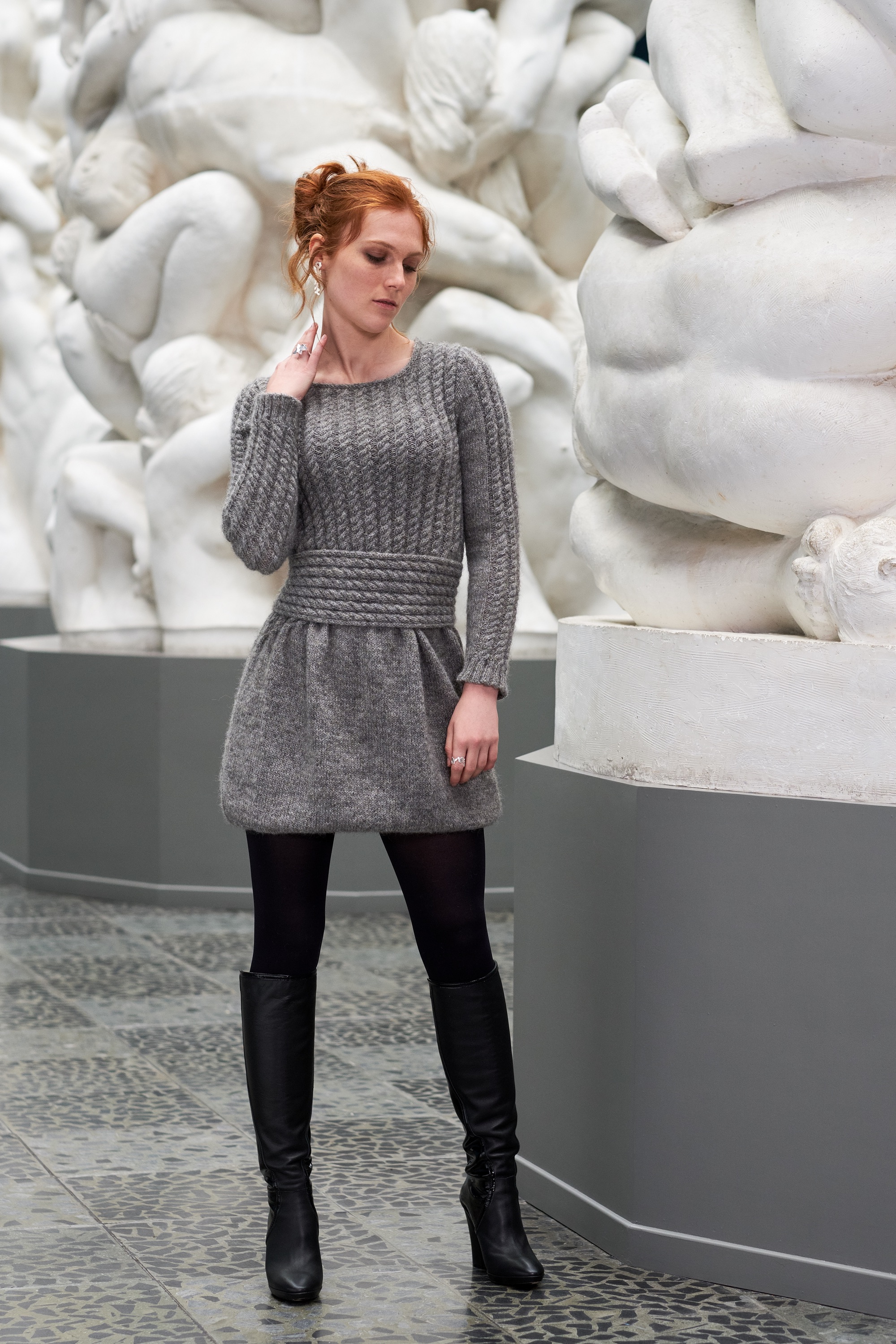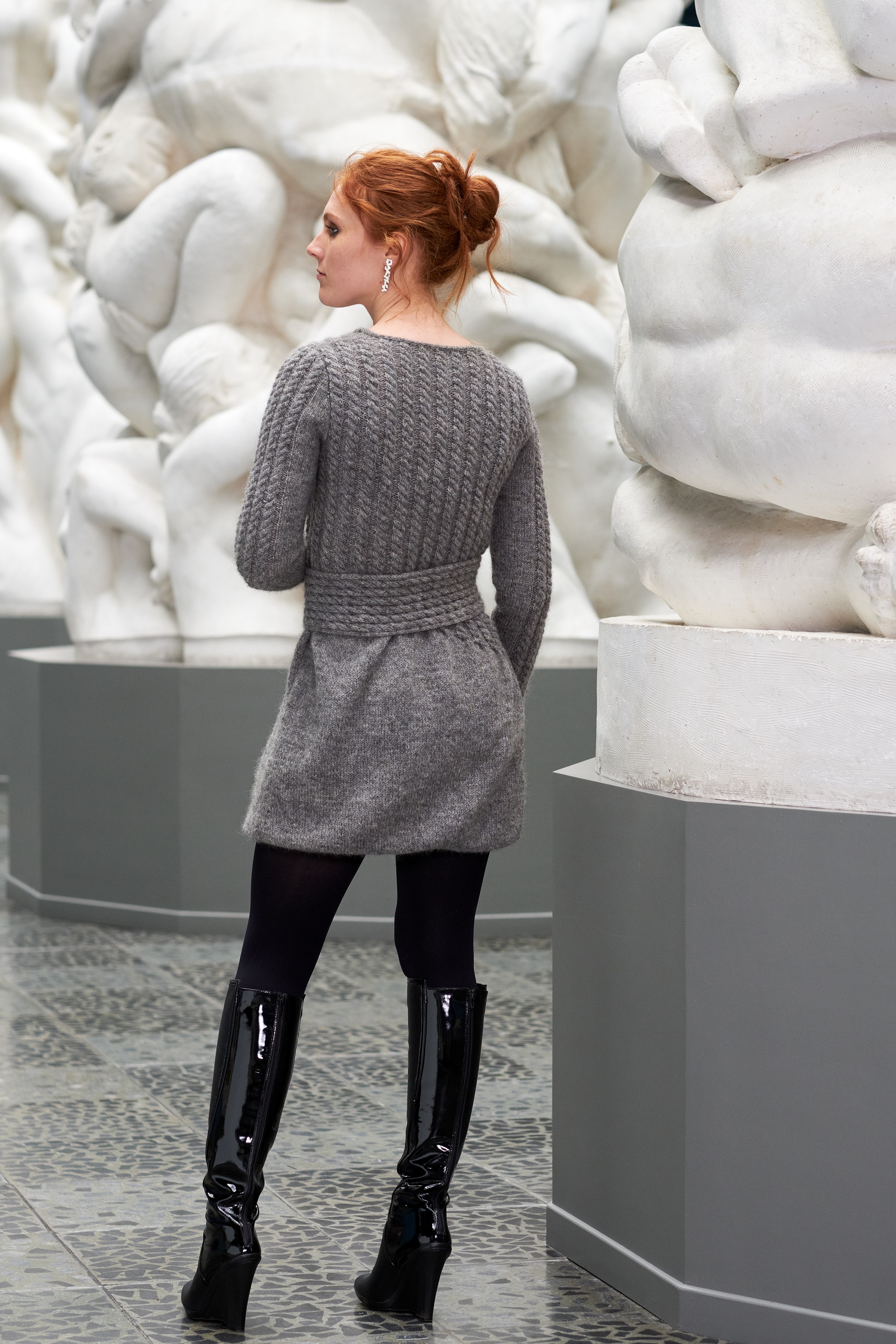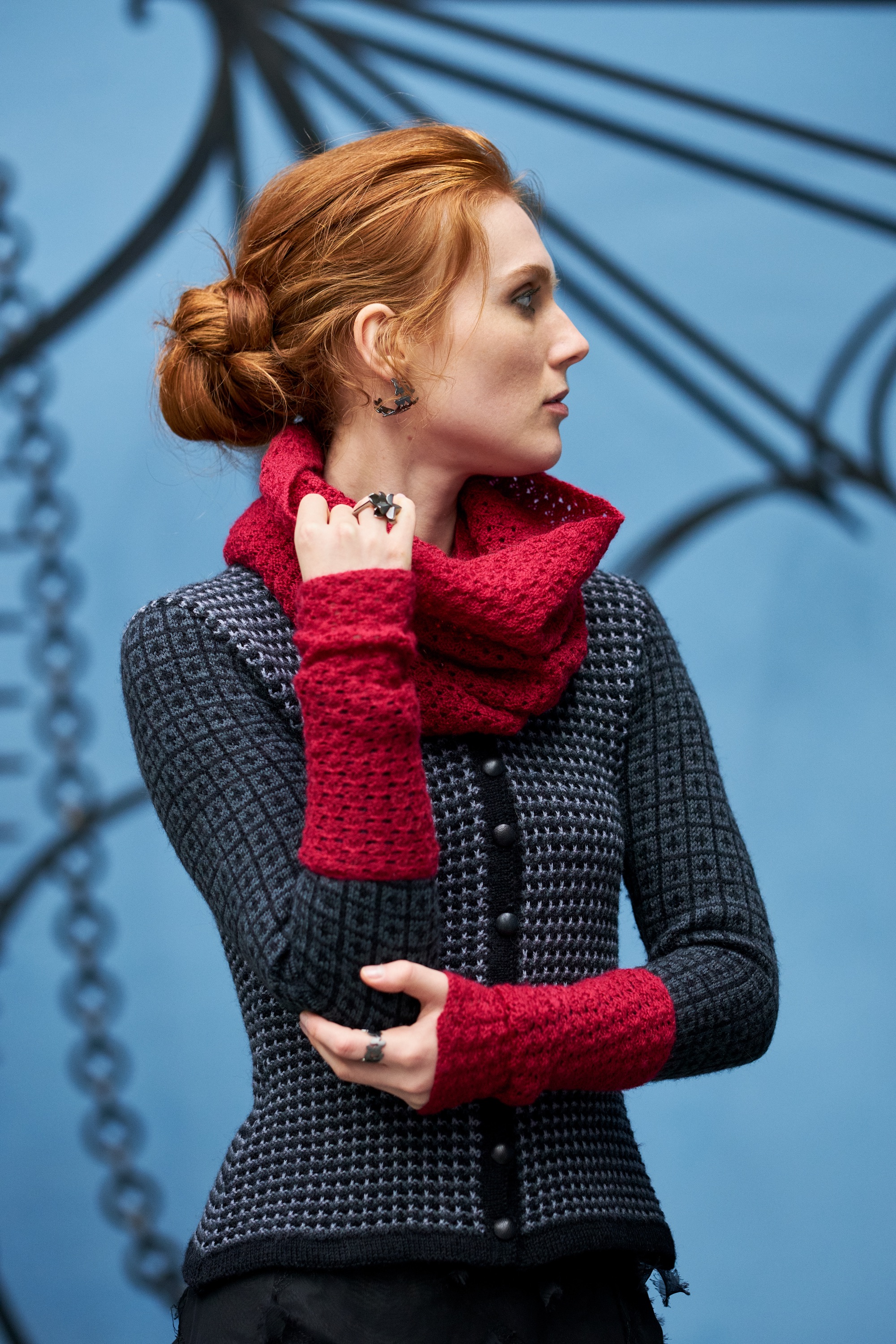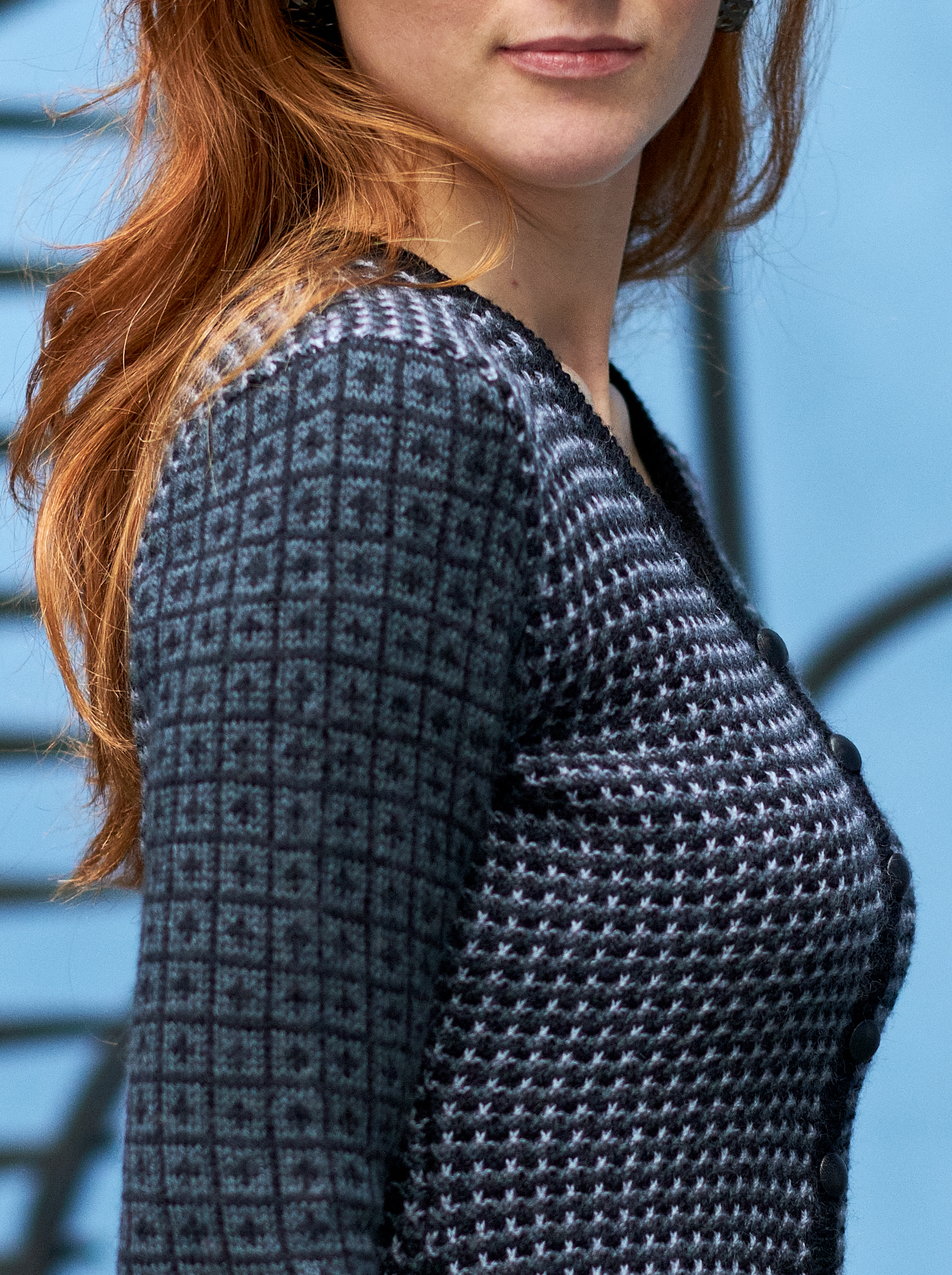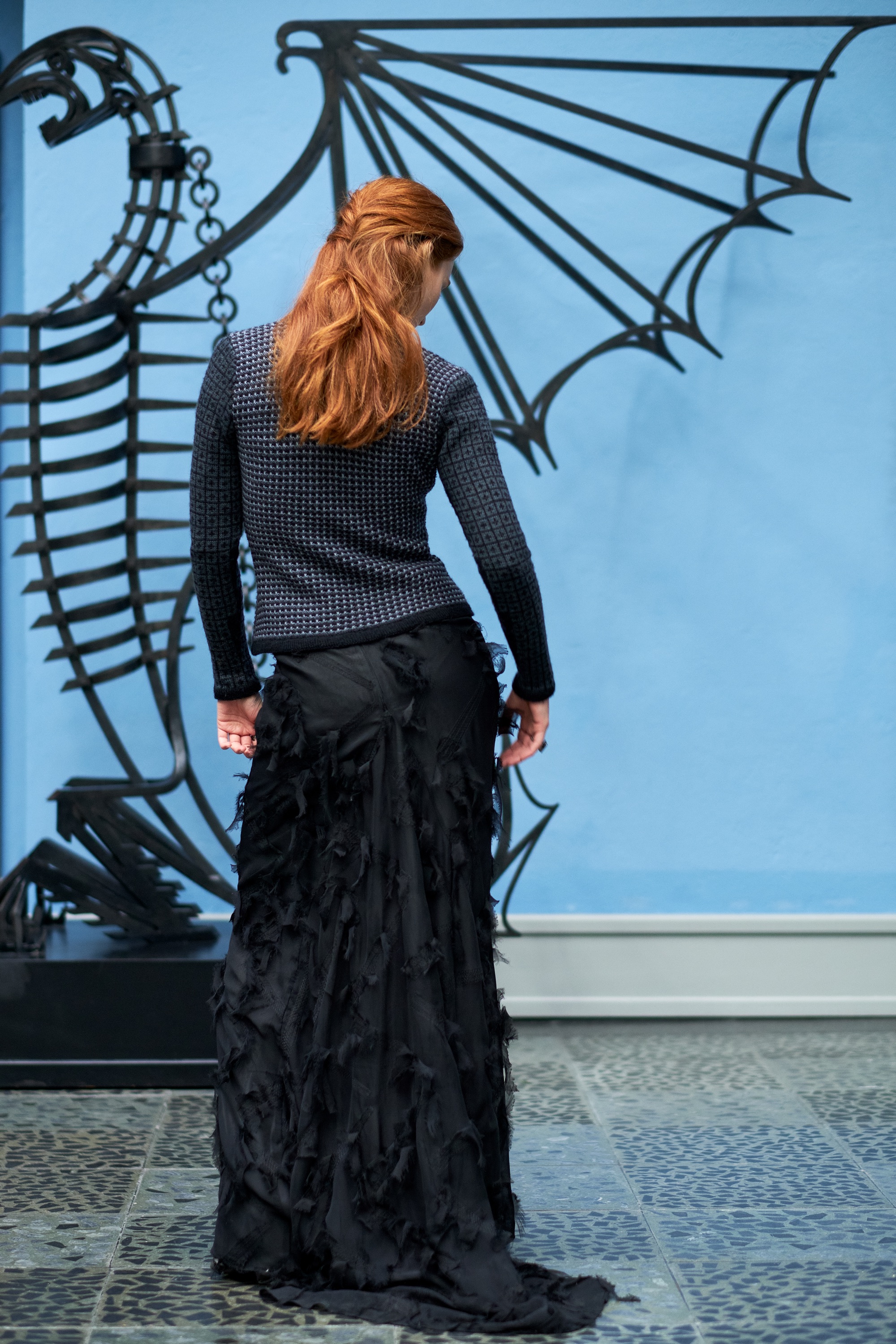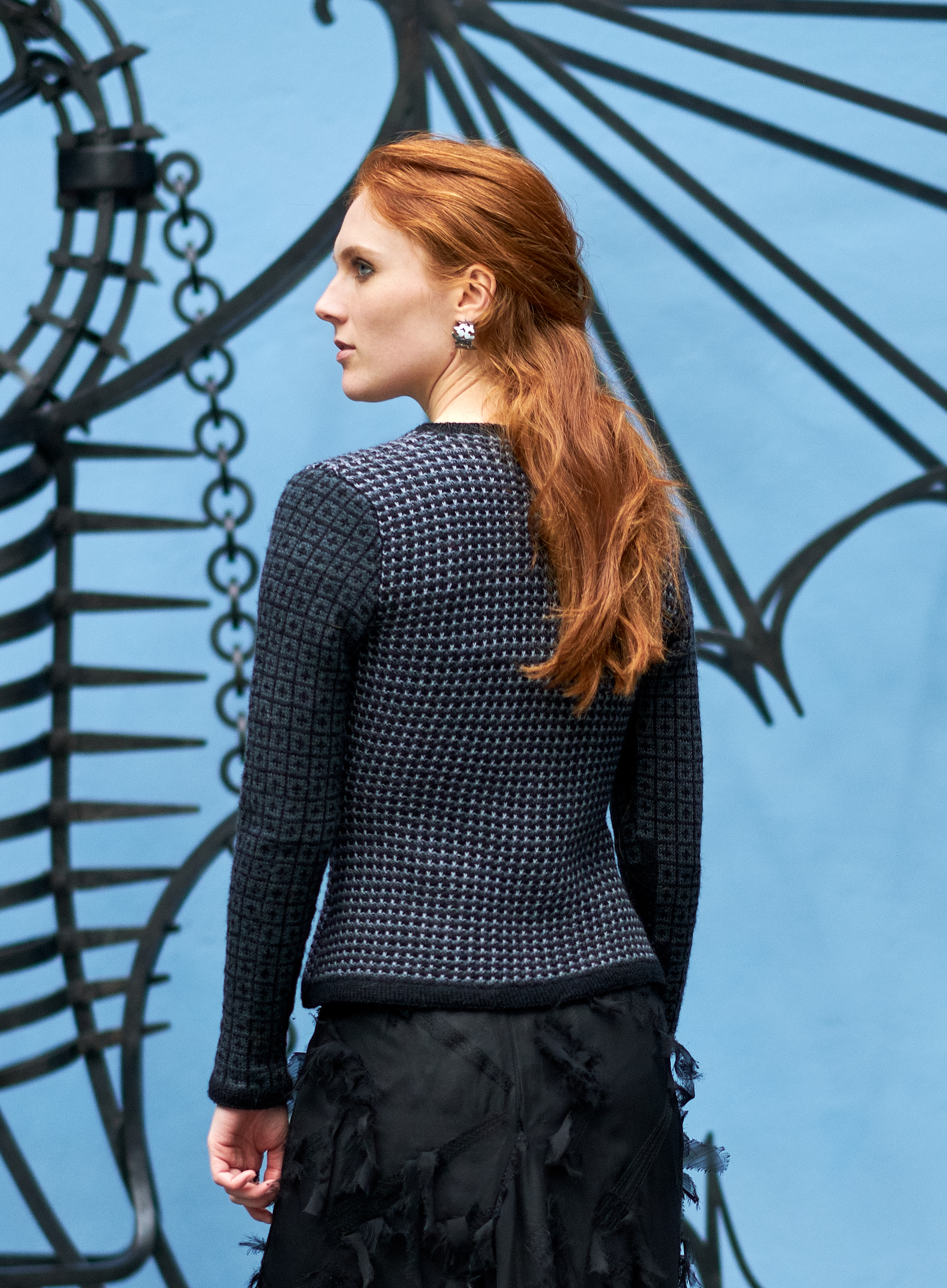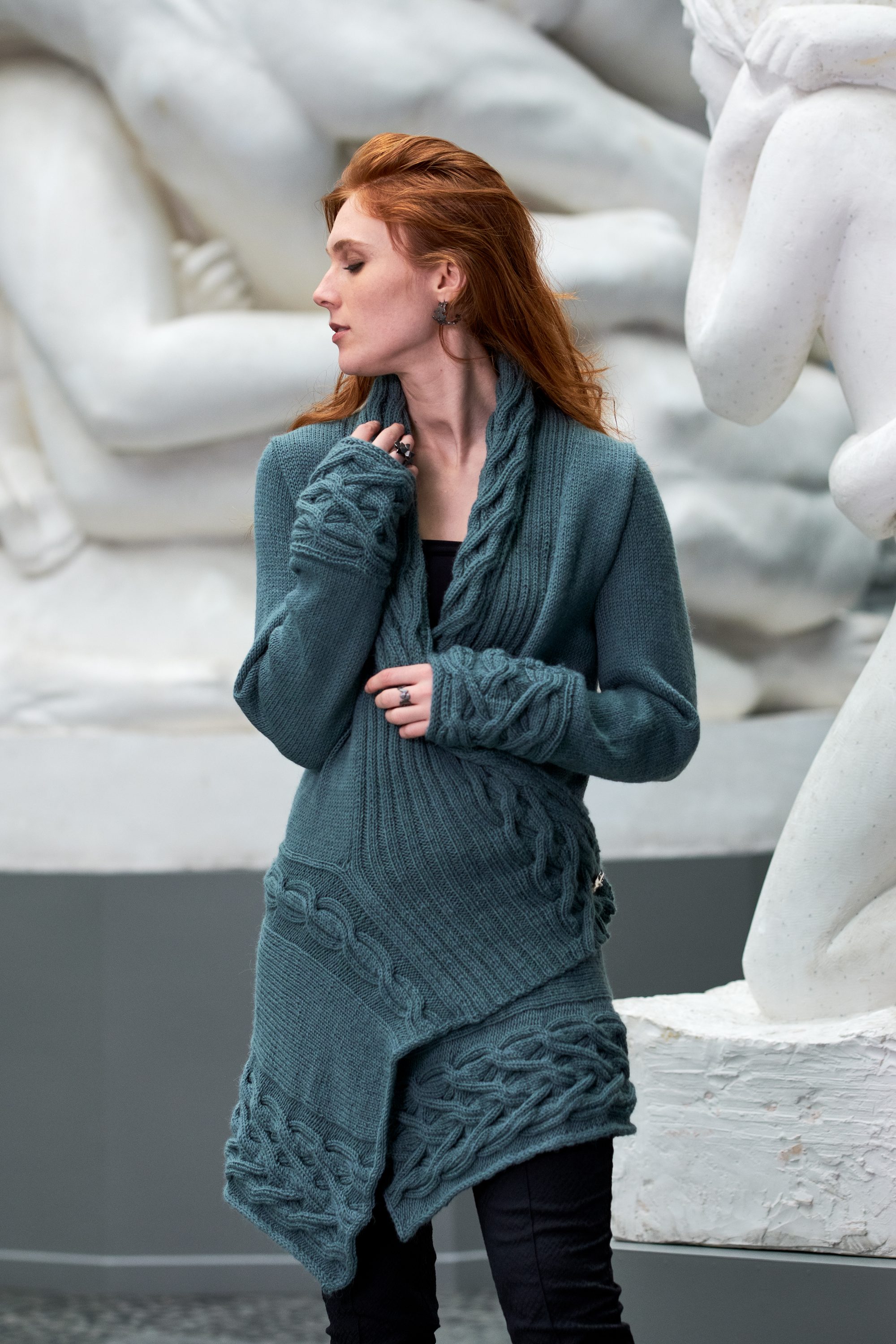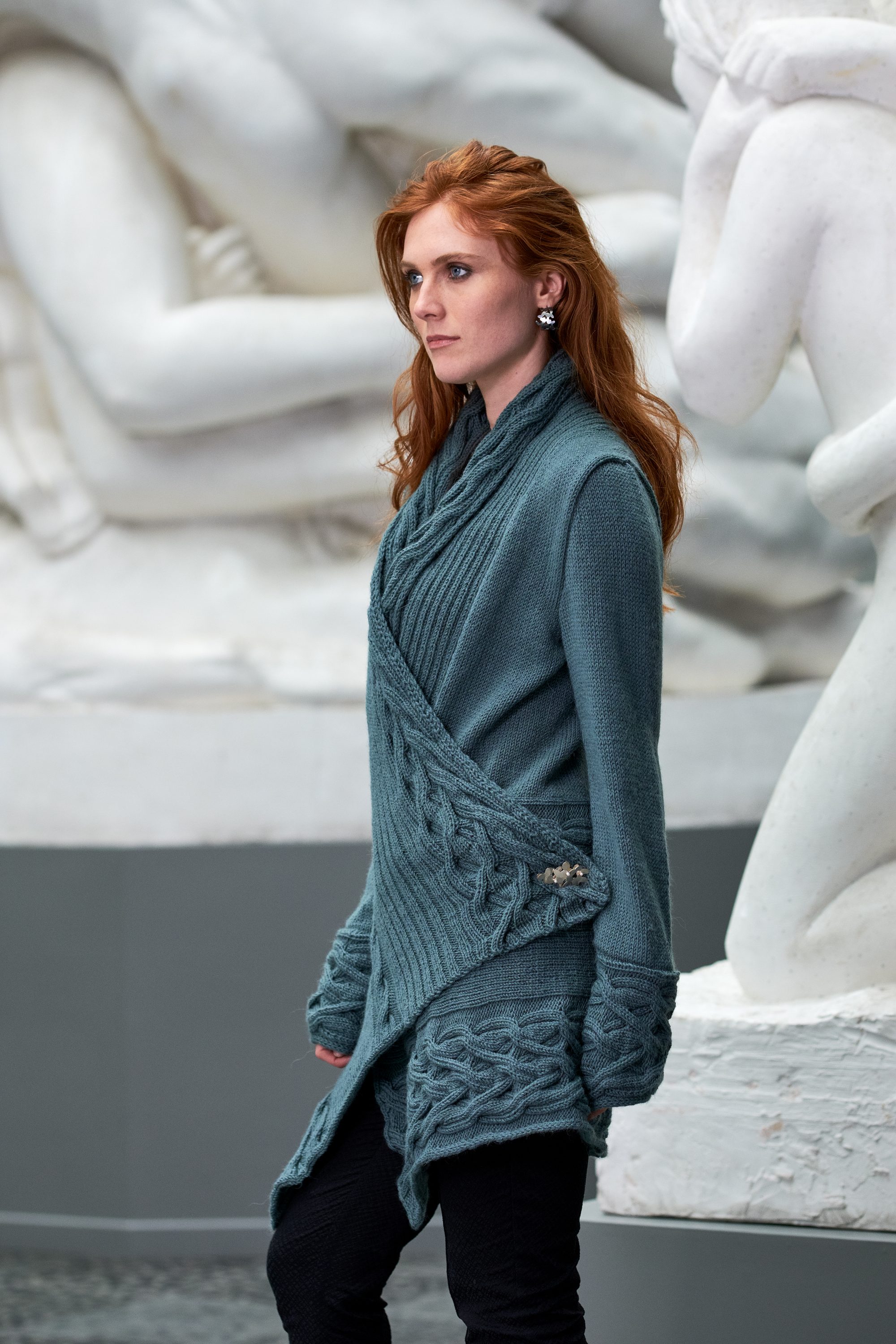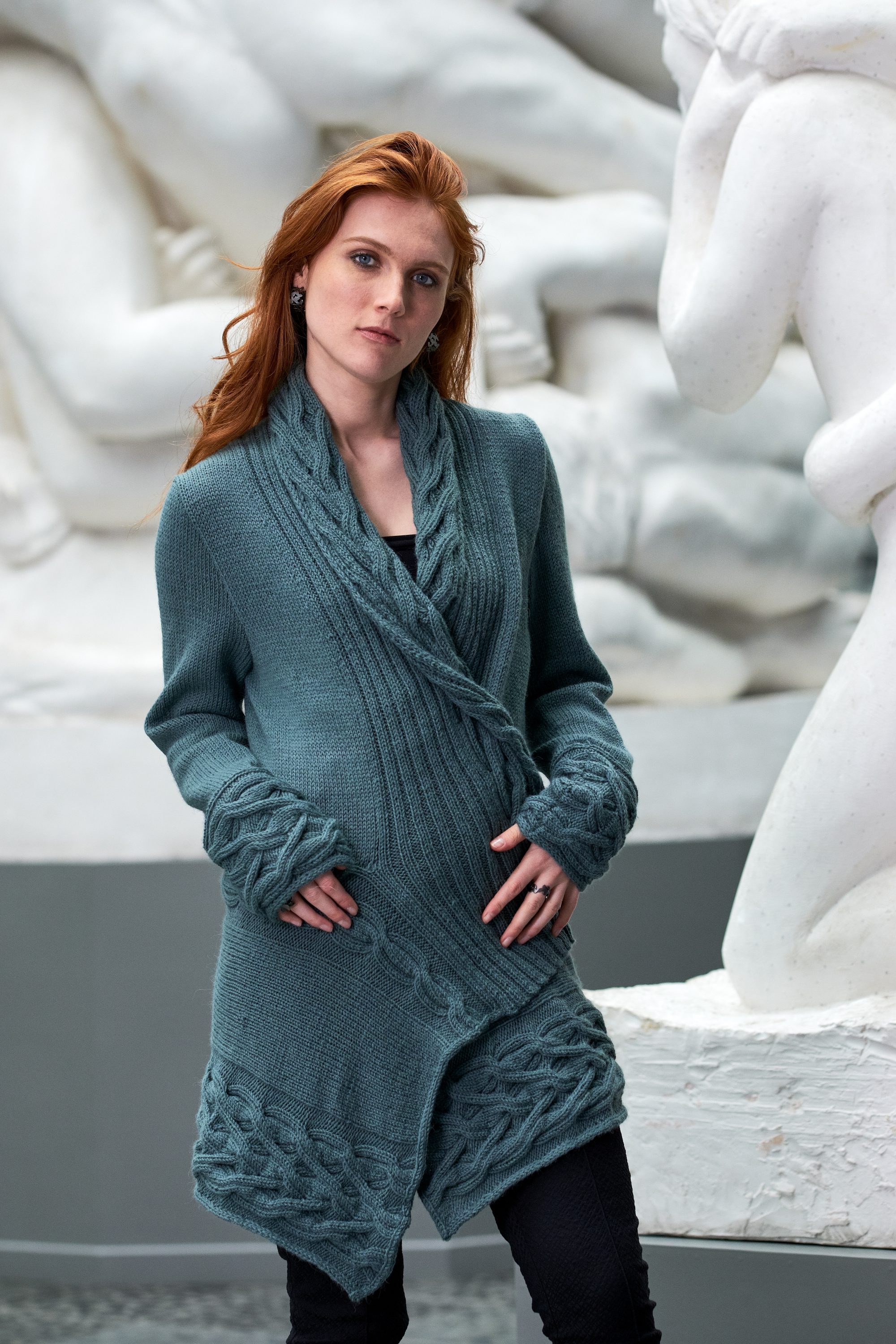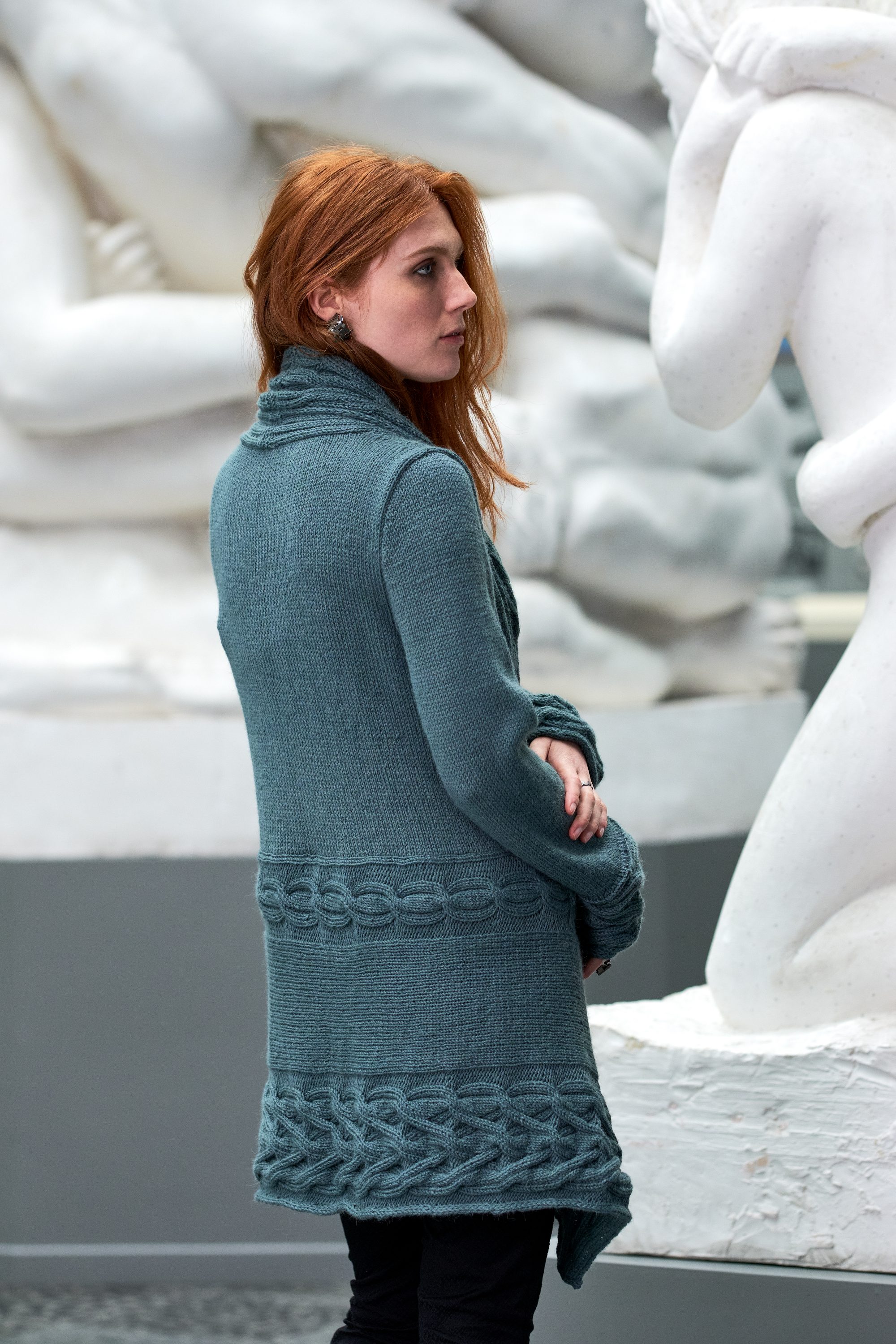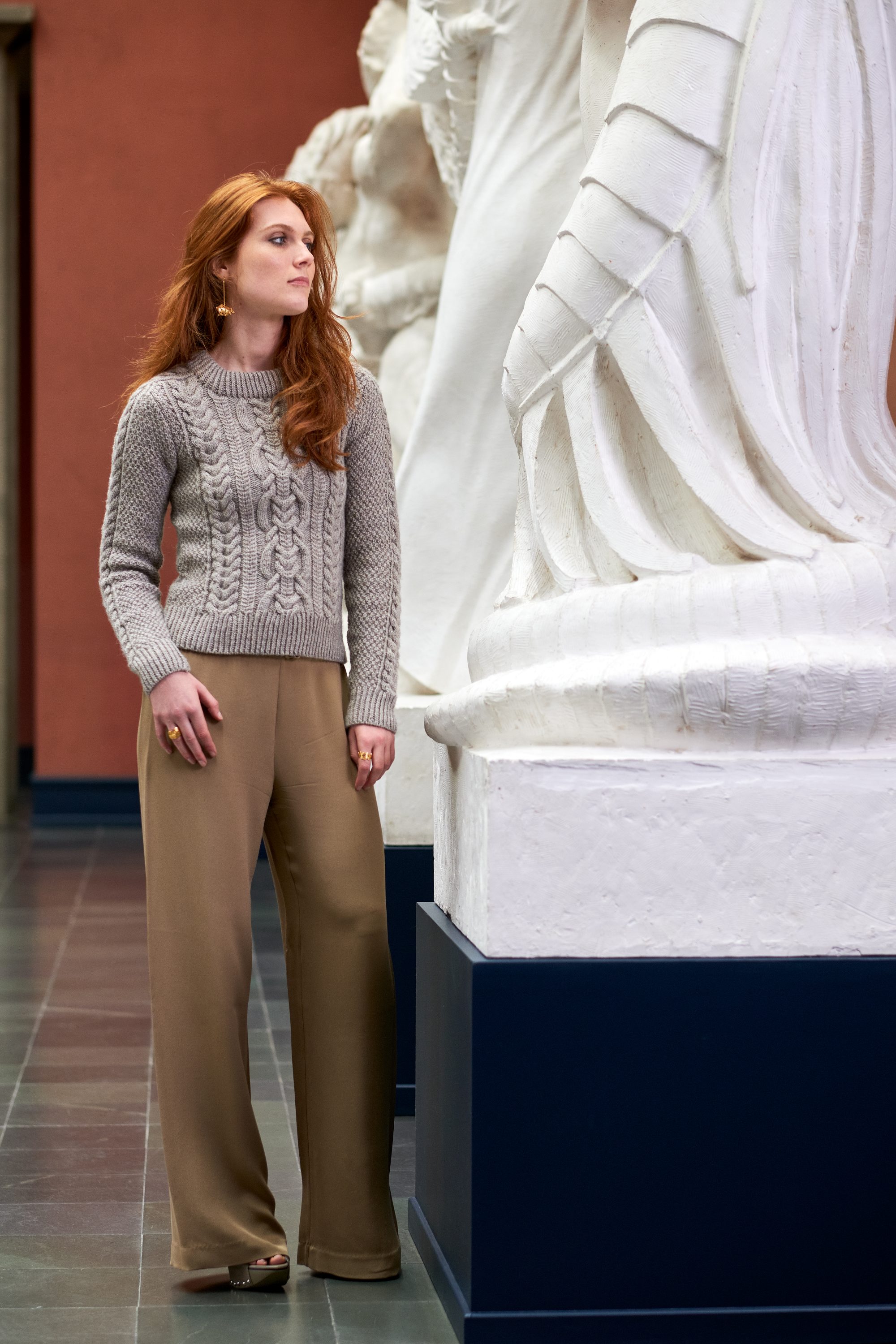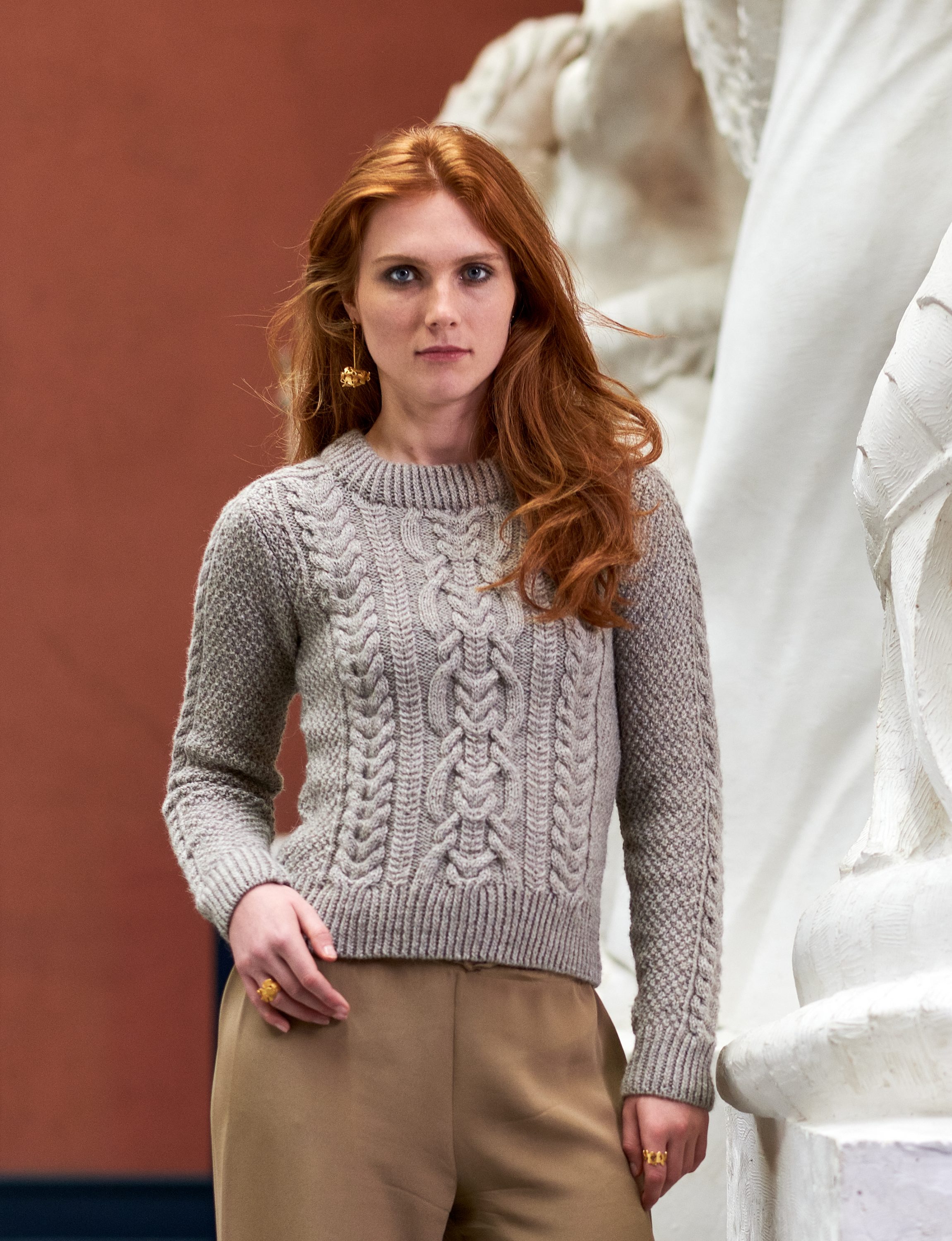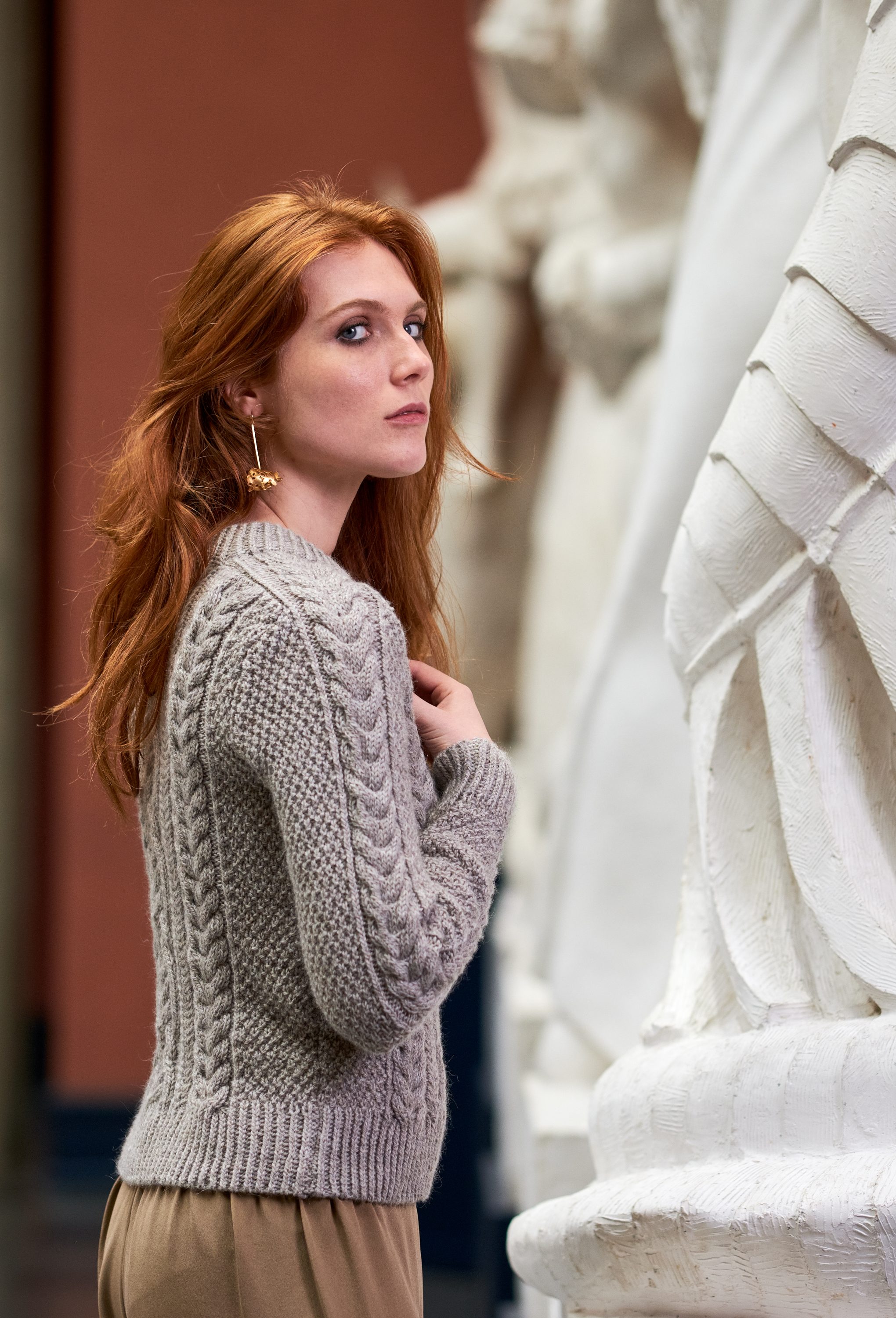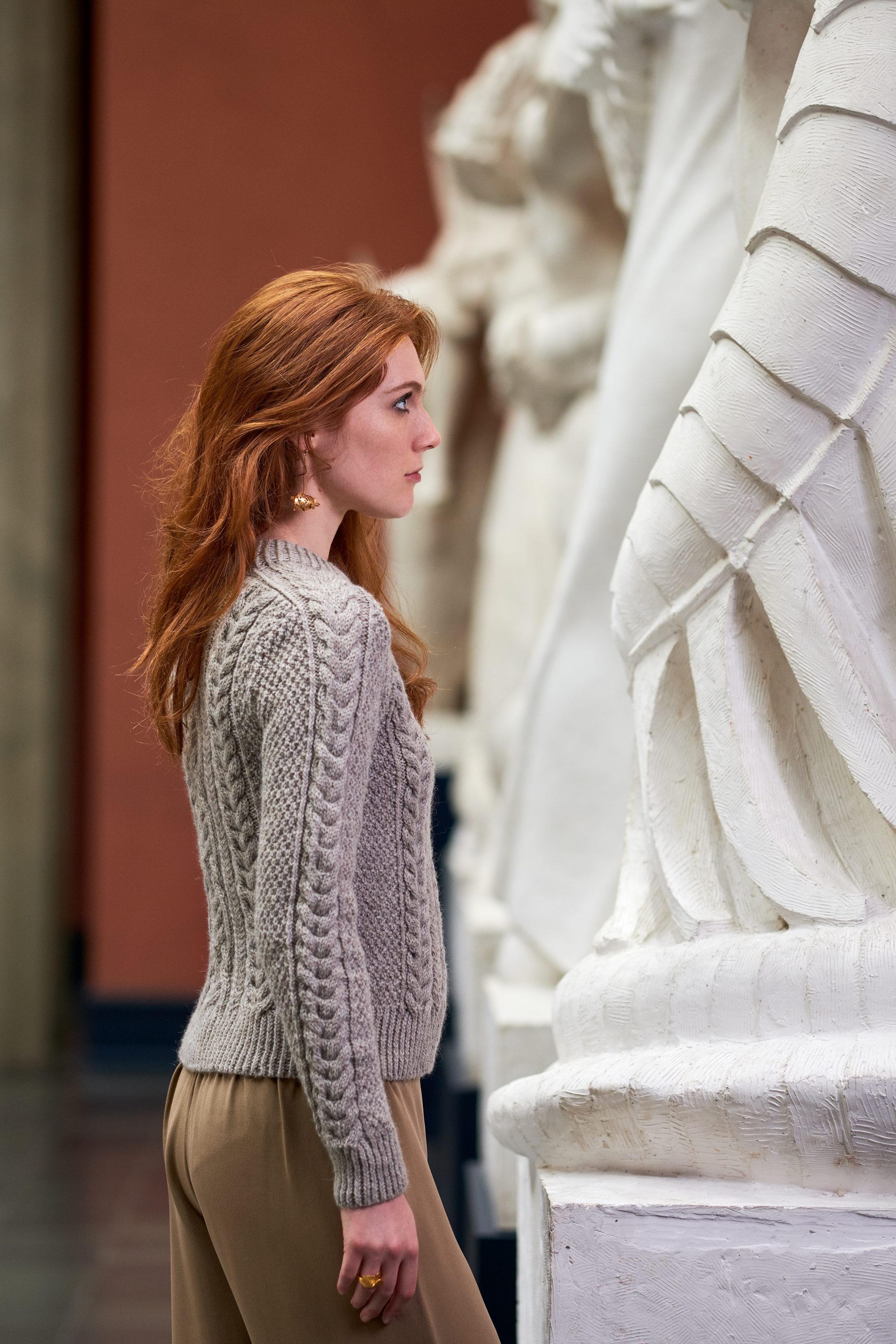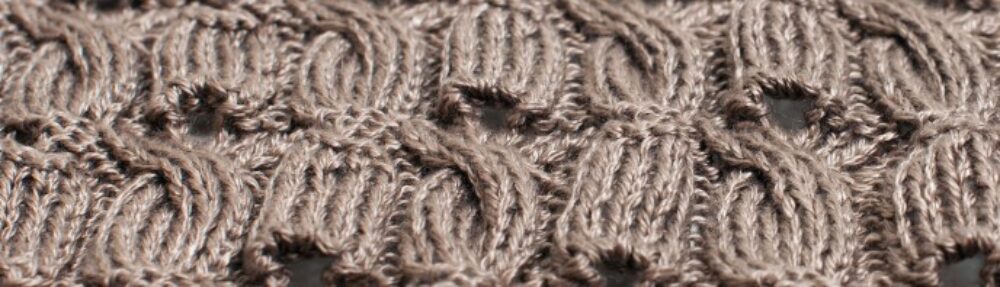
Ataraxia Buttons by Siri Berrefjord

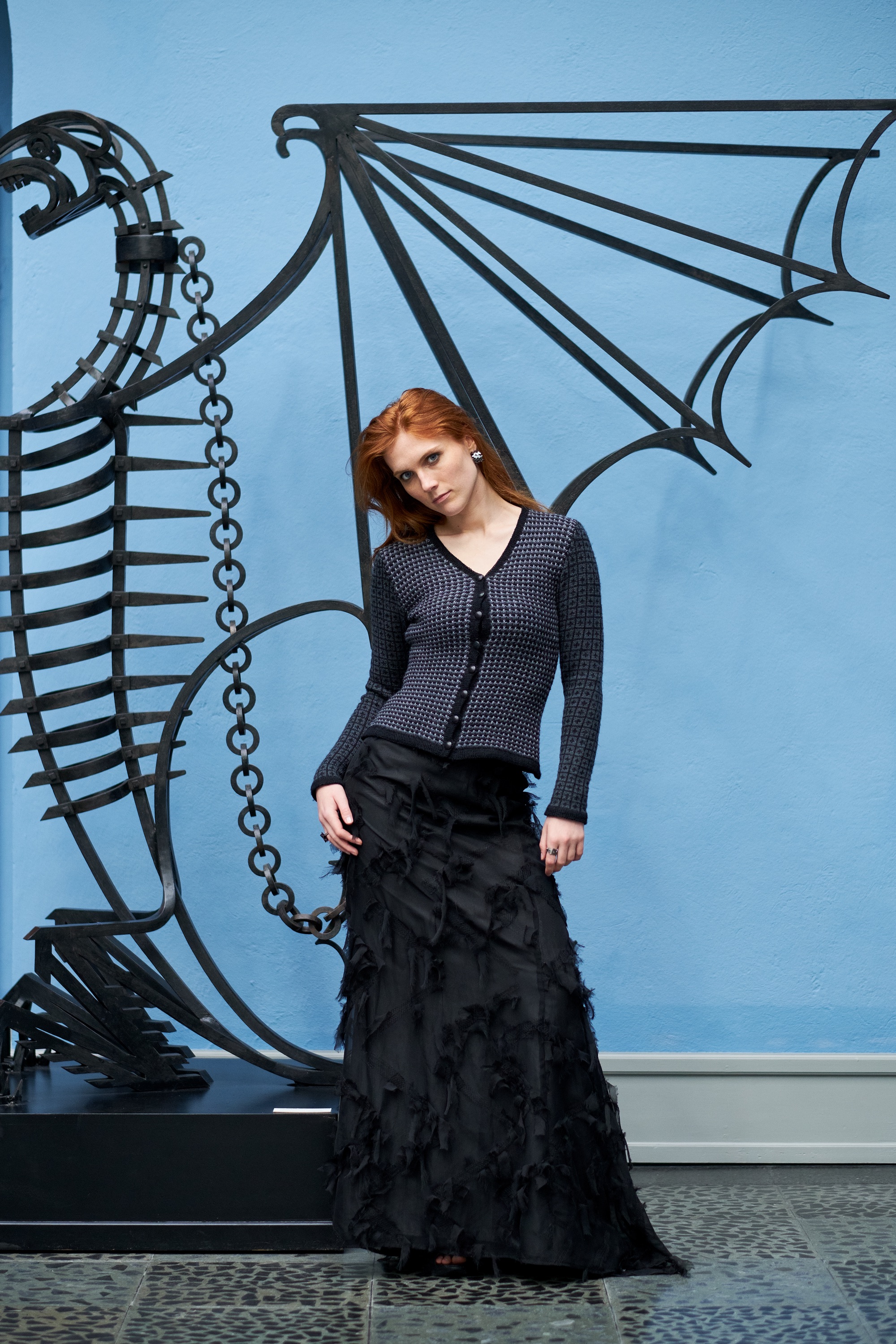
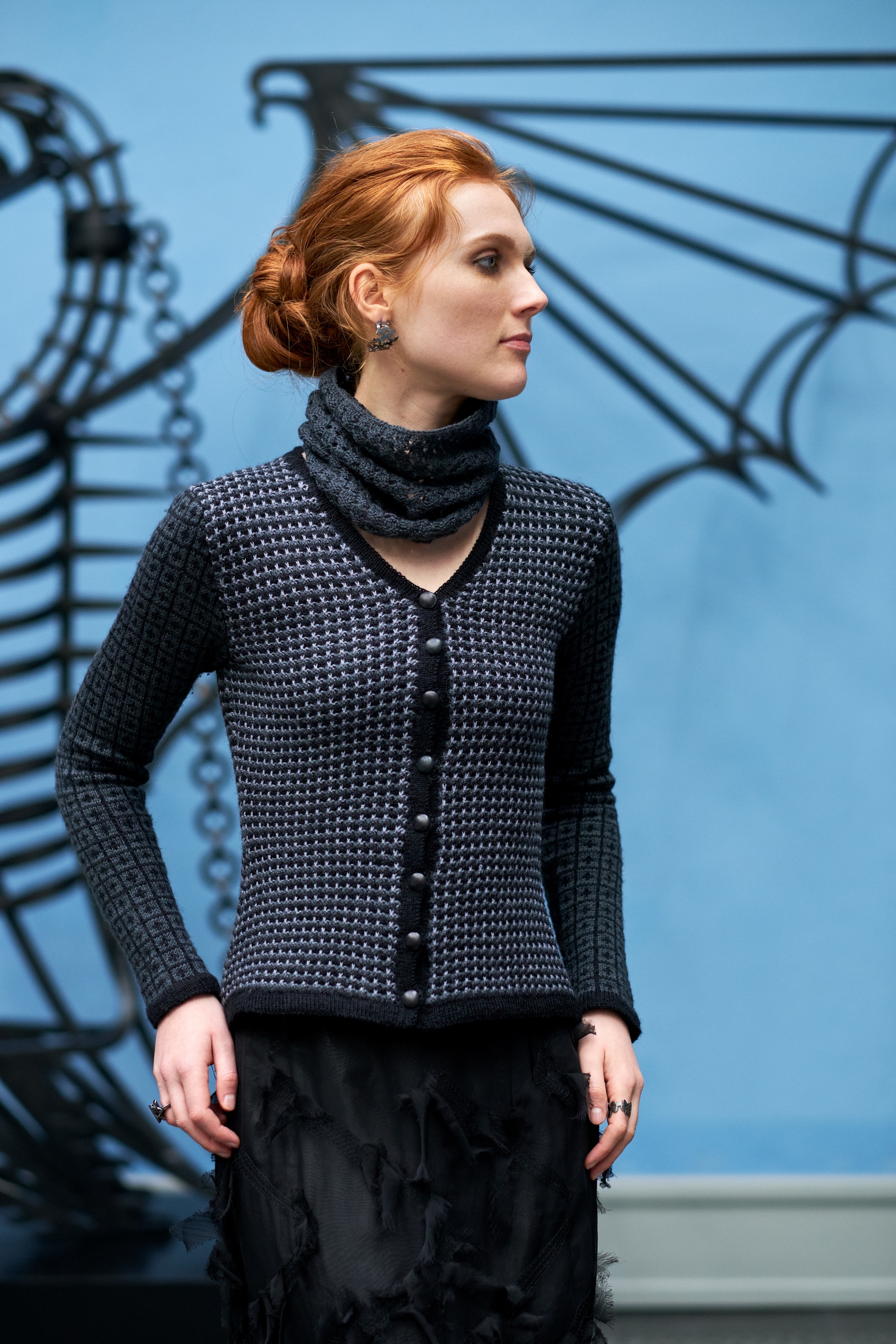
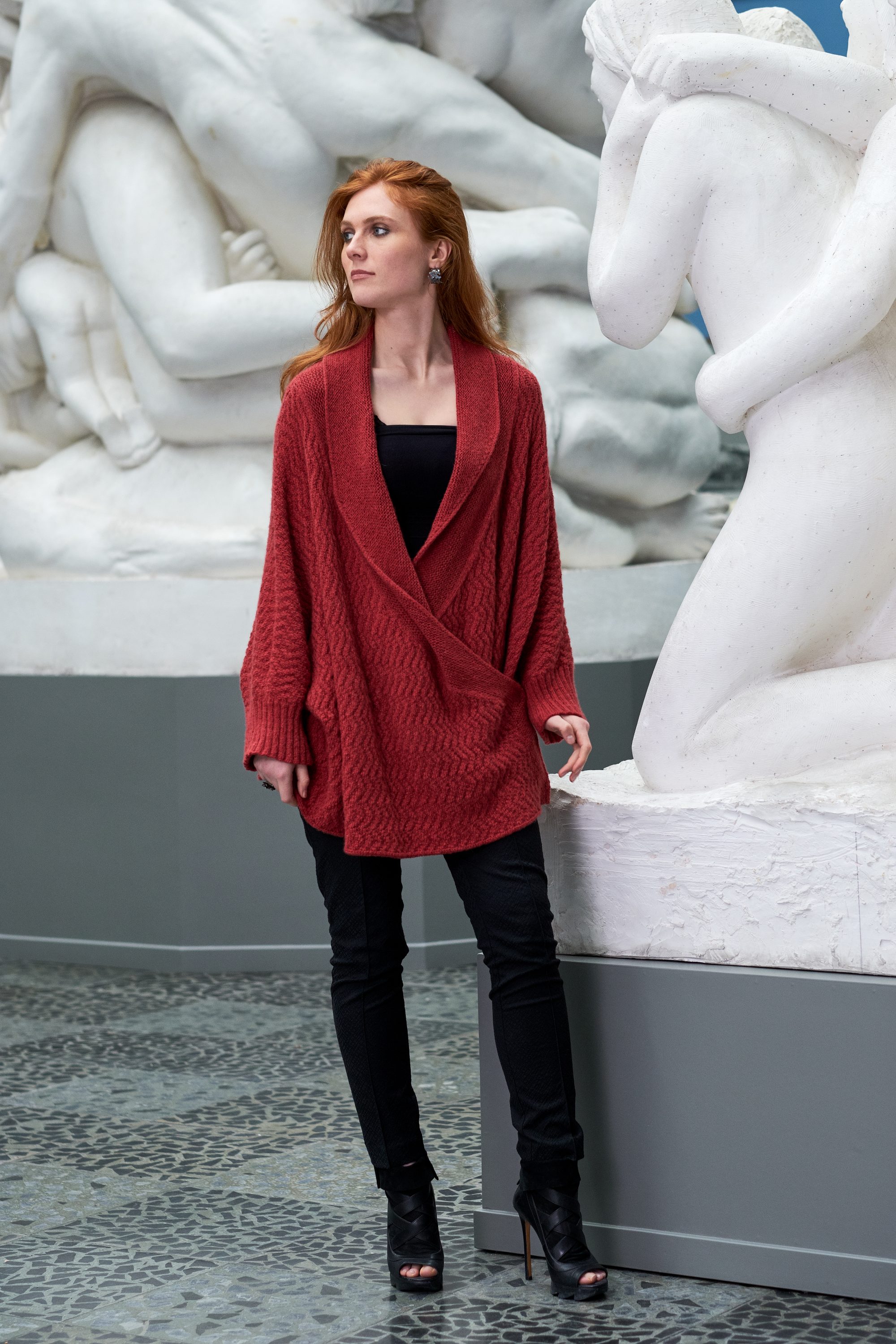
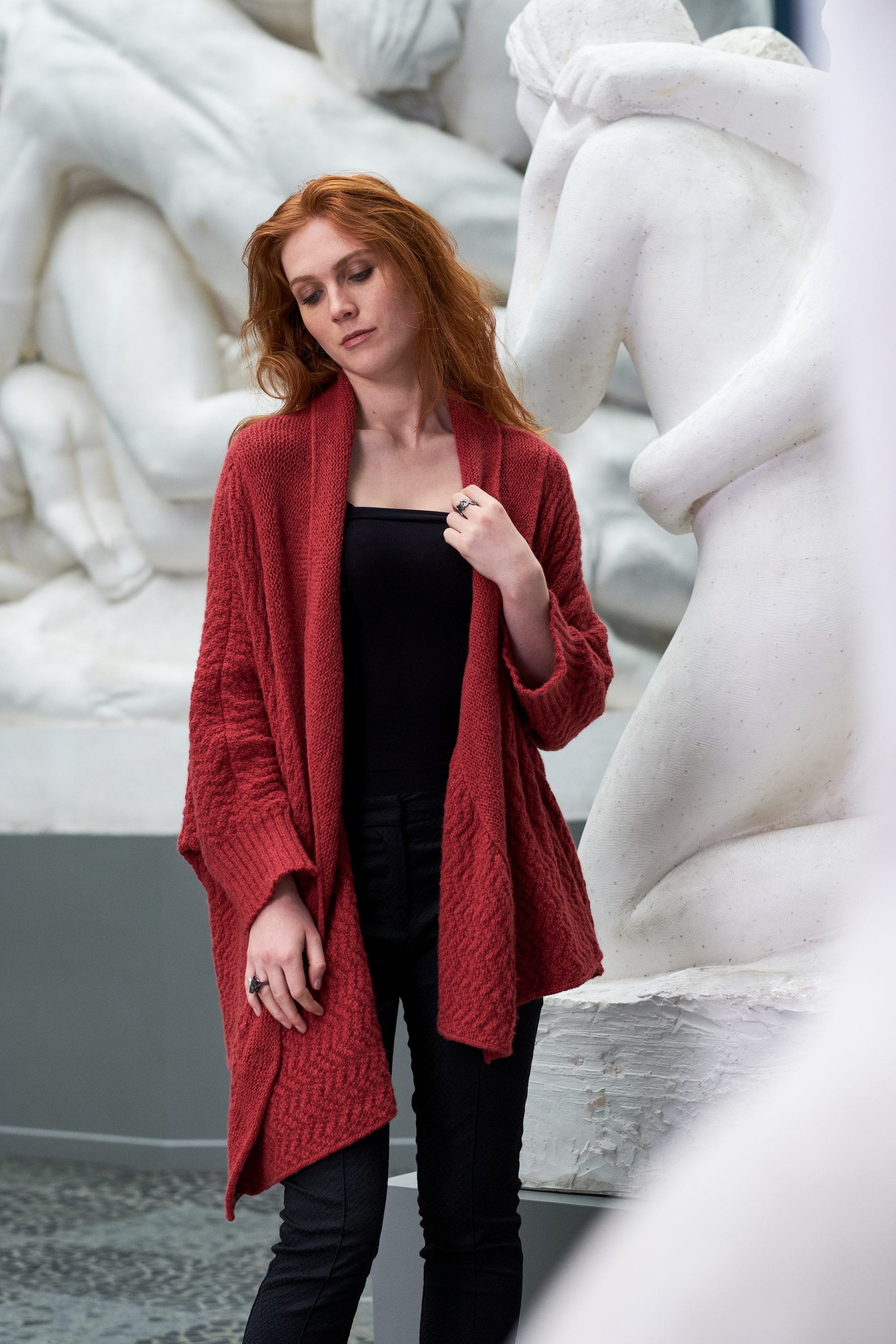
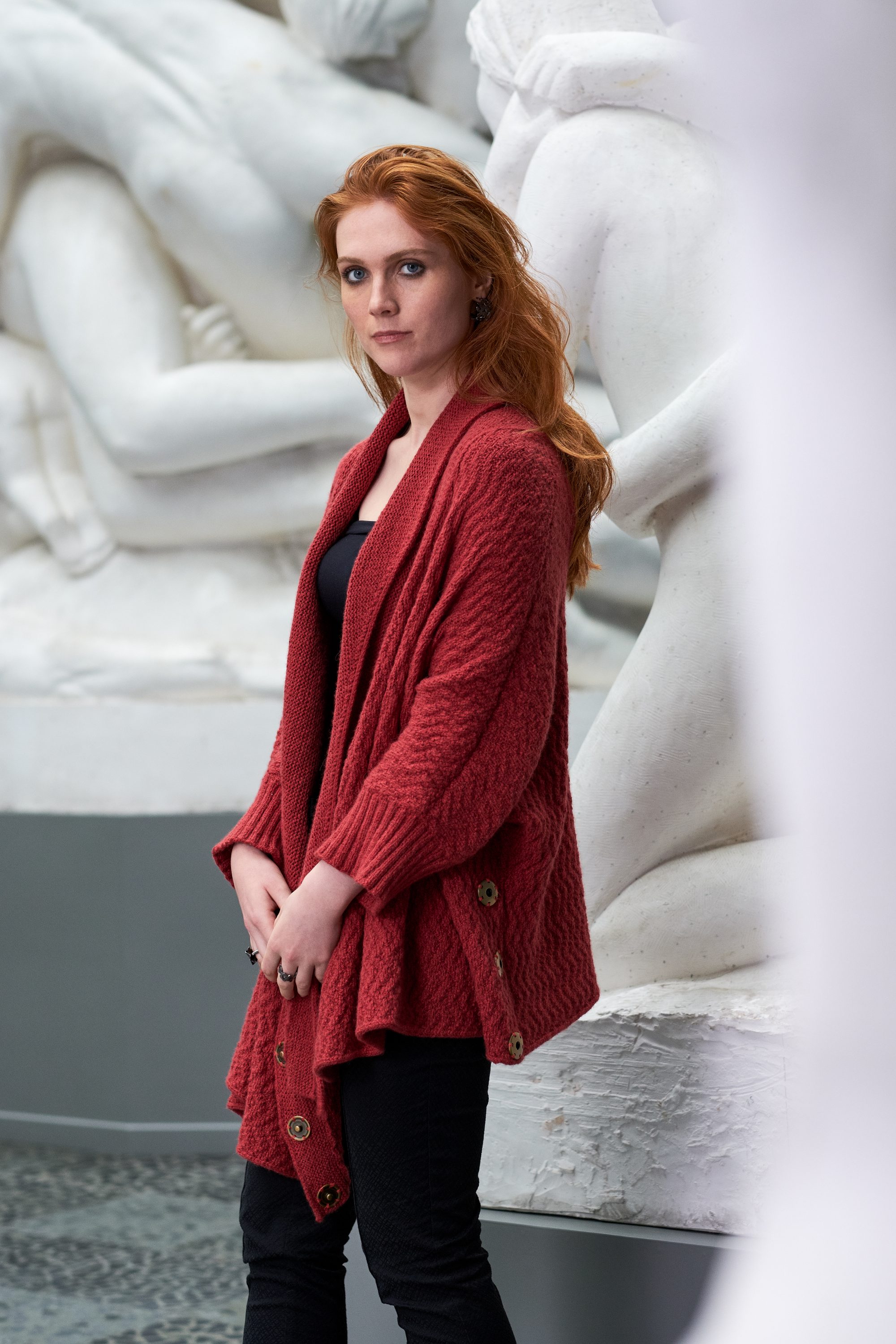
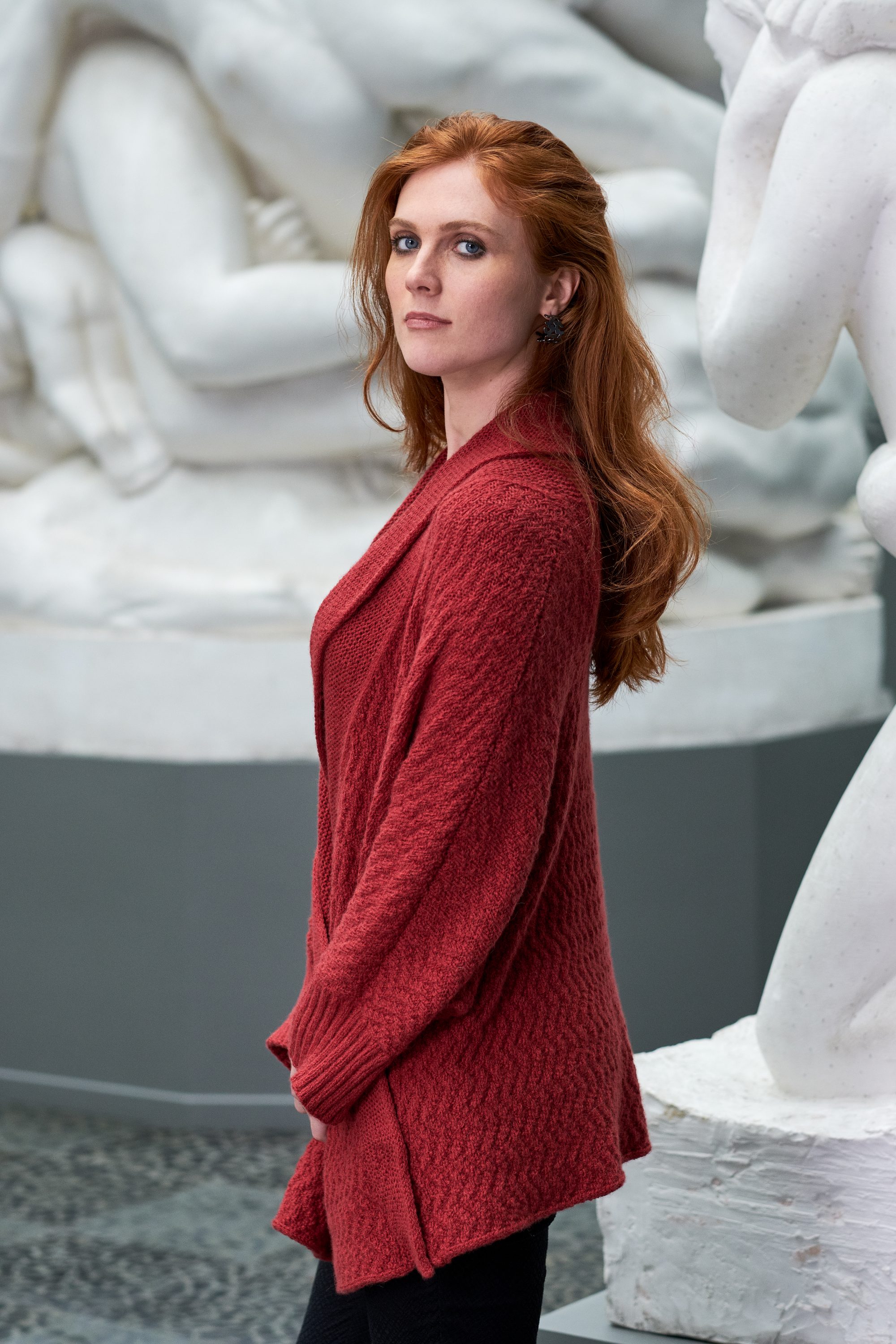
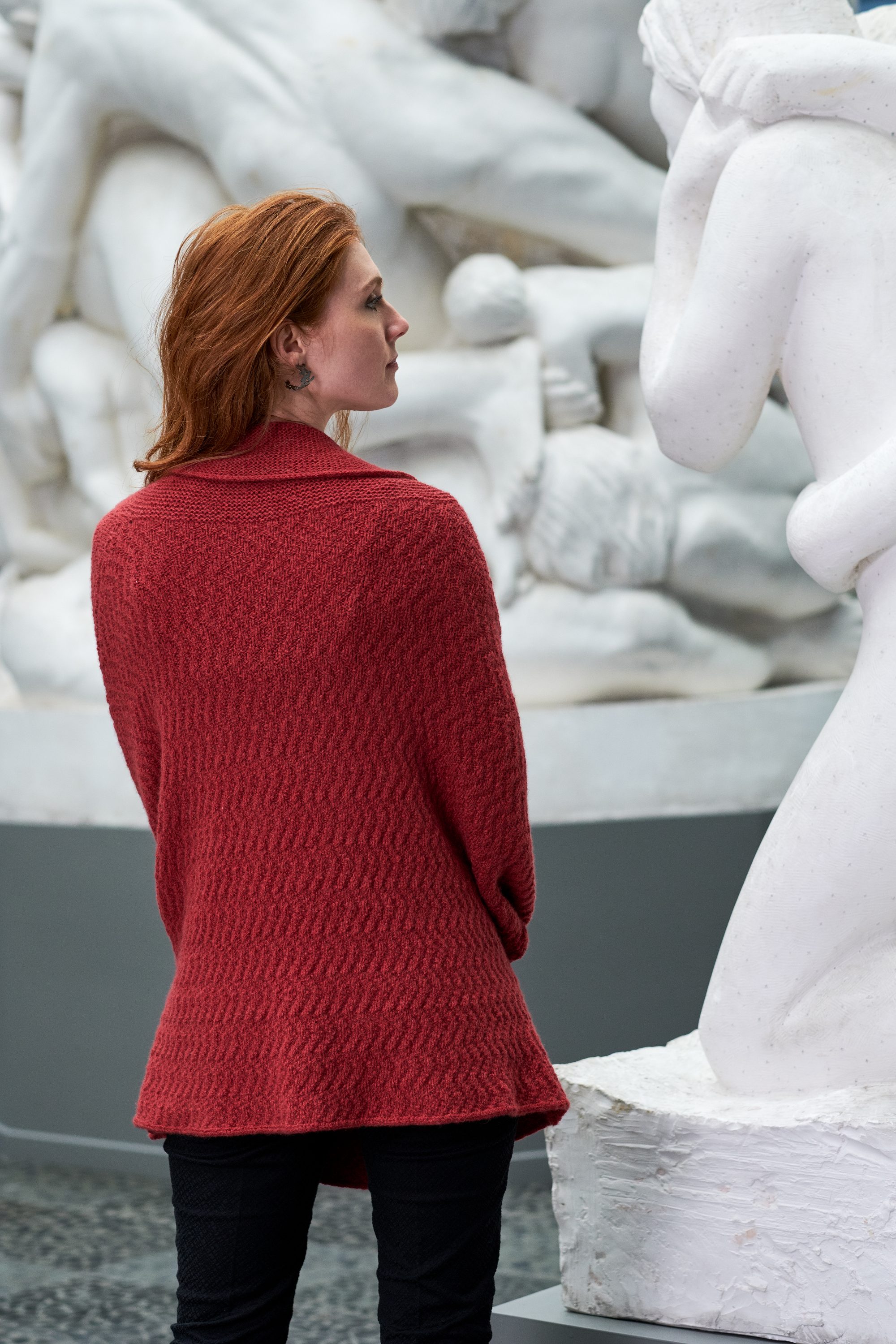
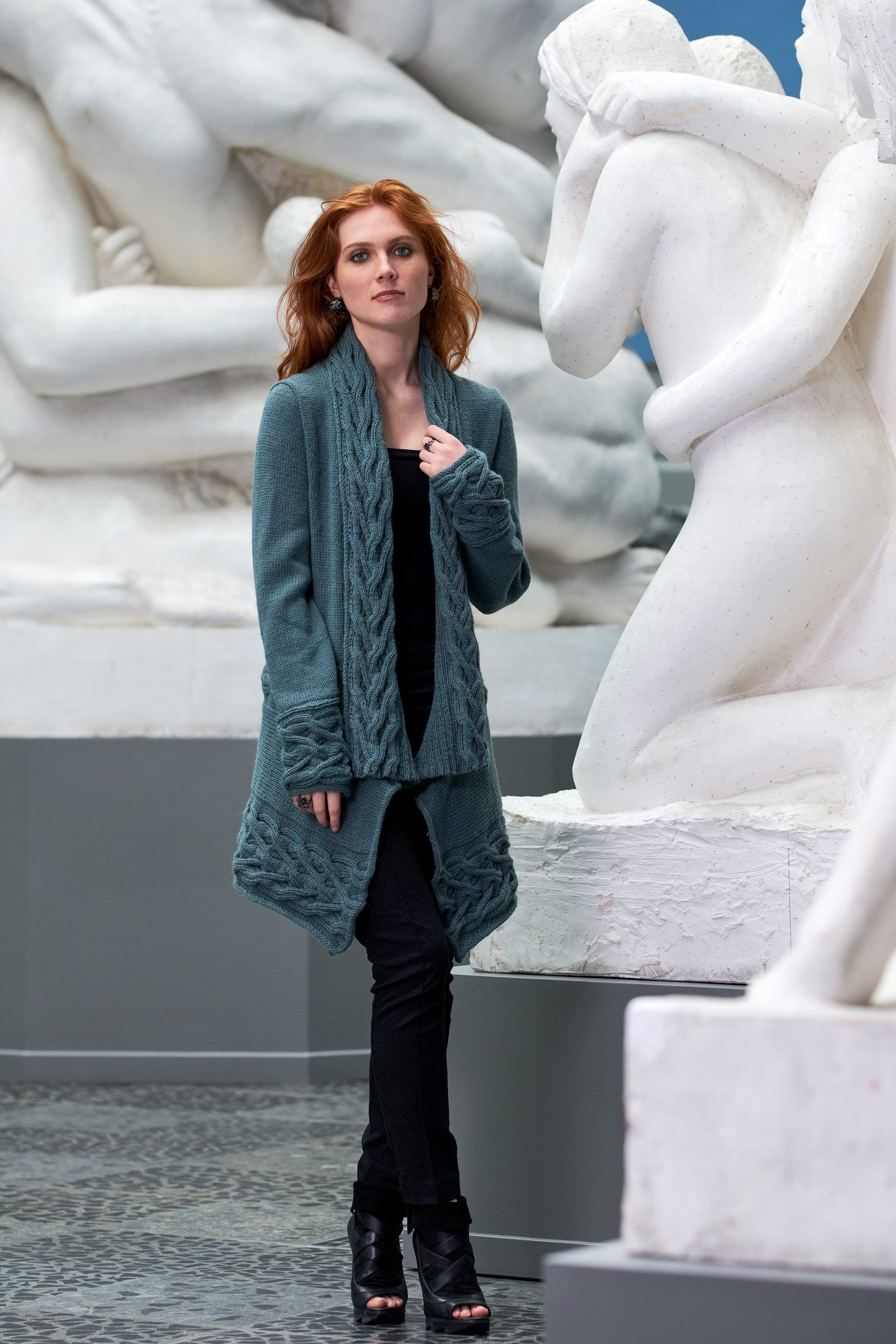
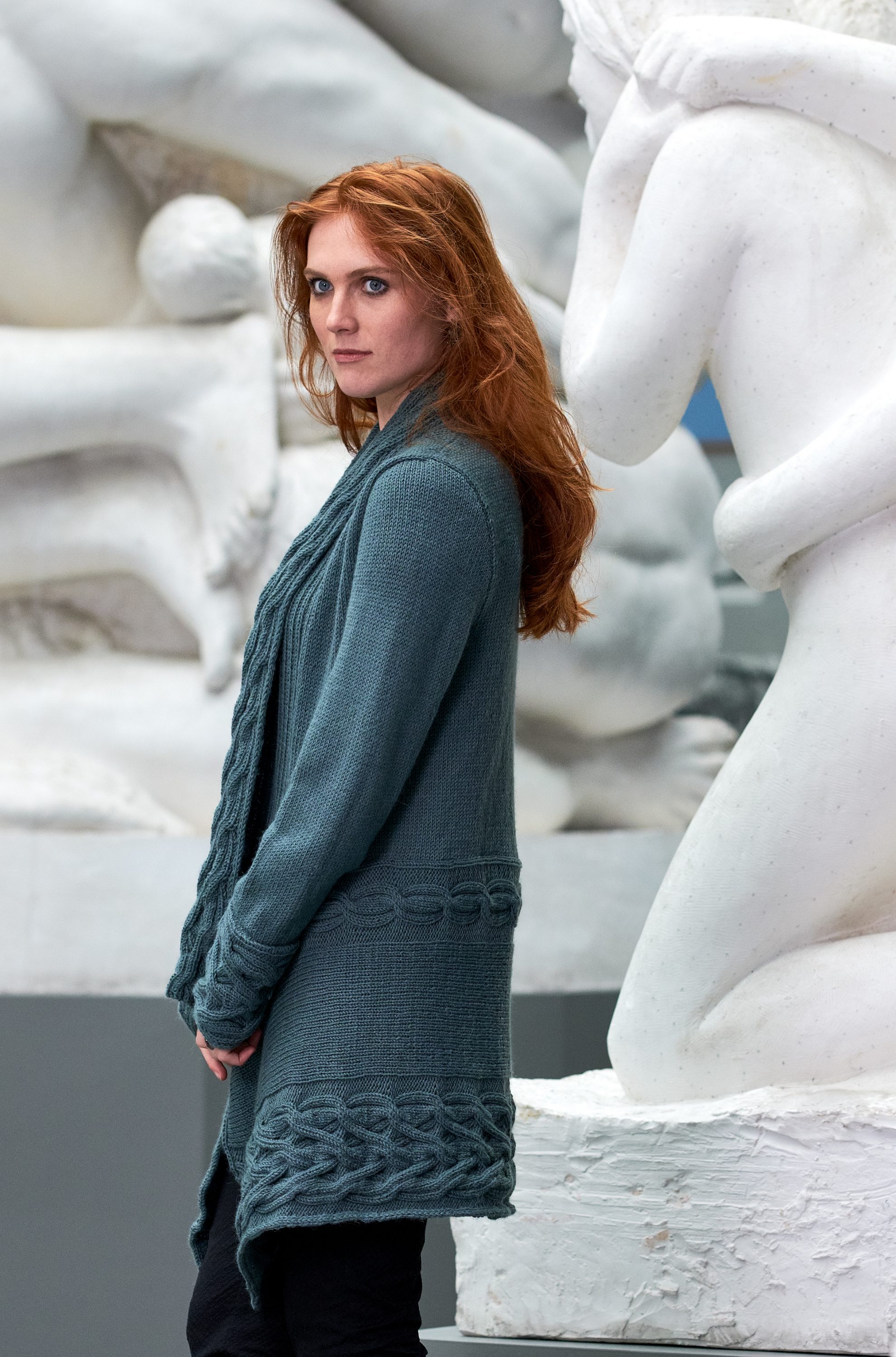
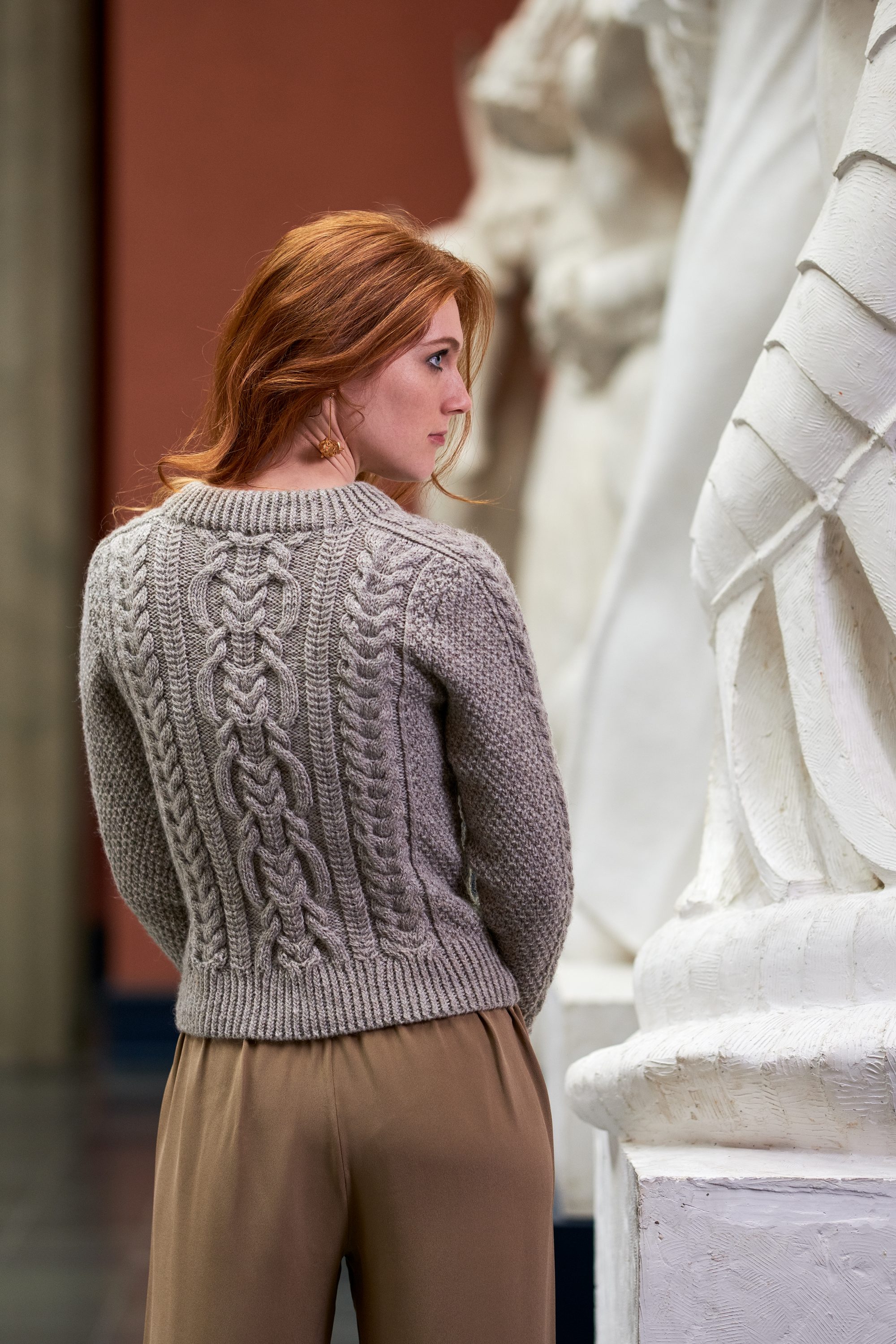
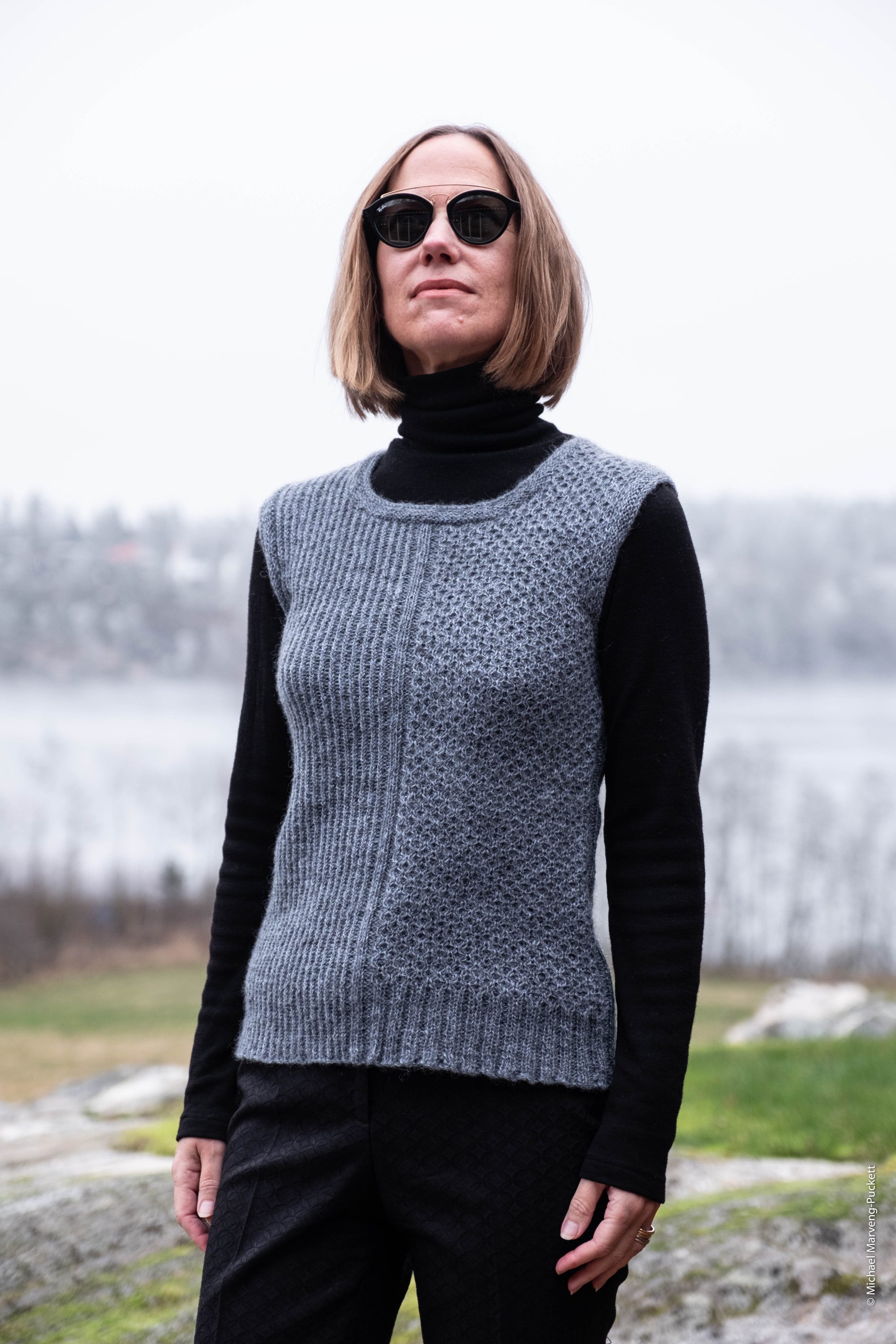
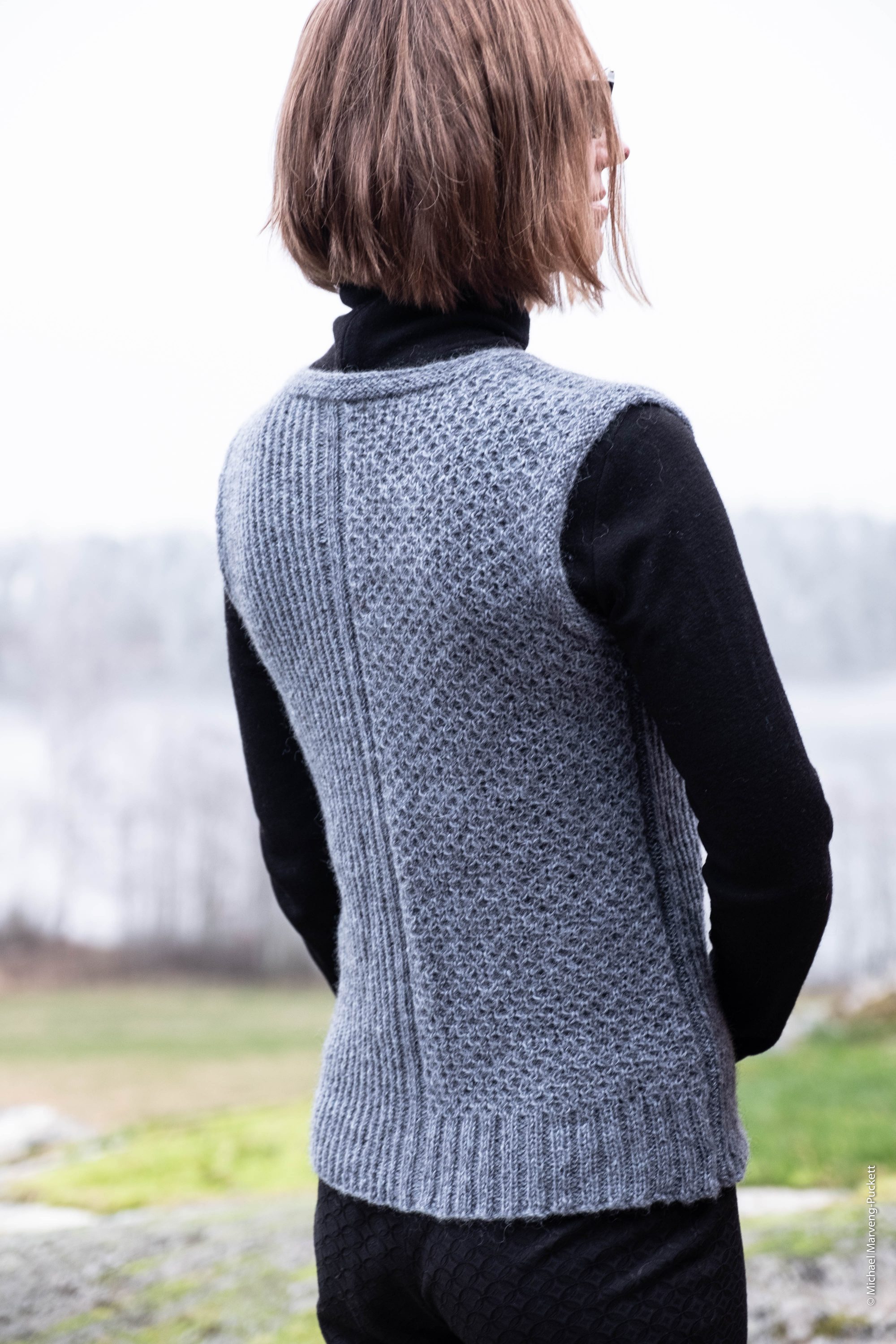
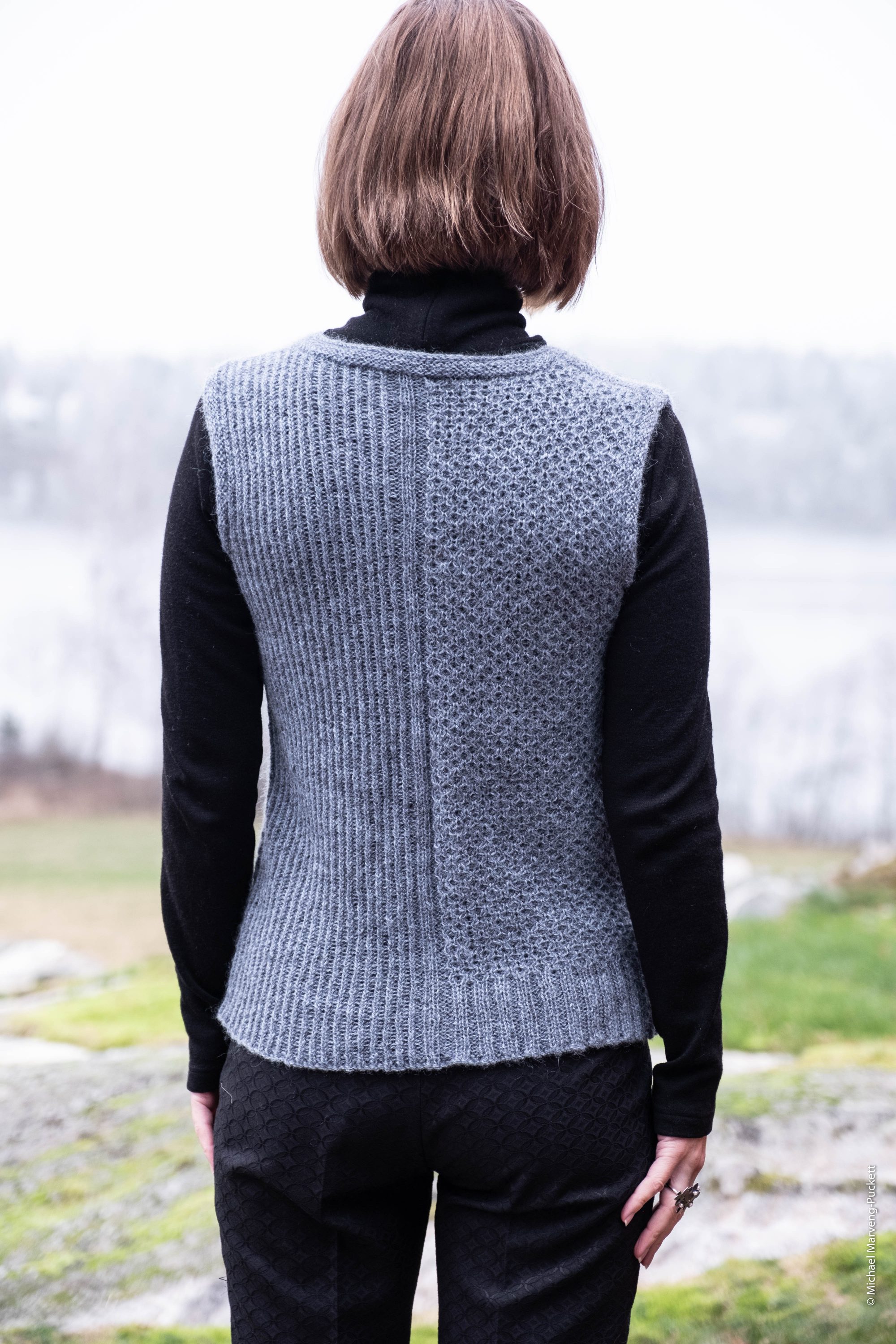
Christmas is coming very soon and we have a blanket of snow covering the ground here in Ørje, so I thought showing you some bright summery colours would be good. The orange swatch (read: knitting speak for tiny sample) knitted in the gorgeous SweetGeorgia Yarns Mohair Silk DK in Pumpkin using 3.5 mm/US 4 needles and 4 mm/US 6 needles, shows off the different stitch patterns on my Ataraxia swatch as well as Siri Berrefjord’s handmade buttons. Yes, Siri is also a trained photographer in addition to being a jewellery maker and a designer, especially of redesign clothes. I sent this swatch to Siri and ordered 9 bespoke small buttons with a diameter of 18 millimeters/0.7″ to match the colour by the beginning of July. Of course, Siri took a number of stunning photos you see here too! Ataraxia was a commission for a the Pom Pom Quarterly 27 Winter 2018 issue with guest editor Norah Gaughan. I made a jacket for the modern warrior women, since the brief stated that “Our muse is a modern woman warrior with a feminine edge. Mix sweet with strong. The Victorian era is the seed of inspiration, but anachronism is welcome”.

 The button design is based on the silver brooches used for the traditional folk costume, called “bunad” in Norwegian. Each button is moulded in plastic then painted with several layers. Siri suggested to use orange at the top, then a lighter colour below and with gold with a bit of brown at the base. As always she was spot on. The luxurious SweetGeorgia Yarns Mohair Silk DK is made of  90% superwash Merino, 5% Superkid Mohair, 5% silk with 200 meters/218 yards per 100 gram with a fantastic stitch definition and lustre to it.

As always I am impressed by the composition of the photos, making sure the background matches or contrasts the object in the photograph. Working with Siri, is such a fun and successful collaboration. Take a look at these previous designs, if you need any more proof: Helka, Gyda, Icelandic Jacket and Ena.

My sample was not included of the magazine simply because the wonderful orange colour did not fit in with the other designs and a second sample had to be knitted up quickly in time for the photoshoot. The second sample for Pom Pom Quarterly 27 Winter 2018 is knitted in The Copper Corgi Fiber Studio, Jones Street Worsted – available at Etsy – made of 60% Merino wool, 30% Alpaca, 10% silk with 192 meters/210 yards per 113 gram skein in the shade Goldenrod. While you can see the  photos of me wearing the orange sample here: Ataraxia Again. I so enjoyed seeing the two different versions of my Ataraxia. Do not miss this amazing issue of Pom Pom Quarterly.

You will find a selection of Siri’s buttons available in her shop on Epla here: Siris Skattkammer and more divine photos on her website: Fredenshavn.

I will end with Felicia Lo’s ending words from the SweetGeorgia Yarns Podcast: Enjoy colour!

Share

New Design: Corra

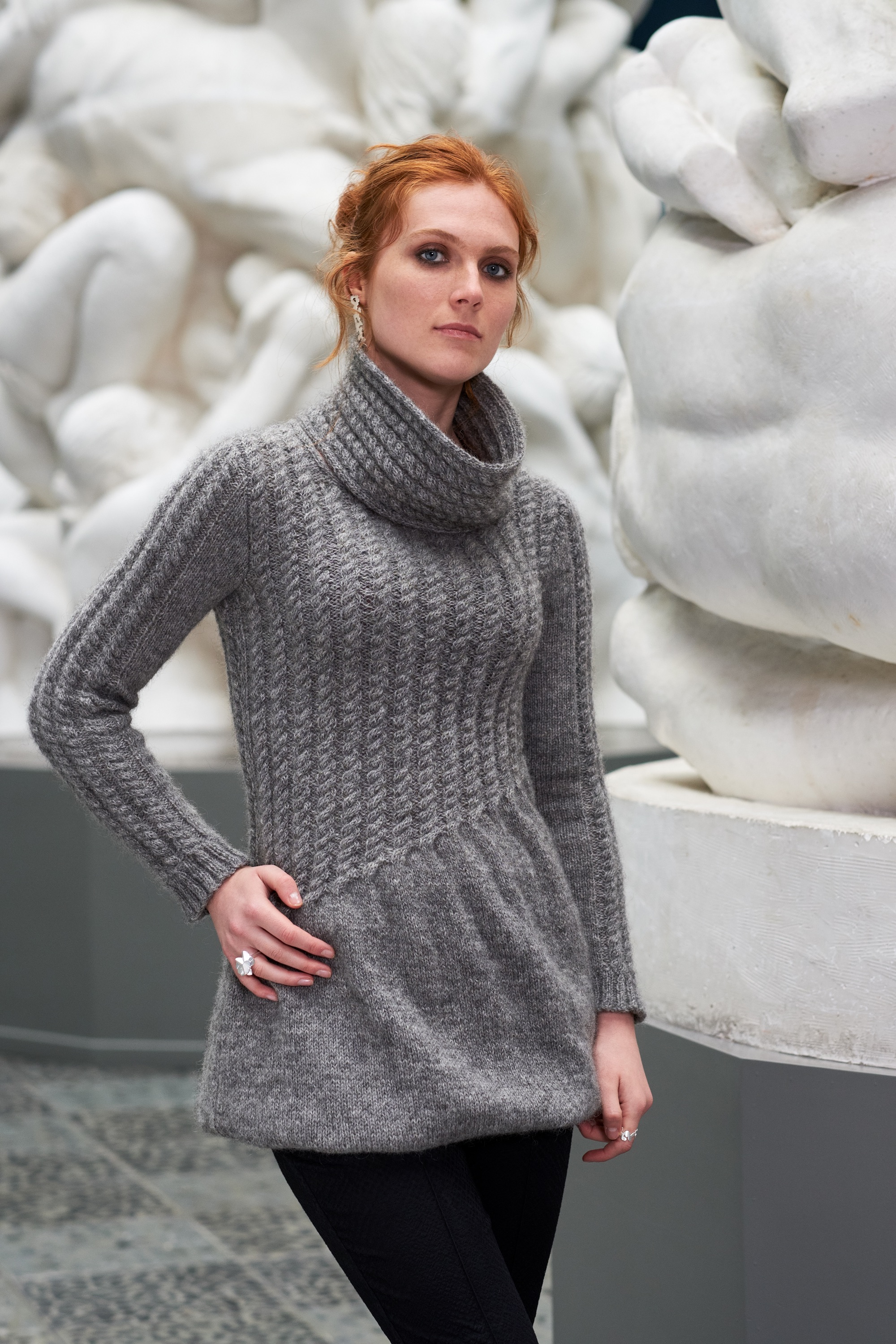
I am thrilled to show you another new design, I have made for Hillesvåg Ullvarefabrikk. This is the second of four new designs for them in the Spring 2019 collection, which will be launched in Norwegian at Fagstrikk/Trade Knits trade fair in April, while the English pattern will be test knitted beginning on the 18th March before its release. Corra is knitted in their divine Tinde pelt wool yarn in the blue turquoise colour 2129 – that Siret used for her Sirona – by my expert sample knitter Kristin Nygård, aka Quiltefeen on Ravelry and Instagram. Here is my introduction to Corra: Named after the Prophecy Goddess is this elaborate cabled pullover with slightly fitted waist. Two large cable panels are divided by a small cable that ends in a Henley neck, framed with an I-cord. Unlike the body the sleeves only have two small cables surrounded by stockinette stitch, so all the focus is on the body. Corra is knitted in pieces and seamed.

The stunning cable pattern is made by Polish designer Dorota Kowalczyk, aka Devorgilla on Ravelry. She also made the cable I used for the popular Prescott Pullover, and has a cable collection that is astonishing. The cable I chose was to wide to have on the sleeves so I chose a small back and front cable instead. I find the Henley neck flattering and decided I wanted a small cable in between the two pattern repeats on body. So that it could end in the v-neck at the front.

I am wearing size Small and photographed on our front terrace by Michael. The pattern is graded from size XS to 2XL with a bust circumference of 86 to 126 cm/33.75 to 49.5″. In the photo above, I was indicating to Michael how much to include in the photo. He did miss a small bit at either end. But never mind. The pullover is worked back and forth in separate pieces and seamed. The front has 2 pattern repeats before the v-neck part of the Henley neck begins, then 2,5 when the round neck begins, while the back has 3 pattern repeats.

Corra is knitted using 3.5 mm/US 4 with a 21 stitches and 30 rows in stockinette stitch gauge. You will find more details on my project page on Ravelry. I have two more designs for Hillesvåg to show you.

Share

Visit at Hillesvåg Ullvarefabrikk

Yes, I have finally been to visit Hillesvåg Ullvarefabrikk at Hjelmås, outside of Bergen. Just to clarify, it is not that I have not been invited before, but because it is far from where I live, on the west coast of Norway. My collaboration with Hillesvåg goes back to 2012, when they sponsored yarn for my Norwegian book and to the sixth collection of designs I am currently working on, which they make yarn kits for. At the end of November I flew from Oslo to Bergen to hold a presentation at The Norwegian Knitting Industry Museum and used the opportunity to visit Hillesvåg Ullvarefabrikk. I traveled by ferry from Bergen to Knarvik Kai/Quay where CEO Øyvind Myhr met me and drove to the near by factory on the north side of the Osterfjorden. The entrance trough the shop is to the right of this picture. Hillesvåg is a family business from 1898, now run by the 4th generation and one of the few factories left in Norway that produces yarn from Norwegian wool.

Hillesvåg is an Économusée, that uses traditional craft techniques and uses old machinery to make their yarn and tops. Watch this video that introduces the factory and you will see that their oldest working machine is from 1835. They do have some spare parts to these machines, but if they do not, they have to make it from scratch. See this newspaper article from the Norwegian newspaper Aftenposten.

The ferry only took 20 minutes to Knarvik and it was less than 10 minutes to drive the last part. The view towards the fjord is equally enticing. I had worked intensely to be able to bring the 4 new designs for the sixth collection to them, instead of sending them. So revealing the new designs and seeing how they looked on me was first on the agenda, after I had met Øyvind’s wife Anette Toft, who deals with customer & designer relations, and in-house designer Berit Løkken. It was fun for me to see their reaction, so I thoroughly enjoyed this delivery in person.

Next on the agenda was Øyvind taking me on a tour of the factory. We started downstairs in the basement. Here is Øyvind standing next to washed white Norwegian wool. The washing is done in the UK, and it comes back in large bags and expands whey they are opened.

The pelsull/pelt wool is a lot greyer but also silkier in its apperance than the white wool.  Øyvind is very happy that they did start producing the pelt wool yarn in the spring of 2012. It comes from the Pelt Sheep which is a mixed breed of the Old Norwegian Short Tail Landrace the Blue/Grey kind and the Gotland sheep. Pelt wool is of medium staple and it is a woolen yarn with no distinctive creep, but it does have a good lock. These days, they make 3 thicknesses. Above you see him holding onto the pelt wool fleece which is naturally light grey and gives the dyed colours a weathered look on a dark fibre base.

The yarn has a mohair, silky feel with a halo, lustre and bounce. Despite its halo, it has a great stitch definition and depth to it. The pelt yarn also blooms and softens when you block it. These days, they make 3 thicknesses; the DK weight first named Norsk Pelsull/Norwegian Pelt Wool – now called Tinde – the thicker Bulky weight called Blåne and the newer 4 ply/Fingering weight called Sølje launched in May 2016.

We walked from the basement, where the fleece is kept; air is blown into it and it is dyed up to the next floor. Here is a close up photo of one of the old machine from 1890, that is used for carding for felting.

It was utterly fascinating to see all these old machines still in use. They made less noise than you would anticipate.

The spinning process was my favorite to watch. I was so impressed that this worker could spot where the yarn needed splicing and doing it with such speed and ease.

Øyvind’s brother Arild is in charge of developing the colours and the dying. He is also the one that has to fix the machines when the stop. They use two different methods that both give the same result. Here is a close up of the one where the hanks are slowly turned around to ensure even colouring, while the other method keep the hanks static but raises the water platform.

After the hanks have been dyed, they are dried over night, maximum 12 hours to avoid the yarn drying out, upstairs at the loft, the so-called drying loft. Here are skeins of Tinde and Ask.

Here are hanks ready for labelling and their final twist or before they are made into cones.

The machine that transfer the hanks onto cones. I was lucky to meet a number of the 20 employees at the factory and saw them doing their job. The order department was busy working on filling Ysolda’s order (to Scotland) – box number 8 – and a large order to Trollenwolweb (to the Netherlands), as well as numerous other orders both to stores and direct to customers.

After Øyvind had shown me around, I wanted him and Anette to help me make a video of me knitting for the Fruity Knitting Podcast. We talked through where we should record it and choose their beautiful Sense Room, where they hold their knitting café, in the end. Anette was in charge of recording, while Øyvind gave me a signal when there was 10 seconds left so that I could look up and smile. But just like knitters in my workshops do make mistakes just because I am looking at them, so did I when I was filmed. I had to redo those rows on my swatch. Anette also made a second video using her mobile, close up of my fingers, as requested by Andrea, presenter of the Fruity Knitting Podcast. You can see the footage in the Podcast here.

Then we had lunch, Øyvind, Anette, Berit and I, in their conference room and not in their canteen which has a view of the fjord. I told them what I have been working on and so did they. I was also asked if I wanted to make another collection for them and I was delighted to accept. Hence after lunch I wanted to have a closer look at their shop, choose some hanks that had to come home with me for swatching for the seventh collection. I also had a second walk about before my return to Bergen. Above is the entrance to the factory, straight into the shop, with the pelt wool displayed: Sølje on the right, then Blåne and Tinde to the left. This is just a small corner of the shop, that had all their other yarns, yarn kits, knitwear, books, knitting notions, and gifts. Then it was time for me to leave to go back to Bergen, pick up my suitcase and head to the airport. Øyvind took me to the bus stop, since the ferry only runs at rush hour, and gave me instructions where to change buses to make sure I came back into the city center. I made it and also managed to get to the airport in time. I had an amazing day at Hillesvåg Ullvarefabrikk, thank you Øyvind, Anette, Berit and to everyone I met! If you do have the chance and are visiting Bergen, do not miss it!

Share

Fruity Knitting Podcast Episode 67

I listen to and watch a number of podcast when I knit, especially close to a deadline when I tend to set aside hours of knitting to finish off the design. Fruity Knitting is one of my favourite shows, due to their in-depth interviews always with pictures and videos, hence I was so chuffed when I received a message on Ravelry from Andrea asking if I would be on the show. I certainly would, and had only a vague idea of the amount of preparation I had to do as well as technical set-up I had to overcome. However, I did leave the technical side of it to Michael, who filmed our first session on Skype, when we went through the answers I had prepared to Andrea’s questions. Our internet connection is not the best here in Ørje, so we had to do a second brief technical trial, this time from Michael’s office upstairs, instead of my studio downstairs. In the end, the final Skype session was done in our living room (in front of the fire place) with an extra cable to our router, with newly bought second-hand tailor busts in the background. Michael filmed this session too and sent the files from our very slow uploading internet connection to Andrea, so they would have the footage as a backup to the Skype recording. Andrea, the pro in all this, was ever so calm and asked a number of part questions each time I came to a halt – panicking if I had remembered to say all I had planned and desperately trying to appear calm. Andrea did a brilliant editing job, hence I appear a lot more cohesive than I thought I sounded.

Andrea suggested I make a short tutorial video of my slip stitch crochet seam and that was another job for Michael. She also wanted two videos of me knitting, and we did try to record one outside at the beach in Ørje on a sunny but cold day. But the footage was too dark and my hands looked nearly blue, so that did not work at all. Luckily, I was going to Bergen, on the west coast, to visit Hillesvåg Ullvarefabrikk as well as holding a presentation, so I sent them an e-mail to ask if they could help take a the videos of me knitting.

They obliged and I could pick where I wanted to sit after Øyvind had showed me around at the factory (read: more in the next blogpost). We did talk about doing it among the old machinery but they were ever so noisy and the lighting was not the best, so we ended up where they have their knit nights with plenty of natural light. Anette filmed me and Øyvind signalled when I needed to look up. We did have fun making this footage! You cannot belive all the knitting mistakes I did in the stitch pattern on my swatch.

I sent over a number of photos relating to my answers and Andrea picked some of the ones I have on my blog as well. In addition I suggested a discount of 30% on all my individual patterns at Ravelry to her patrons, who support the podcast. I love the introduction Andrea gave me: “Linda Marveng’s designs are very distinctive and sophisticated. She uses dynamic silhouettes with lots of texture and very intricate and beautiful cables as well as a fair bit of lace. Linda lived and worked in London for a long time and that’s where she received most of her training in teaching knitting workshops and then later in designing knitwear. I think you can see this mix of British and Scandinavian design reflected in her work…” Continues on the Fruity Knitting Website.

Thank you so much for having me on your podcast, Fruity Knitting! I am overwhelmed with all the positive feedback I have received! Do watch the episode if you have not done so already, and enjoy following the podcast.

Share

Bergen – The Norwegian Knitting Industry Museum

I was so delighted when I was invited to give a presentation at Norsk Trikotasjemuseum/The Norwegian Knitting Industry Museum at their knit night on Tuesday 28th. November, since it took me to Bergen on the west coast and close to Hillesvåg Ullvarefabrikk, which I had the opportunity to visit for the first time. Bergen, the second largest city in Norway, is known as the Gateway to the Fjords of Norway and a UNESCO World Heritage City – yes, it is stunning! The Norwegian Knitting Industry Museum is located at Salhus, while Hillesvåg Ullvarefabrikk is at Hjelmås, both about 20 minutes outside of Bergen.  This first post is about Bergen and the Knitting Industry Museum, while the second one is about Hillesvåg Ullvarefabrikk – a Econo Musee – with their more than 100 year old machinery still in use.

Above are the views from my loft room at the Klosterhagen Hotel at Nordnes, in a lovely and quiet part of the city.

I arrived on a sunny day and Bergen is known for its heavy rain, so I had to take the opportunity to take the Fløibanen, the only funicular railway (read: incline railway) in Norway, that whisks visitors to the top of Fløyen, one of the seven mountains encircling Bergen, 320 meters above sea level. The ride is best described best by Matt Hickman: “Despite the relatively short 8-minute trip to the top, with three local stops on the way, this is one funicular ride many visitors wish would last forever. The views from the railway’s two panorama-windowed, glass-ceilinged cars, Rødhette (the red one) and Blåmann (the blue one), simply defy description. And once you reach the top, you may never want to come down”.

The view from the top of Mount Fløy late in the afternoon with the strong sunlight making dark shadows. This is just the view in one direction, it was impressive in the other directions too. There were a number of paths to go hiking and a large restaurant that is only open at weekends.

Bryggen, the old wharf, which you see in the background is the main attraction in Bergen. “In 1360, the German Hanseatic League set up one of its import and export offices at Bryggen, dominating trade for almost 400 years”. It is on the UNESCO World Heritage List. I went down to the new wharf to check out the ferries to Knarvik, which I took on Wednesday morning, when I went to Hillesvåg Ullvarefabrikk. Managing Director Øyvind Myhr met me at Knarvik harbour and drove me the last bit to the factory. There are a large number of ferries going from Bergen, so I had to make sure I knew where it departed from. Luckily it was a short walk from my hotel.

This is the late afternoon view from my room.

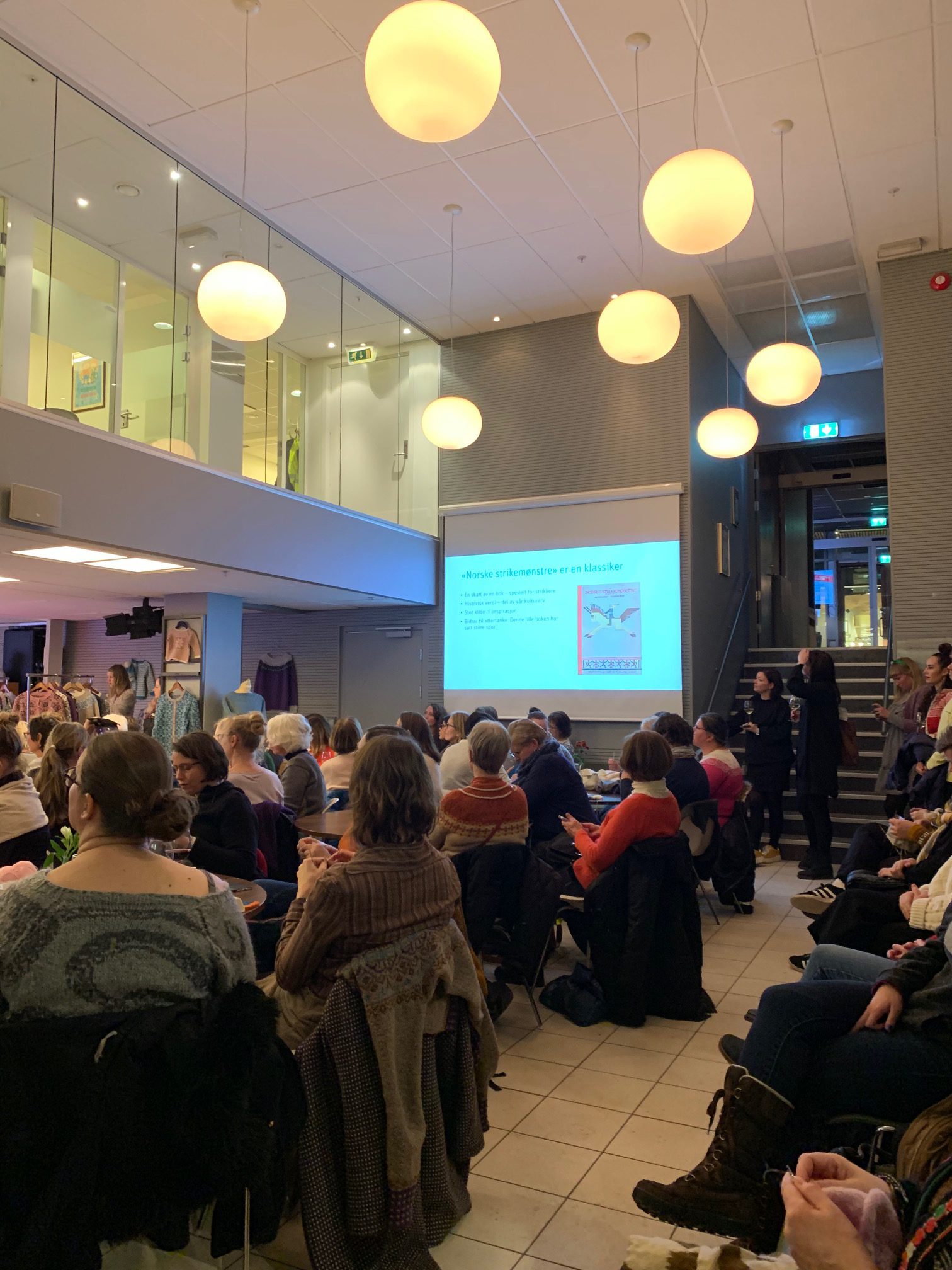
The Norwegian Knitting Industry Museum is located by the fjord, but there were no ferries going there, only a bus. I was fortunate enough to be able to take a taxi (read: the museum covered the cost) with my heavy suitcase filled with samples. Inside the old factory in a large open room with high ceilings and a view towards the fjord, is where I held my presentation. Unfortunately, I did not have time to join a tour of the museum, but you can see it on Kristy Glass Knits’ podcast here: YouTube.

 The museum is the former textile mill Salhus Tricotagefabrik (1859–1989), that mainly produced underwear. Today, they produce a small quantity of yarn and machine knitted garments for sale in their beautiful shop. This museum is also the venue for the Bergen Strikkefestival/Knitting Festival.

Yes, the shop was open during the knit night. Bring what you want to purchase to the coffee and cake till was the order of the evening. But most of the knitters attending seemed to be regulars and was at the museum frequently. I cannot blame them. It is such a lovely venue!

It was really the perfect gift shop with yarn, knitting magazines, books, knitted goods and some toys. As you can probably see from this photos it is a popular venue for photoshoots.

Present at my presentation was Berit who works at Hillesvåg and she had brought the samples from the factory in addition to yarn kits and brochures. I was very pleased to meet Berit again and I also spoke to a number of knitters present. I had a lovely evening. Thank you to The Norwegian Knitting Industry Museum!

Share

New Design: Aibell

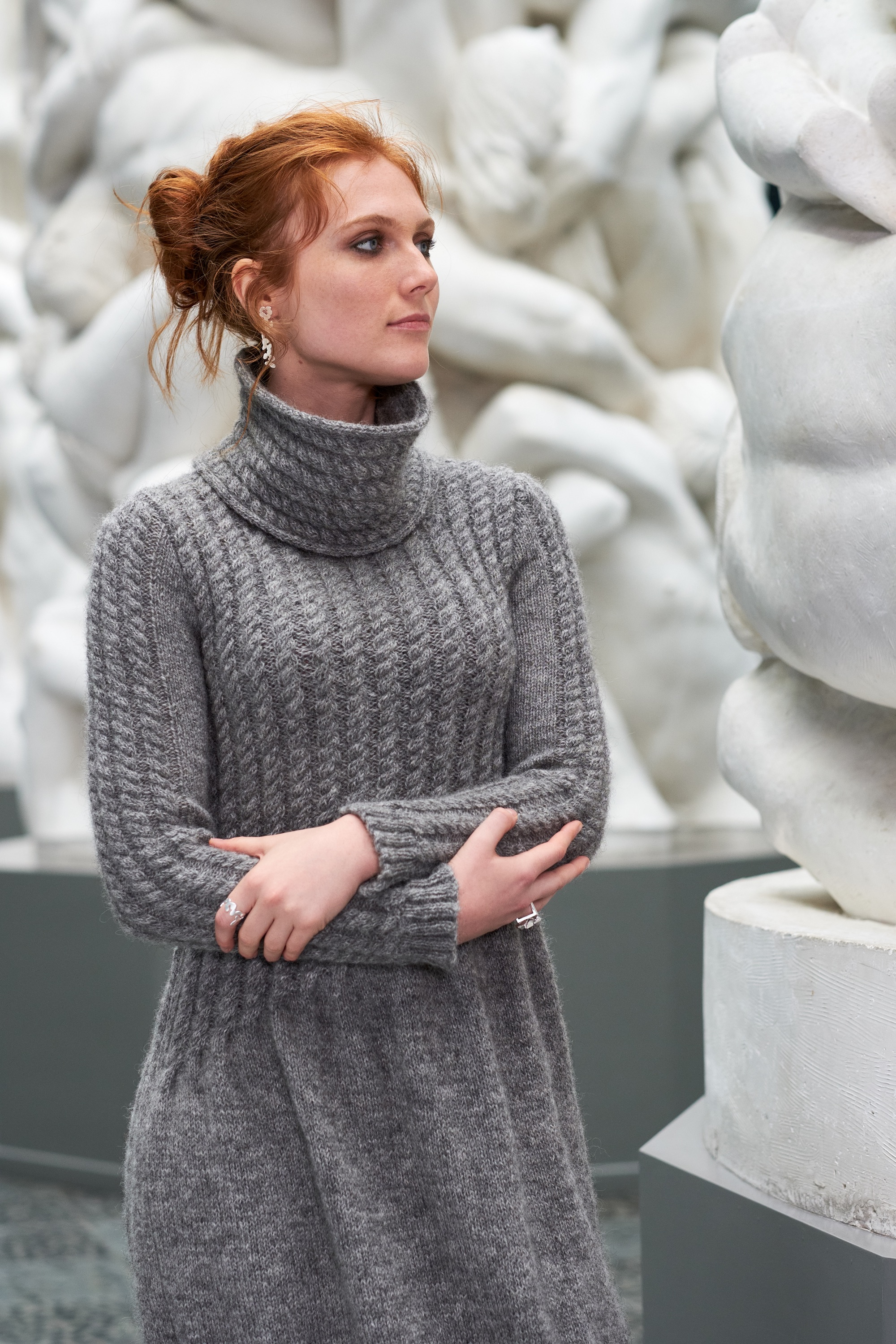
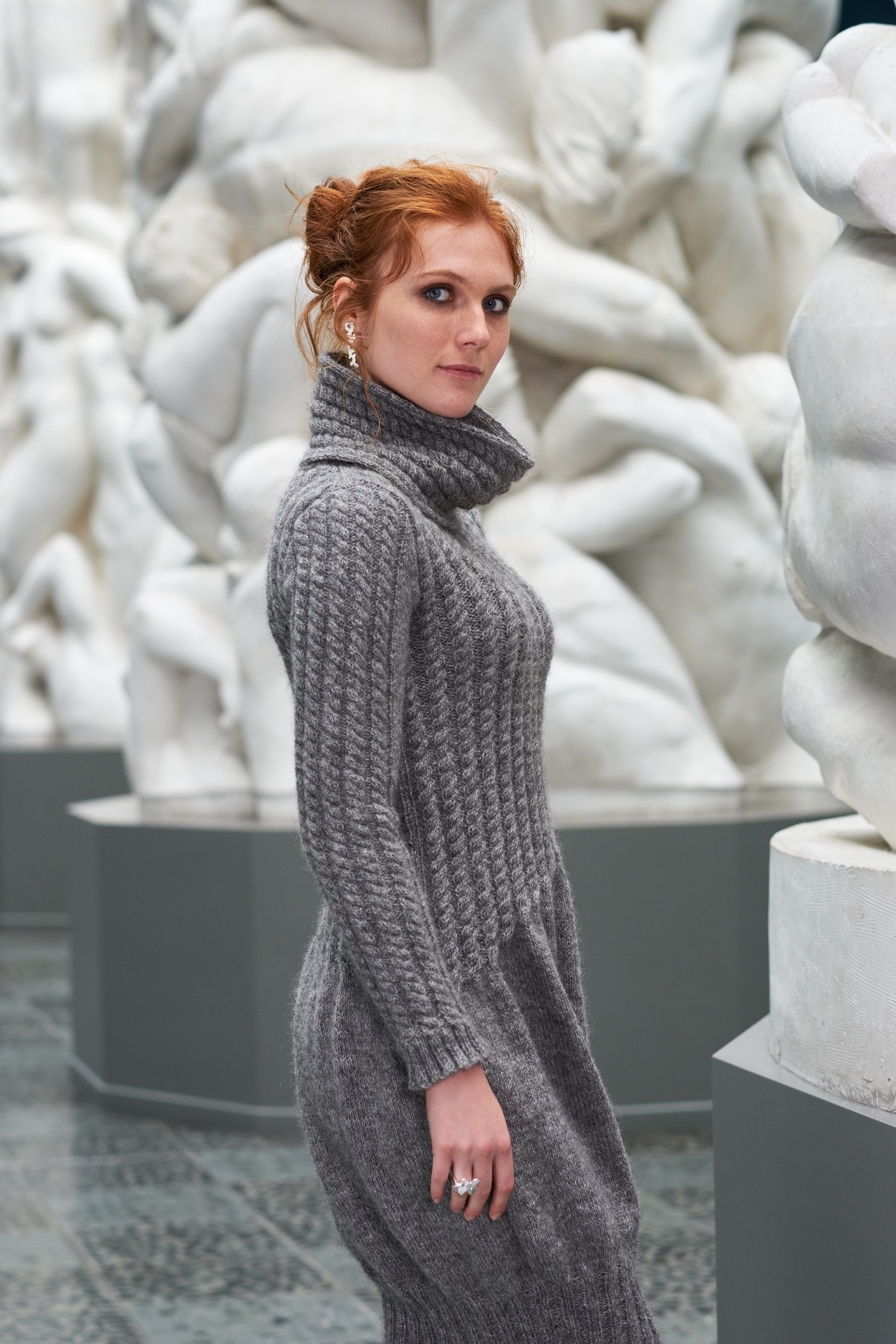
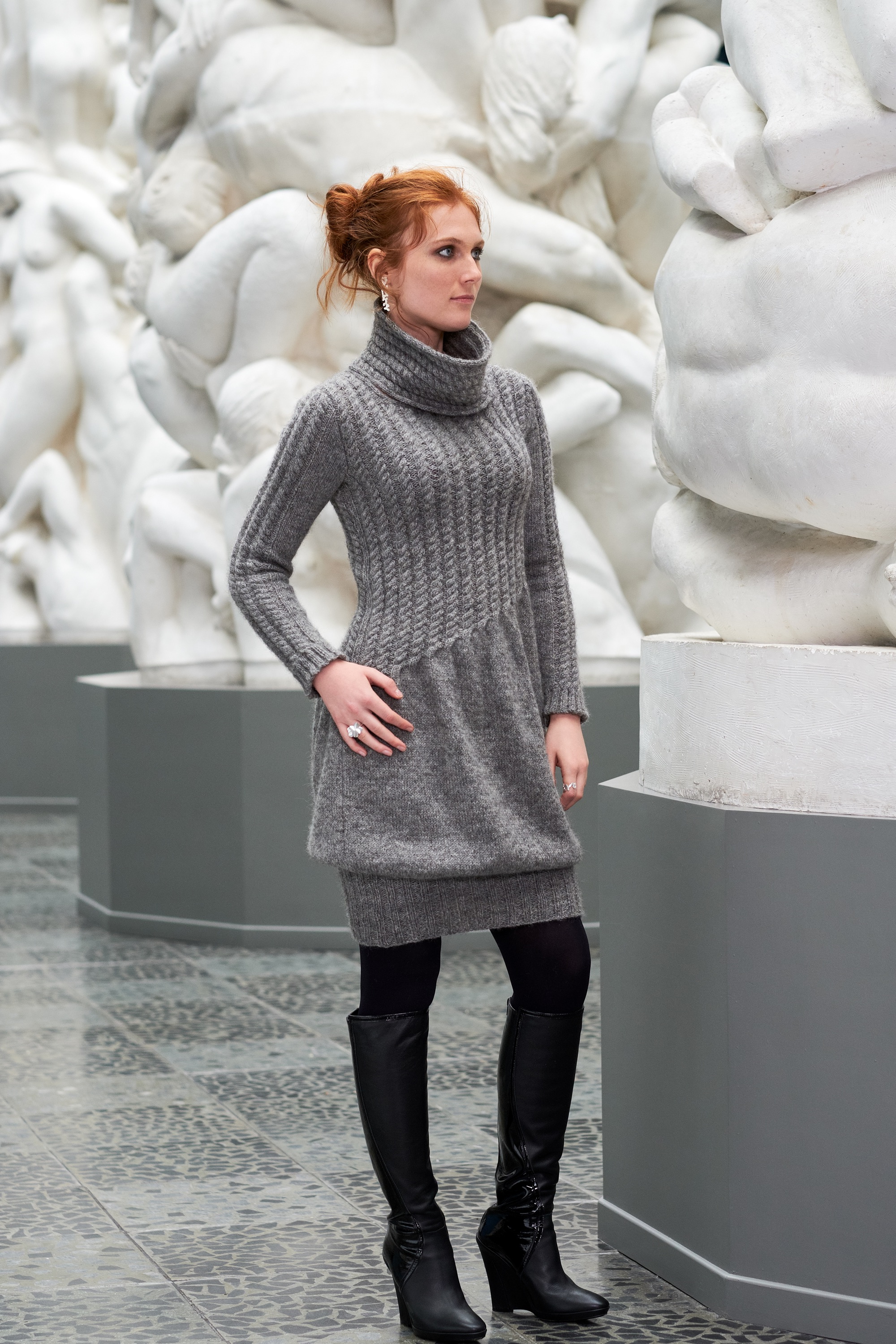
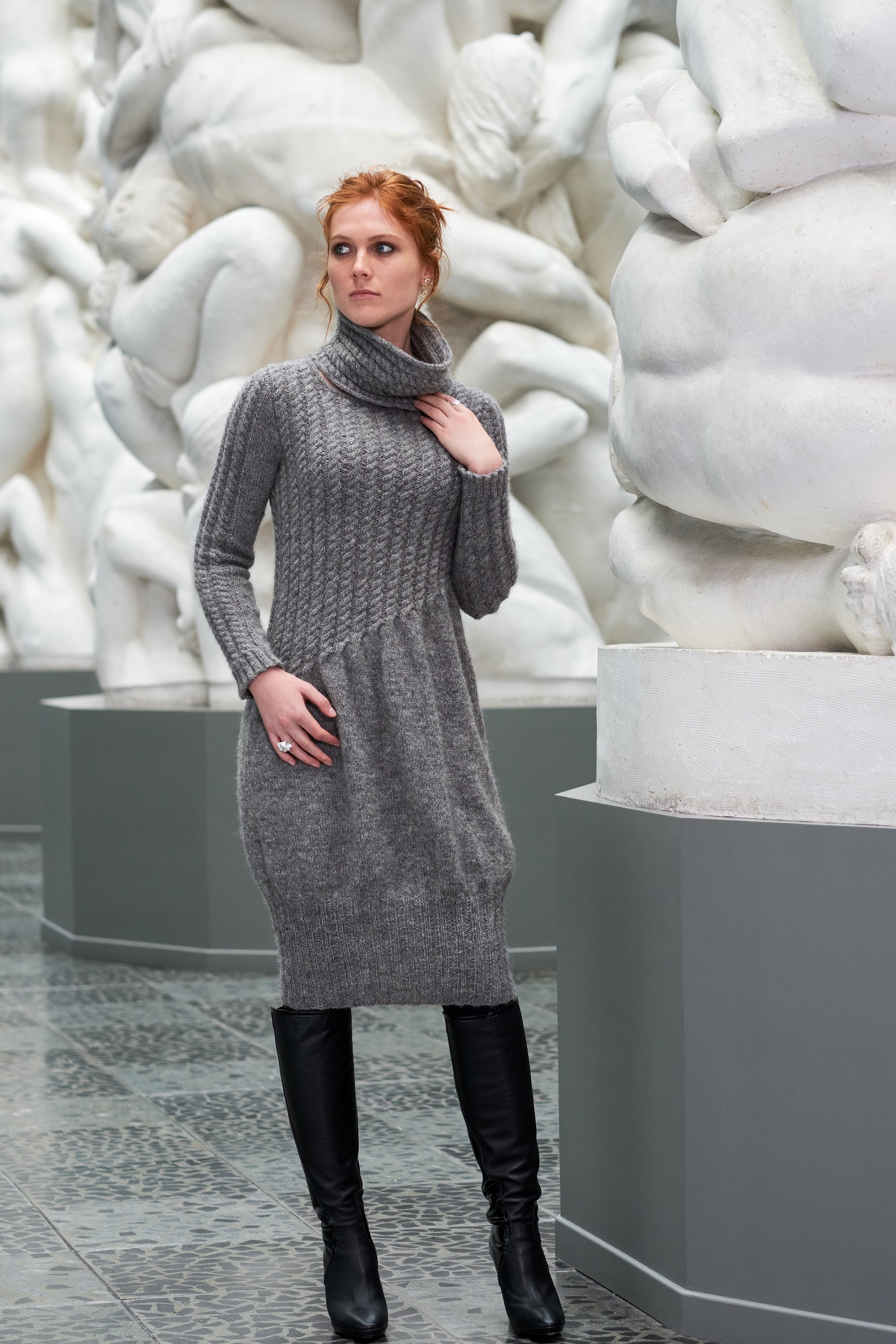
The time has come to reveal my new designs, made in collaboration with Hillesvåg Ullvarefabrikk, in their divine pelt wool yarn Tinde and Sølje. The Norwegian pattern and yarn kit will be launched at Fagstrikk Messa/Knits Trade Fair in April 2019. First out is my second dress design (with a cowl) this time knitted in the thicker Tinde in Natural Grey. Aibell – Named after the Celtic Goddess of Munster who had a magical harp in her possession is this ballon shaped dress where the shaping is done by the cables. The a-line created by the cables is mirrored on the body. The fronthas Right cables beginning at hip one at a time, while the back has Left cables. A cowl make a high cabled collar or a belt. Wear it loose hanging down, slightly pulled up or as a tunic with the rib turned.
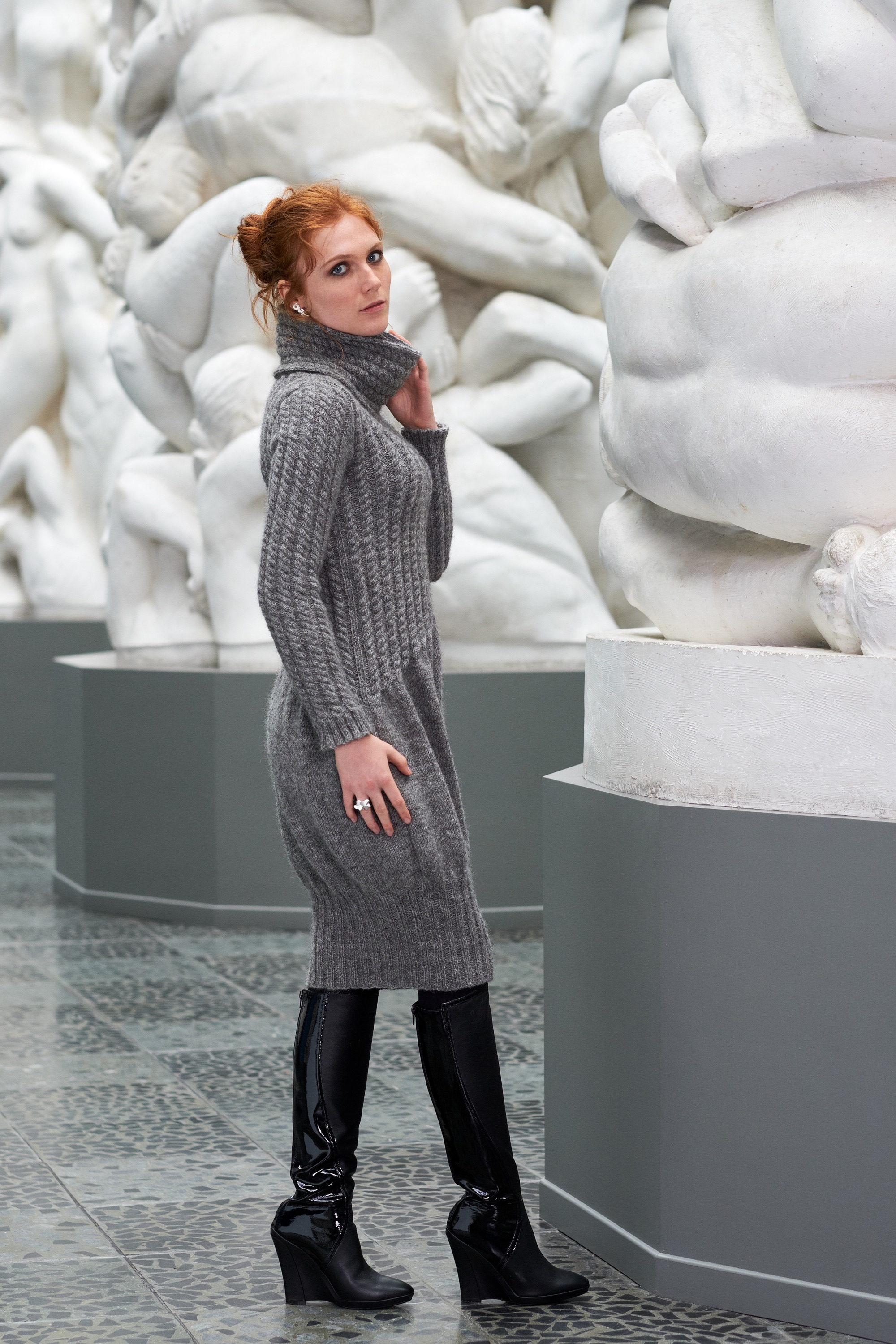
The sample is knitted by my turbo sample knitter, Grete Jenssen, who did a brilliant job as always. The cables shape the upper part and are introduced one by one. I wanted the a-line  to cross the body, so the back and front are not identical. I had planned to insert elastic into the bottom of the rib, but found out that I did not need to, thanks to the lovely bouncy yarn.

We have had few sunny days lately, but found a day without rain to photograph these garments on our front terrace. Michael worked quickly to photograph me in minus 5 degrees celsius/23 degrees Fahrenheit. I discovered after trying it on that you can easily wear it with the bottom rib pulled up a litte or all the way up and turned as a tunic with trousers. Due to the cold, I am wearing trousers under the dress in all these photos. Above you see the rib pulled slightly up.

The dress is knitted in pieces and seamed. The cables shape the dress, by adding one cable at a time. Add elastic to the bottom if you prefer to wear it higher up. Adjust the length in the stocking stitch area, depending on how you prefer to wear it. The cowl can easily be adjusted to your preferred circumference by adding cable repeats or purl stitches.

With the rib at the waist and folded in, making the bottom part double. Perfect for the cold weather here. I am wearing the dress in size Small, with a 92 cm/36.25″ bust circumference, but grading it from XS to 2XL. The finished bust circumference is from 86 to 122 cm/33.75 to 48″. The cowl is one size but can easily be adjusted to your preferred length. In fact, Hair & Makeup Artist Sissel Fylling suggested to wear the cowl as a belt and that worked well on the model Em. While I would need a slightly longer cowl – it is knitted sideways – to make it fit around my waist.

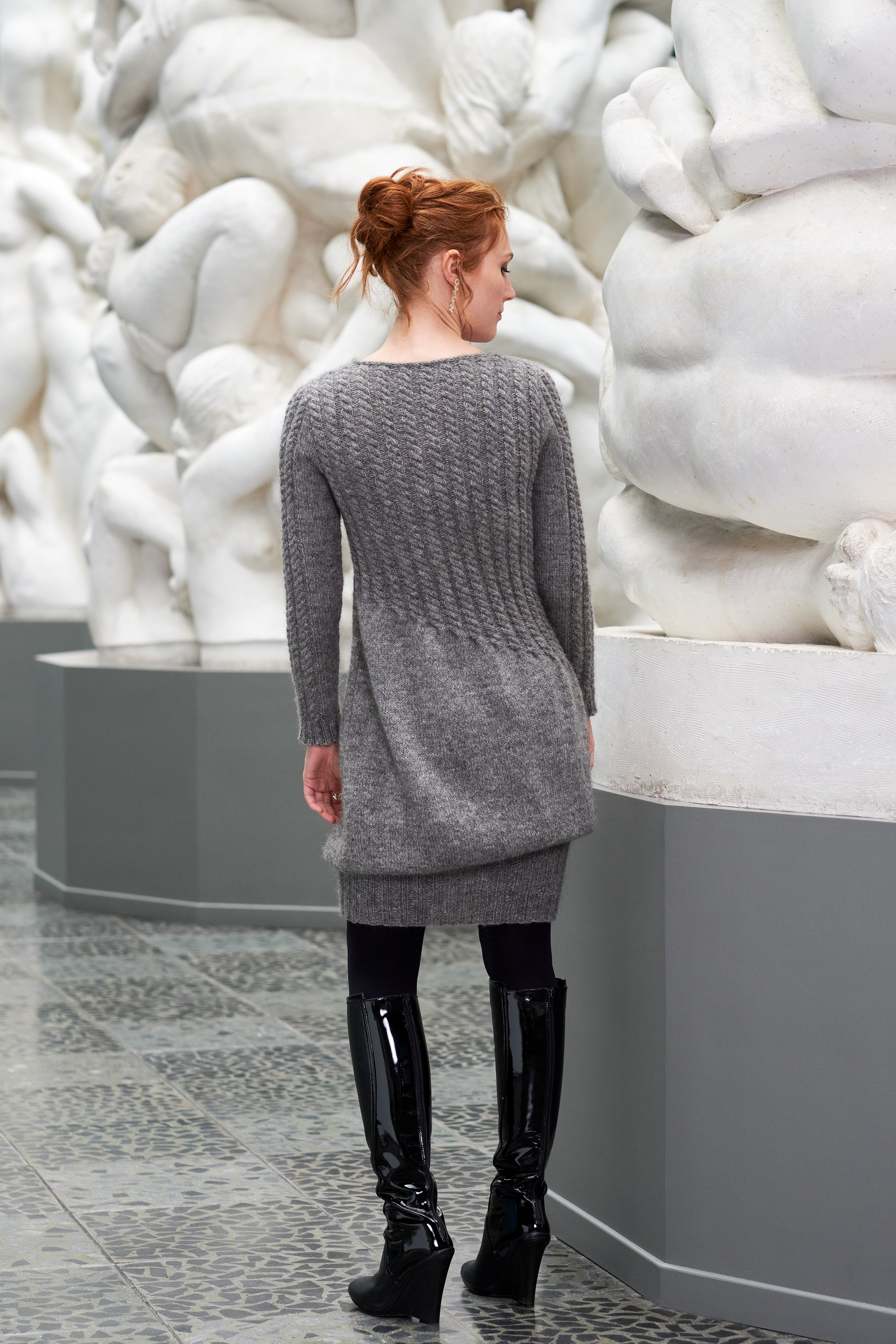
Here is the tunic style from the back, without the cowl. The dress is knitted using 3 mm/US 3 needle for the rib and 3.5 mm/US 4 for the rest. The gauge is 21 stitches and 30 rows in stocking stitch measures 10 cm/4″ square.

I did consider giving the dress a Henley neck but in the end I made a crew neck, with square corners.

This was the clear favourite according to my team at the photoshoot, hence I have decided to have this dress test knit first out of the four new Hillesvåg designs. The last photo shows the cable introduction in detail. The English pattern will be test knitted in my Ravelry group before its release, beginning 11th February. You can find more pattern details on the project page on Ravelry: Aibell. I look forward to showing you the other three new designs and how this dress looked on the gorgeous model Em.

Share

Ataraxia Again

I did promise to show you how Ataraxia looks on me, so here are a number of the photos Michael took last summer, at the beach in Ørje, before I sent off the sample. You will probably be as surprised that I was that is bright orange, knitted in a divine shade called Pumpkin in the SweetGeorgia Yarns Mohair Silk DK, if you have seen the magazine and the green it is photographed in there. The reason the sample is not photographed in the brilliant Pom Pom Quarterly 27 Winter 2018 issue is that the editors realised that the orange was way brighter than they had thought and it would not fit in with the other designs. So Guest Editor Norah Gaughan, together with Pom Pom co-founders Meghan Fernandes and Lydia Gluck, decided that they had to make a new sample in a more muted colour, in no time at all. Hence the replacement yarn was found in Meghan’s stash: The Copper Corgi Fiber Studio, Jones Street Worsted in the gorgeous shade of Goldenrod.

SweetGeorgia Yarns Mohair Silk DK yarn is one of their luxurious yarns and made of 90% superwash Merino, 5% Superkid Mohair, 5% silk with 200 meters/218 yards per 100 gram skein using 4 mm/US 6 and 3.5 mm/US 4 needles. I can confirm that it was wonderful to work with and I loved the result. I  have a 88 cm/34.75″ bust, stands 175 cm/5.9″ tall and I am wearing the sample size S that measured 94 cm/37″ bust with 6 cm/2.25″ positive ease. Despite the same gauge on the two yarns: 21 stitches and 28 rows in stocking stitch, the second sample in the Copper Corgi yarn is heavier and resulted in a 97 cm/38.25″ bust. The cardigan is available in 5 sizes with a finished bust measurement of 91 to 132.5 cm/35.75 to 52.25″.

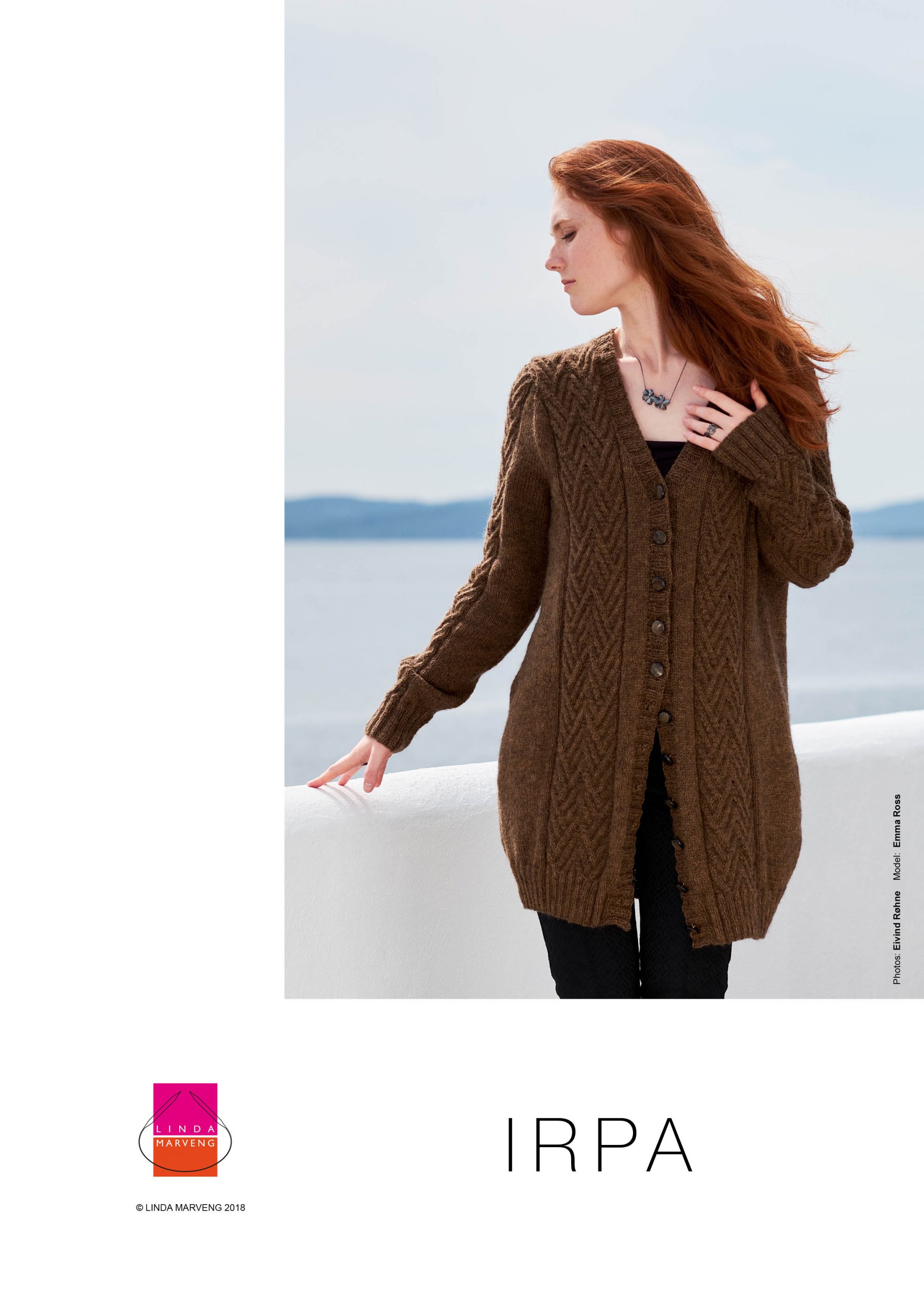
Ataraxia is knitted flat, in pieces from bottom up, and seamed. The asymmetric lower body has extra width in each side that will be bound off before the tuck is made. Waist shaping is worked at the sides and the shoulders are shaped using short-rows. The collar is picked up and completed using an i-cord cast-off. The military inspired jacket did need bespoke buttons so I contacted Norwegian jewellery designer Siri Berrefjord who made these buttons especially for it. Each button is like a piece of jewellery with immaculate texture to it. The design is based on the silver brooches for the traditional folk costume, called “bunad” in Norwegian. As you might know, if you have been following my blog for awhile, Siri is also a photographer so I will soon share her glorious pictures of the buttons on my sample.

Ataraxia is named after one of Caroline’s poems and we hope it gives you a perfect sense of calm, sheltering you from whatever storms you bravely weather. The long jacket’s fitted shape is achieved through a careful arrangement of vertical texture panels and i-cord highlights. Finished with a tucked, asymmetrical peplum, Ataraxia is full of clever ideas. Linda designed this with a mythical shield-maiden in mind, and Caroline Norton reminds us of the everyday heroines battling among us.”

Finally here is a detail, showing the wonderful textures and the shoulder treatment I gave it. You can buy a print issue with a digital download code directly from Pom Pom or a digital issue from Ravelry or from one of their many stockists.

Share

Sigyn Pattern Released

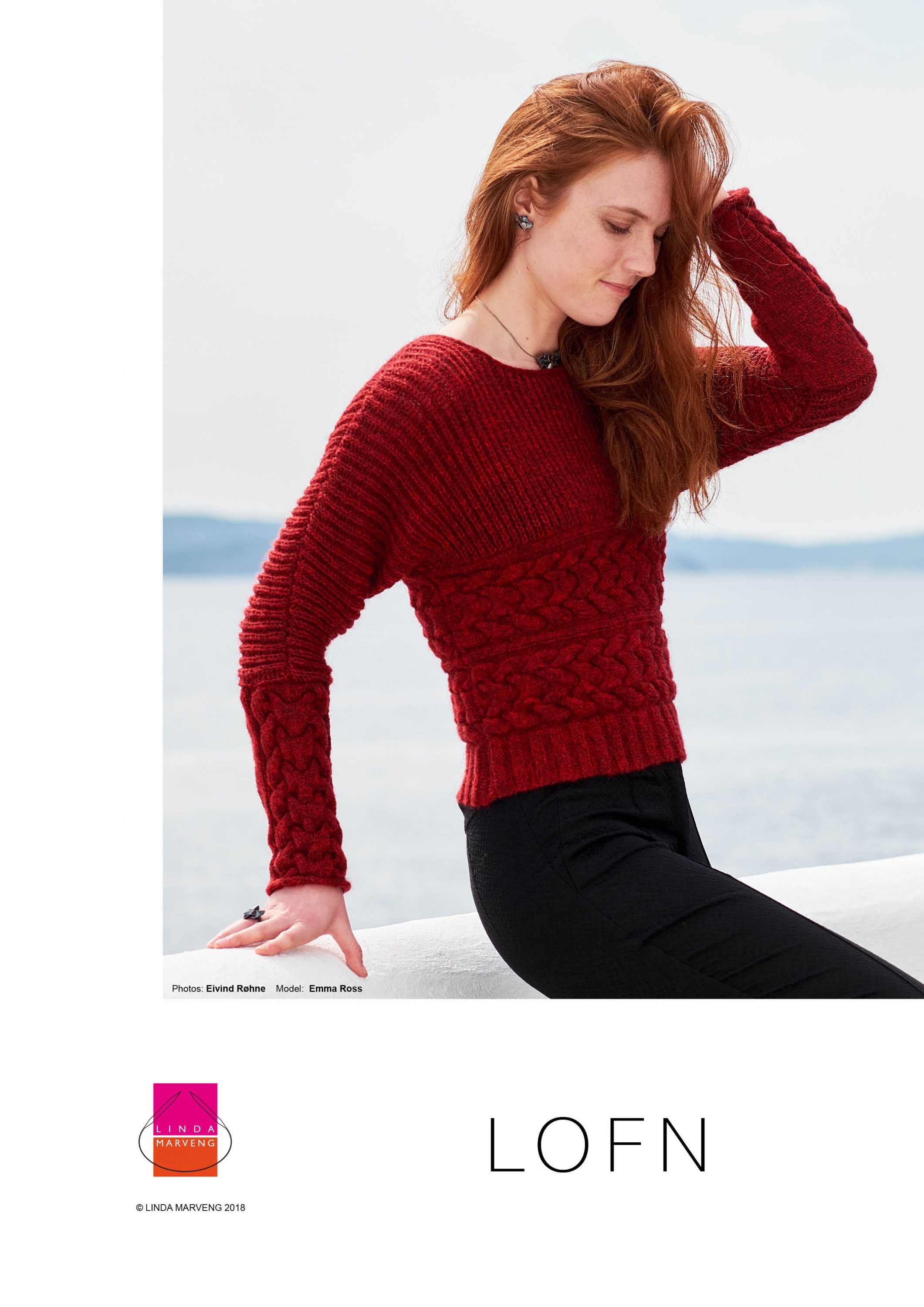
The test knit of Sigyn is coming to an end and I am in awe of all the gorgeous versions that have been made. Several of the 22 test knitters have modified it, some have just changed the length while one decided to move the front v-neck shape further up. You can see photos of a number of the finished dresses on the pattern page, and more will be added as soon as they have been finished. Thank you to all my test knitters for helping me correcting and improving the pattern. In addition I had help from my Technical Editor Barbara Khouri to make the schematic and to check my calculations. Above you see the gorgeous model Emma Ross, with hair & make up by Sissel Fylling and jewellery by Kaja Gjedebo Design, captured by Eivind Røhne at Villa Malla at the end of May. Both the Norwegian and the English pattern is now available at Ravelry and will shortly be coming to Loveknitting.

Sigyn is Norse for victorious girl-friend and ideal for this a-line dress with a central swing cable, surrounded by ribbing to make it figure hugging. The cable is divided and moves towards the shoulder to make a v-neck at the front. Decreases are made in the purl sections to emphasize the silhouette of Sigyn. The dress is knitted in the bouncy Sølje pelt wool from Hillesvåg Ullvarefabrikk.

Sizes: XS (S, M, L, XL, 2XL)
Shown in size Small
Skill level: Experienced

Finished Measurements
Bust: 88 (94, 100, 110, 120, 130) cm/34.5 (37, 39.5, 43.5, 47, 51)“
Bottom width: 116 (122, 128, 138, 148, 158) cm/45.5 (48, 50.5, 54.5, 58.5, 62)”
Length: 118 (119, 120, 121, 122, 123) cm/46.5 (46.75, 47.25, 47.75, 48, 48.5)“
Sleeve length: 49 (50, 50, 50, 51, 51) cm/19.25 (19.75, 19.75, 19.75, 20, 20)”

Yarn: Hillesvåg Ullvarefabrikk, Sølje Pelsull (100% pelt wool, 350 m/383 yds, 100 g). The sample is knitted in Grass Green 2134; 5 (6, 7, 8, 10, 11) skeins; 1732 (2012, 2292, 2761, 3230, 3699) m/1894 (2200, 2507, 3019, 3532, 4045) yds.
Note: The model is wearing size S and is 173 cm/5.8” tall.
https://www.ull.no/produktkategori/garn/nyhet-solje-pelsu…

Yarn alternatives: Cascade 220 Sport (100% wool, 50g, 150 m/164 yds).
http://www.cascadeyarns.com/cascade-Cascade220Sport.htm
Tosh Sock (100% wool, 100 g, 361 m/394 yds).
http://madelinetosh.com/tosh-sock/
Berroco Quechua (60% merino wool, 20% alpaca, 20% yak, 50g, 150 m/164 yds).
https://www.berroco.com/yarns/berroco-quechua
Or another Sport/5 ply or Fingering 4/ply yarn.

Needles: 3 mm/US 3 straight needle.
3 mm/US 3 circular needle (40 cm/16”) for neckband.
Adjust needle size as needed to match gauge.

Notions: Stitch markers (removable), cable needle and yarn needle.

Gauge: 24 sts and 32 rows in st st measures 10 cm/4” square.
26 sts and 32 rows in rib measures 10 cm/4” square.
10-sts Right/Left cable swing measures 4 cm/1.5” wide.

Notes: The dress is worked back and forth in pieces and seamed. The decreasing for a-line is done in the purl sections of the rib. The cables are moved towards the shoulder on the front, beginning 10 cm/4” before the armhole and ending just before the neck shaping. You can easily adjust the length of the dress if you prefer, for instance by shortening (or lengthening) it with up to 7 cm/2.75” before the a-line shaping begins. For a tunic, reduce the length with a further 17 cm/6.75” by working 1 cm/0.5” less between each of the decreases.

Share

Behind the Scenes: Photoshoot at Vigeland Museum

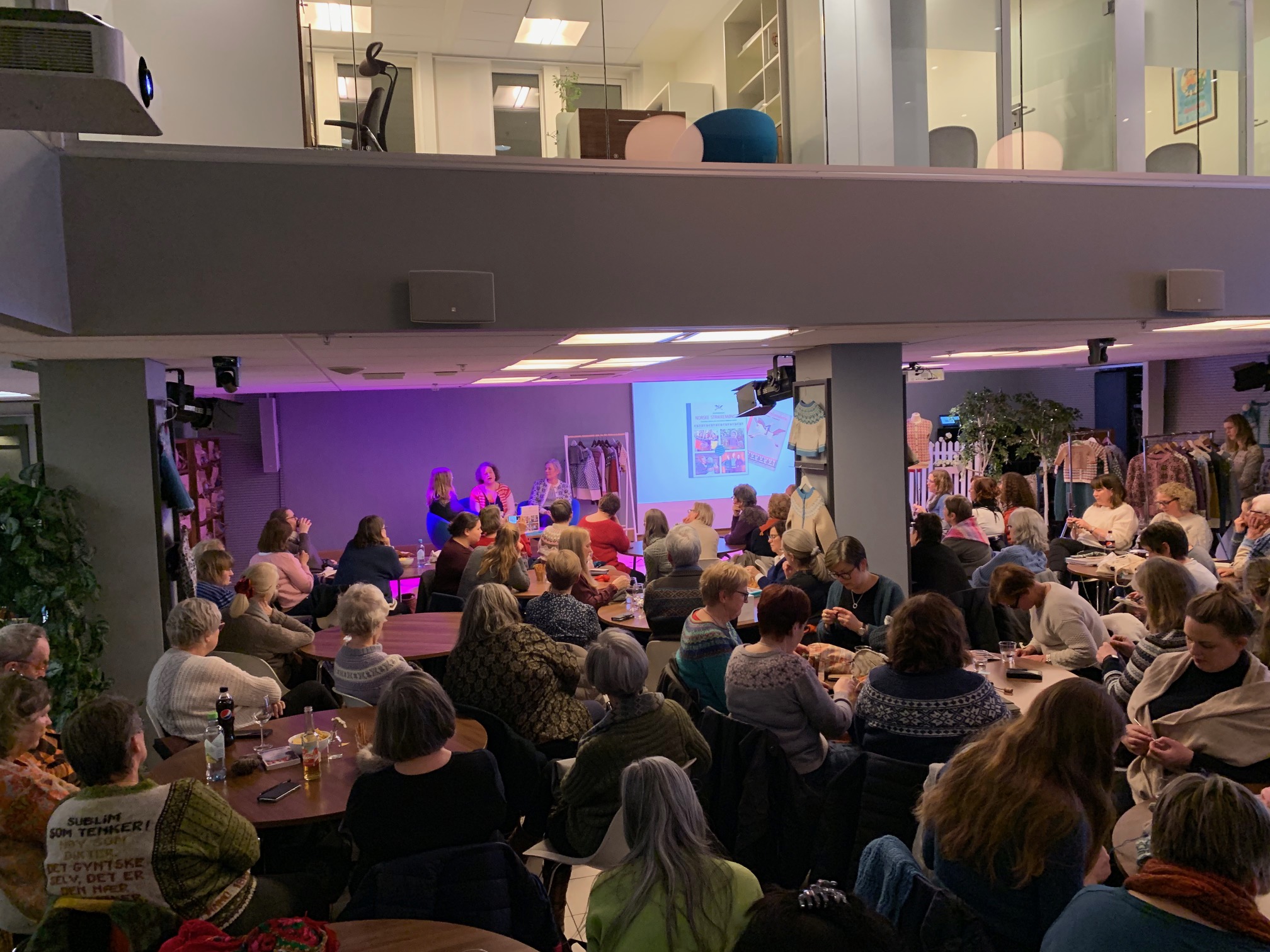
On Monday, I had a photoshoot at the Vigeland Museum, next to the Vigeland Park in Oslo. The brick building, with a majestic ceiling height, was built in the 1920’s in a Norwegian Neo Classical style. “The museum is the result of a unique contract between Gustav Vigeland and the city of Oslo signed in 1921: The Municipality agreed to build a studio, residence and future museum for the artist and his work, and in return Vigeland donated nearly all his works, previous and future, to the city”. It was with anticipation we (read my brilliant team: Photographer Eivind Røhne; Hair & Make Up Artist Sissel Fylling; Model Emma Ross; Michael; and me) were let in by one of the curators, as the museum is closed to the public on Mondays. During the day we had the chance to observe the curators at work and they us. As much as we admired their work, they enjoyed watching the beautiful garments being photographed and wondered which fashion magazine we were from. I explained that I designed handknit and that the photos were for the patterns and for the magazine Familien. Above you see gorgeous model Em, photographed by Michael in front of one of the plaster models for a sculpture to the park. Em is wearing Eira Pullover made for knit.wear Fall/Winter 2017, soon to be released in English in my Ravelry store.

“Vigeland moved into the new building in 1924, living in the apartment on the top floor of the east wing. Here he resided and worked until his death in 1943. From the tower in this majestic red brick building he had a beautiful view towards the fields of Frogner, where his great project, the park, soon was to be reality.” We were guided into the Children’s room, were we would camp out all day. I am sure we enjoyed it as much as the children who usually visit that room! While Hair & Make up Artist Sissel was working her magic on Em, Eivind and I did a round in the museum. We picked two halls as for our shoot: Hall 9, which you see above and the Monolith Hall, which you see below. On the agenda was photographing a total of 10 garments: 4 new designs for Hillesvåg Ullvarefabrikk; 1 new design for the Norwegian magazine Familien: Nemetona; 4 returning designs from Interweave: Eira Pullover, Rørbye Cardigan, White Mountain Ruana and Andaman Top; 1 old design from my book: Tweedjakke with accessories: Duggdråpe Halser.
“The museum opened in 1947, houses almost Vigeland’s entire production; sculptures in plaster, granite, bronze, marble, works in wrought iron, thousands of drawings, woodcuts and woodcarvings. In the museum you will find the original plasters to his famous busts and monuments, in addition to the plaster models to the sculptures in the Vigeland Park.” Above you can see Eivind in action, with me standing next to him and Michael just behind him. In the end we photographed nearly all of the garments, with the two exceptions you see above, in the Monolith Hall.

The lizard in wrought iron is a model for the gates in the Vigeland Park and the most complicated of these wrought iron works Vigeland made. Their graphical presence added extra drama and was perfect for the Tweedjakke worn over Judith Bech’s wonderful skirt with a train. I was wearing the Patent Poncho, while Sissel – as you can see was cold – and wore her coat inside. To our surprise she did not cut Em’s hair this time. I had also borrowed jewellery by Kaja Gjedebo Design, as I usually do. There is no café at the museum so I had ordered catering from the nearby Eckers Cafe, with one delivery of drinks in the morning and one for lunch, so that we would not loose too much time looking for a nearby restaurant and wait for our lunch. That worked well and while we spent quite a bit of time to set up and prepare for the first garment, the remaining ones went quickly.

Michael assisted Eivind but also had the time to photograph some of the collection in the museum. Eivind had brought both extra lighting and a huge flash to make sure the lighting would be good enough. Above is the Monolith model for the park in front of the Monolith itself. “In the Monolith Hall stand several of the original plaster models to the 36 granite sculptures on the Monolith plateau, as well as the Monolith itself. This sculpture was carved in one piece (hence the name Monolith), but it was first modelled in clay, and then casted in plaster in three parts, as displayed in the museum today.”

The Vigeland Museum is a popular venue for fashion shows, but also for concerts outside in the courtyard during the summer. The photoshoot was exhausting but also extremely rewarding and wonderful at the same time! After the shoot was a wrap – thanks to a brilliant team – and we had taken farewell with the curators and the security officer, we headed for the park, as Em has not had the time previously to see it. Above you see here in  front of the Monolith in granite. Do visit both the park and the museum, when in Oslo, they are worth it. I will recapture our visit by choosing pictures from Eivind.

Share

New Design: Nemetona

I am thrilled to show you my new design Nemetona, knitted in the divine The Fibre Co. Cumbria, that I chose as part of my payment for designing Stonethwaite for them. Nemetona and four new designs for Hillesvåg Ullvarefabrikk, plus returned designs from Interweave, will be professionally photographed on model Emma Ross by Eivind Røhne on Monday at the Vigeland Museum in Oslo. Nemetona is Celtic for goddess of all sacred places. Like a magical cable grove is each part of this pullover: Staghorn, Roman; and double cables are framed by Honeycomb pattern. The flowing longer back with its curved hem, creates a stylish contrast to the straight front. In these photos you see me wearing size Small with 2 cm/0.75″ positive ease, photographed by Michael at our nearby boat slip this autumn. Notice the new windmills that have popped up in the background.

 This time I wanted maximum texture and decided that even the sides should have cables in the shape of Honeycomb pattern. To give the side seam extra depth, I framed the Honeycomb stitches with a twisted stitch and a purl stitch in each side. I also choose to decrease inside the double cable to shape the longer back. The sweater can easily be modified to remove the longer back, if you wish.

The Fibre Company Cumbria Worsted is made of 60% Merino Wool, 30% Brown Masham Wool, 10% Mohair on each 100 gram skein and has 218 meters/238 yards. I knitted the sample in White Heather 105 with a 20 stitches and 28 rows in stockinette stitch gauge measuring 10 cm/4″ square using 4 mm/US 6. I have graded the pullover from size XS to 2XL with bust circumferences of 84 to 126 cm/33 to 49.5″.

The sweater is knitted back and forth in pieces and then seamed. The neckband is worked in the round, double and folded down. The longer back has decreases in the double cable at the bottom. The vent edges are made with slipped stitches. Above you see a detail of the sleeve with its double cable, Roman cable dividers and Honeycomb pattern.

I plan to have the English pattern of Nemetona test knitted in my Ravelry group, set to begin 7th of January, and will release the pattern after the test knit is completed. The Norwegian pattern will be printed in the magazine Familien, the date will be confirmed later. But first you will see how it looks on Emma Ross.

Share